
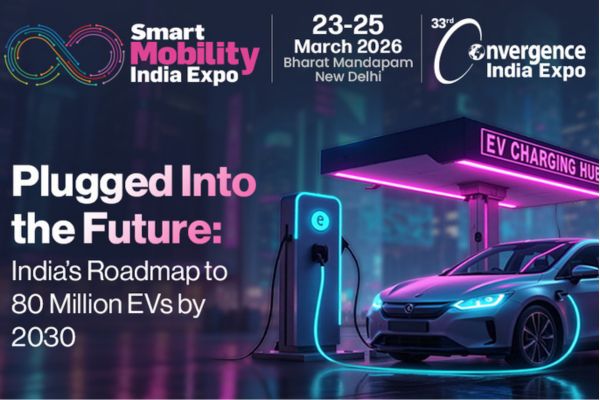
India’s electric vehicle (EV) sector is growing rapidly, driven by government incentives and new technologies. The FAME scheme (Phases I & II) has accelerated the adoption of clean transportation by boosting EV sales across all segments. The country aims for 30% EV sales in private cars, 70% in commercial vehicles, 40% in buses, and 80% in two- and three-wheelers. It is also developing charging infrastructure and battery energy storage. These efforts will add about 80 million EVs to Indian roads by 2030.
The EV market was valued at $2.7 billion in 2024 and is projected to grow to $164 billion by 2033, representing 57% growth. As EV sales accelerate, the Indian government has launched several initiatives to add approximately 72,000 new EV chargers by FY26, reflecting strong policy support for infrastructure development. While the PLI Scheme for ACC Battery Storage has played a vital role in attracting investment, the Electric Mobility Promotion Scheme (EMPS) was designed to specifically support the two- and three-wheeler segments.
The country is now advancing in sustainable mobility. Electric cars dominate headlines. But electric two-wheelers (e-2Ws) and three-wheelers (e-3Ws) are the largest and fastest-growing segment of India’s EV market. As of early 2026, they account for about 91% of India’s total EV sales. India’s EV transition differs from many other global markets: it starts not with passenger cars but with two- and three-wheelers, which are the backbone of everyday mobility. These vehicles serve commuters, small businesses, and India’s rapidly growing delivery economy as the core of the nation’s last-mile transport system.
India’s EV battery market is expected to grow from $2.2 billion in 2024 to $14 billion by 2033. Driving this transition is the rise of Battery-as-a-Service (BaaS) models. Instead of drivers bearing the full upfront cost of batteries, they can subscribe to battery services or quickly swap depleted batteries at dedicated stations. By separating the battery cost from the vehicle, upfront expenses can be reduced by up to 40%. As a result, sustainable mobility is becoming more accessible for millions of drivers and entrepreneurs.
Additionally, as a National Battery Swapping Framework is under development, the industry is moving toward a plug-and-play ecosystem with clearer technical standards, ownership models, safety norms, and interoperability. Accordingly, these developments could scale EV penetration in e-2W and e-3W segments to over 60% by 2030, especially in Tier-1 and Tier-2 cities.
Convergence India & Smart Mobility India 2026
Electric mobility is no longer a speculative transition; it is the most rational economic choice for last-mile transport and sustainable mobility. As demand surges and ecosystems mature, collaboration across policymakers, innovators, manufacturers, and infrastructure providers becomes pivotal to scale this transition. The Convergence India Expo is the foremost platform for this upcoming segment! With a legacy spanning three decades, it remains India’s premier forum for showcasing cutting-edge innovations shaping India’s digital and infrastructure landscape. The 33rd Convergence India Expo and the 11th Smart Future Cities India Expo will host 50,000 attendees and 1,000 participants, including 200 startups, from 25 countries, from March 23-25 at the Bharat Mandapam, New Delhi. Up to 50 Conference Sessions will be organised, with 200 speakers.
Co-located with the event, Smart Mobility India Expo 2026 will spotlight innovations in EV technology, connected vehicles, and next-generation mobility. Building on this, the pavilion will showcase exhibits from OEMs and technology partners across the EV value chain, featuring advancements in connected vehicles, intelligent systems, and digital platforms. Together, these elements offer a comprehensive view of how smart mobility is shaping future vehicles. Exhibitors such as Arcadis, National Highways Authority of India, Mercetech Innovations, Quiklink, Navtelecom, Eyesline, Aditi Tracking, Ruptela, Top Fly, CP Plus, Prama, and Omnicon will present their telematics, sensors, GPS, dashcams, and other automotive technologies.
In parallel, the Society of Indian Automobile Manufacturers (SIAM) pavilion is set to unveil the Smart Integrated Automotive Mobility Lab (SIAM Lab), establishing a collaborative space that will encourage knowledge exchange, cross-sector engagement, and strategic partnerships among key stakeholders.
A major attraction will be the specially curated conference sessions on Smart Mobility. These will focus on connected vehicles, telematics innovation, and the latest developments in the EV market. Topics include how connected vehicle data unlocks cross-industry collaboration. The sessions also examine the role of AI and real-time analytics in predictive services and in-vehicle intelligence, as well as the need for new policies and infrastructure to support vehicle-to-everything. Panellists will explore how to build an interconnected, interoperable, intelligent transport network. They will address V2V communication for safer roads, real-time traffic management, and ADAS designed for India’s unique road conditions and diverse scenarios. The development of physical and digital highways with smart infrastructure integration will also be covered.
The forum will also discuss creating connected, intelligent, and efficient telematics by exploring the convergence of IoT, AI, and cloud for real-time intelligence. Additional topics include data-driven decision-making in fleet and logistics management, telematics for electric and autonomous vehicle ecosystems, and integration with smart city and mobility infrastructure. Esteemed panellists include Naveen Chopra, CTO & COO (Manufacturing Operations) HEV, SUN Mobility; Tarun Aggarwal, Senior Executive Officer & Head – Engineering, Maruti Suzuki India; Puneet Aggarwal, Head Smart Mobility & Sustainable IoT, Jio Platforms Ltd.; and Abhijeet Sinha, Program Director – National Highways for Electric Vehicles (NHEV) & National Program Director – Ease of Doing Business.
By bringing together the ideas, technologies, and partnerships shaping the future of transport, the Smart Mobility India expo ensures that innovation is translated into real-world solutions, effectively connecting key stakeholders for impactful progress.


 has accelerated the adoption of clean transportation by boosting EV sales across all segments.)