

The global night vision driver monitoring system market size was calculated at USD 3.30 billion in 2025 and is predicted to increase from USD 3.64 billion in 2026 to approximately USD 8.88 billion by 2035, expanding at a CAGR of 10.40% from 2026 to 2035.The market is expanding rapidly because the focus of automotive safety is changing to intelligent and real-time in-cabin monitoring.
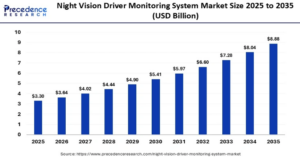
AI Agents Market Key Insights
- North America dominated the global night vision driver monitoring system market in 2025.
- Asia-Pacific is expected to grow at the fastest CAGR in the market during the forecast period.
- By technology, the thermal imaging segment held a dominant position in the market in 2025.
- By technology, the near-infrared technology segment is expected to grow at the fastest CAGR in the market between 2026 and 2035.
- By component, the cameras segment led the global market in 2025.
- By component, the processors segment is expected to grow with the highest CAGR in the market during the studied years.
- By vehicle type, the passenger vehicles segment dominated the global market in 2025.
- By vehicle type, the commercial vehicles segment is expected to expand rapidly in the market in the coming years.
- By application, the driver monitoring segment held the largest market share in 2025.
- By application, the pedestrian detection segment is expected to expand rapidly in the market in the coming years.
- By application, the customer service and virtual assistants segment contributed the highest market share in 2024.
- By application, the healthcare segment is expected to grow at the fastest CAGR in the AI-agent market.
- By end-user, the enterprise segment captured the major market share in 2024.
- By end-user, the industrial segment is projected to grow at the fastest CAGR in the market.
Role of AI Night Vision Driver Monitoring System Market
Artificial intelligence (AI) transforms the night-vision DMS by allowing real-time face recognition, eye tracking, and behavior pattern analysis. AI-based algorithms allow additional differentiation between temporary glances and longer distractions, enhancing the accuracy of alerts and decreasing false alarms. Machine learning models evolve with the constant changes in the behaviour of drivers, providing greater personalization and predictive safety interventions. Other companies, such as Smart Eye AB and Seeing Machines, are the first to develop AI-powered in-cabin sensing platforms in next-gen cars.
Regional Outlook for Night Vision Driver Monitoring System Market
North America held a major revenue share of the night vision driver monitoring system market in 2025, driven by the great usage of advanced technology in automotive safety. High demand for high-end cars with ADAS functionalities helps to grow the market. The fact that the major automotive technology providers are in the region and the ongoing investment in R&D enhances regional leadership.
The use of government safety programs and insurance incentives also encourages integration of the system. Fleet operators in the companies are adopting driver monitoring to improve road safety. The region also enjoys the first-mover advantages of autonomous vehicle testing programs.
Asia-Pacific is expected to host the fastest-growing market in the coming years due to the increase in vehicle manufacturing and the growing middle-class population. The rapid urbanization and the rising road traffic accidents are driving demand for advanced safety systems. Most of the emerging economies are slowly rolling out tougher vehicle safety standards. Adoptions are rising at a faster rate through technological partnerships between international suppliers and local OEMs. Additional investments in electric and connected automobiles contribute to market growth.
Europe is expected to grow at a notable CAGR in the foreseeable future, driven by its stringent road safety laws and excellent automotive innovations. OEMs increasingly install driver monitoring systems in their new cars due to regulatory requirements. The penetration of high-cost vehicles is enhanced, and this will lead to early usage of thermal and infrared systems.
Advanced safety solutions are also in favour of sustainability goals and smart mobility programs. The inter-relationship between automakers and technology suppliers helps make the system sophisticated. The growth of consumer safety awareness leads to a high market growth.
Market Scope
| Report Coverage | Details |
| Market Size in 2025 | USD 3.30 Billion |
| Market Size in 2026 | USD 3.64 Billion |
| Market Size by 2035 | USD 8.88 Billion |
| Market Growth Rate from 2026 to 2035 | CAGR of 10.40% |
| Dominating Region | North America |
| Fastest Growing Region | Asia Pacific |
| Base Year | 2025 |
| Forecast Period | 2026 to 2035 |
| Segments Covered | Technology, Component, Vehicle Type, Application, and region |
| Regions Covered | North America, Europe, Asia-Pacific, Latin America, and Middle East & Africa |
Segmental Outlook of Night Vision Driver Monitoring System Market
By Technology Outlook
The thermal imaging segment dominated the night vision driver monitoring system market in 2025 because it has a higher ability to detect heat signatures, irrespective of the conditions of lighting. It guarantees high performance under full darkness, fog, and other unfavourable weather conditions. Automotive OEMs tend to use thermal systems in high-end and commercial vehicles where increased safety is very important. The technology is better at detecting fatigue of the driver and other hindrances by detecting contrasts in temperature. Its excellent accuracy and known aspect of being integrated in luxury cars boost the segment’s growth.
The near-infrared technology segment is expected to show the fastest growth over the forecast period because of its low prices and small design of the system. NIR cameras reflect the face of the driver with the invisible light of infrared that allows tracking eyes and faces in low-light conditions. To strike a compromising equilibrium between performance and cost, automakers are embracing the use of NIR systems in mid-range cars.
Reliability is increasing as sensors become more sensitive and AI-based tools enhance image processing. The rapid growth of the NIR systems is being driven by the scalability of the new technology to be used in mass-market vehicles.
By Component Outlook
The cameras segment held the largest market share in 2025, since they are the heart of the sensing component of night vision monitoring systems. The infrared and thermal cameras can take high-resolution images, allowing accurate eye tracking, head location, and face orientation. Car manufacturers are laying emphasis on the use of multi-camera designs to increase accuracy and reduce blind spots. CMOS sensor technology has been continuously advancing to enhance the performance of low-light and to minimize the size of hardware.
By Vehicle Type
The passenger vehicles segment led the night vision driver monitoring system market in 2025 , as they are produced in large quantities and are increasingly demanded to be equipped with sophisticated safety standards. Night vision DMS is being incorporated in ADAS packages by the luxury and mid-range car manufacturers.
An increase in awareness about road safety and driver fatigue has increased uptake by owners of personal vehicles. In the new passenger models, integration is also facilitated by regulatory requirements in various areas.
By Application Outlook
The driver monitoring segment registered its dominance over the global market in 2025, driven by the need for fatigue, distraction, and drowsiness detection. These systems are based on real-time eye tracking, analysis of blink rate, and head movement. Rising road accident rates are being caused by careless driving, and OEMs are thus focusing on finding solutions to solve these issues by focusing on drivers. Combination with ADAS enables synchronized interventions like straightening the lane or emergency braking.
Recent Developments
- In July 2025, Mobileye introduced its Driver Monitoring System, enhancing road safety by monitoring driver attention and alertness. The system leverages AI-powered computer vision and ADAS to detect drowsiness and distraction, providing real-time feedback. This innovation aimed to improve vehicle safety by ensuring drivers remained attentive while on the road.
- In May 2025, Omnivision launched the OX01N1B image sensor to make in-cabin automotive monitoring systems more cost-effective and energy efficient while improving performance. The sensor can capture high-quality images for applications, such as driver-awareness monitoring and night vision.
Night Vision Driver Monitoring System Market Companies
Veoneer Inc.
A Sweden-based automotive technology company focused on advanced driver-assistance systems (ADAS) and autonomous driving solutions.
Specializes in perception systems, radar, vision, and software for vehicle safety.
OMRON Corporation
A Japanese electronics company known for automation, sensing, and control technologies across industries.
In automotive, it provides advanced sensors and electronic components supporting safety and efficiency.
Magna International Inc.
A global automotive supplier headquartered in Canada, offering vehicle engineering, manufacturing, and component solutions.
Key areas include ADAS, electrification, body systems, and complete vehicle assembly.
DENSO CORPORATION
A leading Japanese automotive components manufacturer and a key member of the Toyota Group.
Focuses on thermal systems, powertrain, electronics, and advanced mobility technologies like ADAS and EV solutions.
ZF Friedrichshafen AG
A German technology company specializing in driveline and chassis systems, as well as active and passive safety technology.
Also a major player in autonomous driving, electrification, and mobility software solutions.