According to our Growth Market Report, the personal electric vehicle market size reached USD 47.2 billion in 2024 globally, reflecting robust momentum driven by urban mobility trends and sustainability concerns. The market is projected to grow at a compelling CAGR of 12.5% from 2025 to 2033, positioning its value at approximately USD 134.5 billion by 2033. Key growth factors include rising urbanization, environmental awareness, and supportive government policies, which are collectively fostering the rapid adoption of personal electric vehicles (PEVs) worldwide.
Introduction: A Shift from Ownership to Smart Mobility
The global transportation landscape is undergoing a fundamental transformation, and personal electric vehicles (PEVs) are at the heart of this change. From electric scooters and bikes to compact electric cars, these vehicles are redefining how people commute, especially in densely populated urban environments. For countries like India, where traffic congestion and pollution are pressing concerns, and for the United States, where sustainability and innovation drive consumer behavior, the PEV market represents both an opportunity and a necessity.
What Are Personal Electric Vehicles?
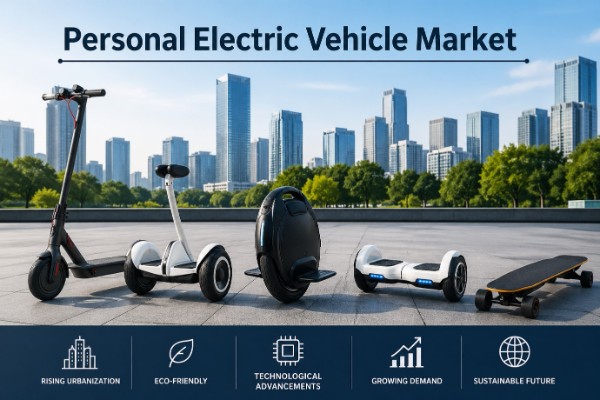
Personal electric vehicles refer to lightweight, battery-powered modes of transport designed for individual use. These include:
- Electric scooters (e-scooters)
- Electric bicycles (e-bikes)
- Electric skateboards and hoverboards
- Compact electric cars and neighborhood electric vehicles (NEVs)
Unlike traditional vehicles, PEVs are energy-efficient, cost-effective, and often integrated with smart technologies, making them highly appealing to modern consumers.
Market Drivers: Why the Demand is Accelerating
1 Rising Fuel Costs and Economic Sensitivity
In both India and the U.S., fluctuating fuel prices have pushed consumers to explore alternatives. Electric vehicles significantly reduce operating costs, making them attractive for daily commuting.
-
Urban Congestion and Space Constraints
Cities like Mumbai, Pune, New York, and Los Angeles face severe traffic challenges. PEVs, with their compact design, offer a practical solution for navigating crowded streets and reducing travel time.
- Environmental Awareness and Regulations
Governments across the globe are implementing stricter emission norms. In India, policies like FAME (Faster Adoption and Manufacturing of Electric Vehicles) are boosting adoption, while in the U.S., federal and state-level incentives encourage EV purchases.
-
Technological Advancements
Battery technology, particularly lithium-ion and emerging solid-state batteries, has improved range, charging time, and safety. Integration with mobile apps, GPS tracking, and IoT features further enhances user experience.
Competitive Landscape
- Segway-Ninebot
- Xiaomi
- Boosted Boards
- Razor USA
- Inmotion Technologies
- Yadea Group
- NIU Technologies
- Gogoro
- Unagi Scooters
- Bird Rides
- Lime
- Spin (Ford Mobility)
- Ola Electric
- Ather Energy
- Super Soco
- Zero Motorcycles
- E-TWOW
- Apollo Scooters
- Kaabo Electric Scooters
- Micro Mobility Systems
Emerging Trends Shaping the Market
-
Micro-Mobility Ecosystems
Cities are increasingly adopting shared mobility solutions, where users can rent e-scooters or bikes through mobile apps. This reduces the need for ownership and supports sustainable urban planning.
-
Battery Swapping Technology
Particularly relevant in India, battery swapping eliminates long charging times and reduces upfront costs, making EVs more accessible.
-
Integration with Renewable Energy
Charging stations powered by solar or wind energy are gaining traction, aligning mobility with clean energy goals.
-
AI and Data-Driven Mobility
Advanced analytics are being used to optimize routes, predict maintenance, and enhance safety, creating a smarter mobility ecosystem.
Challenges That Cannot Be Ignored
Despite its growth potential, the PEV market faces several hurdles:
- Limited charging infrastructure in developing regions
- High initial cost compared to conventional vehicles
- Battery disposal and environmental concerns
- Regulatory inconsistencies across regions
Addressing these challenges will be critical for sustained growth.
Future Outlook: What Lies Ahead?
According to our Growth Market Report, The personal electric vehicle market is poised for exponential growth over the next decade. In India, mass adoption will likely be driven by affordability, government incentives, and urban necessity. In the United States, innovation, infrastructure, and environmental consciousness will continue to fuel expansion.
Key future developments may include:
- Ultra-fast charging technologies
- Wider adoption of autonomous features
- Expansion of EV infrastructure in rural and semi-urban areas
- Increased collaboration between governments and private players