
Condensation and water ingress can lead to corrosion, short circuits, and other electrical malfunctions in safety-critical electronic systems. This is especially significant in ADAS/AD and x-by-wire applications, where components must consistently perform with high reliability, as any failure could directly compromise safety. To address these challenges and to ensure compliance with regulations, manufacturers should adopt solutions capable of detecting condensation and water ingress under diverse real-world environmental conditions. Sensirion’s digital tempera- ture and humidity sensors, like the SHT41A, are ideally designed to detect condensation and water ingress in such scenarios effectively.
Introduction
Autonomous driving (AD) is poised to transform consumer experiences, making travel safer and more enjoyable. The potential benefits include increased productivity during commutes, geographical shifts in workplace locations, and improved mobility for elderly drivers. Safety gains are also anticipated, with a projected 15% reduction in the number of accidents by 2030 in the main European markets through advanced driver-assistance systems (ADAS) ¹.
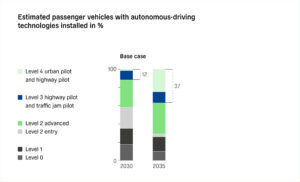
A study conducted by Waymo shows a significant reduction of bodily injury claims of 92% ² as compared to human-driven vehicles over 25.3 million accumulated miles. Beyond consumer advantages, AD presents a lucrative opportunity for the auto industry, with McKinsey estimating a global market penetration of a 37% for level 3+ autonomous driving system (hands off and eyes off driving) by 2035 in its base case scenario³.
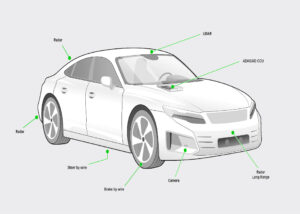
Full autonomous driving necessitates the seamless integra- tion of diverse sensor inputs. While there’s no one-size-fits- all approach among Original Equipment Manufacturers (OEMs), there seems to be a consensus that multiple opti- cal sensing technologies are necessary to enable autono- mous driving beyond SAE Level 3. Typically, OEMs leverage a combination of LiDAR, long-range radar, and camera sen- sors to equip their vehicles with environmental perception capabilities. Subsequent sensor fusion is typically executed using a Central Control Unit (CCU) or an Advanced Drives Assistance Gateway.
Furthermore, x-by-wire systems play a crucial role in enabling autonomous driving technology by replacing tra- ditional mechanical linkages with electronic controls, allow- ing for more precise and responsive control over various vehicle functions. X-by-wire technology provides the foun- dation for this integration by enabling direct electronic con- trol of vehicle systems. This allows the autonomous driving software to directly interface with and control the vehicle’s critical functions.
For vehicles equipped with SAE Level 3 and higher auton- omy, the systems must be designed to be fail-operational, meaning they must continue to operate safely even in the event of a component failure. This requirement is critical as it ensures that the vehicle can still perform essential func- tions such as steering and braking, allowing the car to be safely maneuvered to a stop or continue driving until a safe
state is achieved. Fail-operational systems provide an extra layer of security, crucial for the safety of autonomous vehi- cles. Implementing fail-operational systems necessitates robust safety architectures that include redundancy, fault tolerance, and comprehensive monitoring capabilities. One of the critical threats to reliability is condensation and water ingress.
The problem: Condensation and water ingress in safety-critical systems
While condensation, if not properly managed, can contribute to water accumulation, the root causes of these issues are often different. Condensation and water ingress can therefore be considered as two distinct failure modes. Conse- quently, its criticality profile varies depending on the underlying use case, influenced by factors such as installation position, product design and its potential to interfere with the core functionality of the product (e.g., condensation on camera windshield).
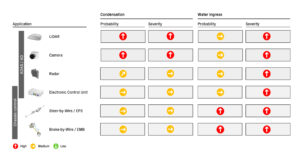
Safety critical electronic systems (incl. optical sensors) are conventionally engineered with hermetic sealing to safe- guard sensitive components from external influences. Yet, sustaining airtightness throughout their operational lifes- pan proves arduous due to the rigorous mission profiles and extensive deployment scales.
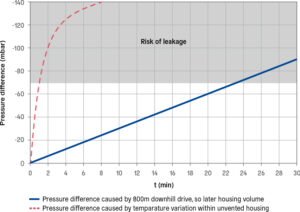
Electronic components within a vehicle are often subjected to variations in temperature and pressure due to operation at different levels of altitudes as well as heat generation during operation. These conditions can lead to significant under- or over-pressure within the housing, potentially com- promising seals and allowing the ingress of liquids, parti- cles and air (including moisture).
The inadvertent condensation build-up and water ingress poses a significant threat to electronics precipitating issues such as corrosion, short-circuits and other electrical fail- ures. Furthermore, excessive water may condense inside
the outward-facing cover glass, severely impacting the opti- cal performance of the system. Some manufacturers opt for an enclosure with pressure vent to prevent any pressure build-up, however this will inadvertently lead to the intro- duction of moisture through air exchange.
Regulation and industry standards are impacting the product design decisions:
As advanced driver-assistance systems (ADAS) and the asso- ciated sensor suits become essential components of modern vehicles, traditional regulations must be revised to accom- modate these technological advancements.
OEMs and their Tier-1 suppliers must therefore proactively address current regulatory frameworks, anticipate future changes, and design their products accordingly. This is par- ticularly critical in the context of Software-Defined Vehicles (SDVs) where vehicles sold today often come with the prom- ise for future functionalities through over-The-Air (OTA) updates. This implies that all components must be equipped with hardware capable of not only fulfilling the functional and safety relevant requirements of today, but also that of the future. (incl. regulations and standards)
Regulatory bodies and international organizations are devel- oping comprehensive safety standards and validation require- ments to foster consumer trust and acceptance of autono- mous technologies.
To ensure reliability, safety and performance in harsh environ- ments, standards such as AEC-Q for automotive electronics have been established, which include rigorous tests, such as temperature cycling and humidity exposure, to validate component durability.
In addition to the AEC-Q standards, the UNECE is creating a legal framework to maintain high safety levels for autonomous vehicles. For example, UNECE Regulation 157 (Addendum 156) ⁴ mandates manufacturers to provide documentation detailing the measures implemented to ensure safe vehicle operation under various environmental conditions. Similarly, EU Regu- lation 2022/1426 ⁵ requires manufacturers to demonstrate how the Automated Driving System (ADS) mitigates unreasonable risks when affected by environmental factors. Furthermore, while ISO 26262 on functional safety and ISO 21448 on the safety of the intended functionality (SOTIF) are not legally enforced by law, they have effectively become de facto stan- dards due to widespread adoption by all major OEMs.
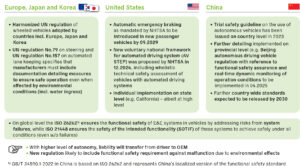
Beyond managing functional safety risks, adhering to inter- national standards can help mitigate liability exposure, espe- cially for higher levels of vehicle autonomy. These standards provide robust evidence of a state-of-the-art approach to safety, reinforcing accountability and compliance.
Establishing clear regulations on liability is essential for OEMs to launch Level 3 vehicles, as vehicle control is shifting from driver to the autonomous vehicle. This requires OEMs to accept responsibility for accidents occurring while their sys- tems operate in autonomous mode. This shift in liability creates opportunities, such as new B2B insurance models,
but also necessitates the implementation of robust second- ary measures for failure diagnostics.
As a result, an increasing pull from the OEMs can be observed, with suppliers being required to implement secondary mea- sures to address condensation build-up and water ingress in addition to conventional sealing. Additionally, Tier-1/2 suppli- ers are also proactively adopting various solutions to enhance their value proposition, position themselves for scalability in anticipation for impending regulatory changes.
The solution: Real-time humidity and water ingress detection in addition to mechanical ingress protection is a cost-effective solution to ensure regulatory compliance, functional safety over lifetime and enables new business models
There are various methods to address condensation build-up and water ingress in safety-critical systems, each with its own pros and cons. At Sensirion, we recommend a combined approach, utilizing mechanical protection alongside active detection such as employing a digital temperature and humidity sensor to achieve an optimal balance between cost and performance.
Active detection of condensation enables the implementation of reactive mitigation measures, such as removal of condensation via heating and/or ventilation. This reactive approach has proven to be more energy efficient compared to a purely preventive solution, leading to an overall better total cost of ownership.
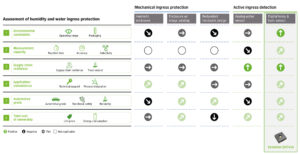
In terms of water ingress, there is typically a temporal gap between the water ingress event and system failure. Real-time detection enables smart action to prevent potential harm to individuals and to improve driver experience:
- Enabler for predictive maintenance: Systems that are exposed to high level of humidity or water ingress may be replaced before failure to ensure maximum uptime
- Smart degradation: Enables smart vehicle degradation concept through the estimation of probability of failure (e.g., limp-home mode)
- Boost passenger safety: Water ingress in safety-criti- cal system should be considered in the Hazard Analysis and Risk Assessment as part of ISO 26262
- Enabler of new business model: New B2B insurance models are emerging as liability transitions from driver to the vehicle in autonomous driving scenarios. Active monitoring can further reduce the overall risk profile in data-driven risk assessment models
- Cost-effective solution: Digital active water ingress detection is highly cost-effective compared to alterna- tives like a second sealing concept, thanks to miniatur- ization, economies of scale and ease of integration
Sensirion’s digital humidity and water sensors such as the SHT41A are therefore uniquely suited for detecting condensa- tion build-up and water ingress in sealed or semi-permeable enclosures, where a rapid and/or large rise in humidity would trigger an action within the system. The most straightforward example is in the case of hermetically sealed enclosures (e.g. in Camera or LiDAR systems). Here, a rise of both the absolute and relative humidity measured within the enclosure would indicate that the seal has been compromised and that action needs to be undertaken.
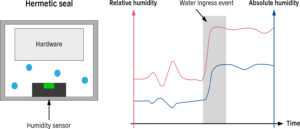
A significantly more challenging situation is when some air exchange between the enclosure and the environment is pos- sible (semi-permeable, typical in x-by-wire systems). In this case, one needs to be able to differentiate between naturally occurring condensation and actual water ingress. In either case a “standard” humidity sensor would output a 100% RH measurement, without being able to distinguish between the two.
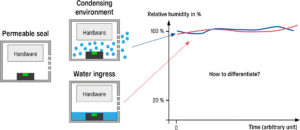
Sensirion’s 4th generation of automotive Humidity and Temperature sensors, SHT4xA, incorporates a powerful heater that enables the differentiation between the two cases by analyzing the dynamic response to heat pulse. When a rise in humid- ity is detected, a heat pulse is sent and the temperature response curve is analyzed: a significant drop in relative humid- ity will be observed if there is no direct water contact with the sensor (i.e., condensation), whereas the relative humidity drop will be minimal in the case of direct water contact.
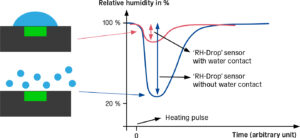
The variation in RH Drop and time to recovery will vary depending on the system implementation but the general principle can be used in most cases for detecting water ingress and differentiating between direct water contact and condensation.
Sensirion’s SHT41A: a unique solution for safety-relevant applications
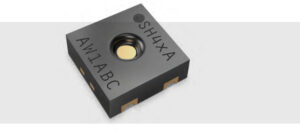
SHT41A represents the state-of-the-art in terms of humid- ity and temperature sensing in Automotive applications. SHT41A is newly available as an ASIL-A Safety Element out of Context, in accordance with ISO 26262. The available Safety and Diagnostics Manuals outline safety goals and diagnostic procedures specifically aimed at detecting water ingress, thus enabling ADAS / AD and x-by-wire system inte- grators to achieve their desired ASIL and safety goals.