As India accelerates toward its ambitious 2030 electric mobility goals, the focus is shifting from vehicle adoption to ecosystem readiness. Charging infrastructure, battery safety, semiconductor manufacturing, localization, and policy harmonization are emerging as the defining pillars of the country’s next EV growth phase. The question is no longer whether India will embrace electric mobility, but whether it can build a globally competitive EV ecosystem that supports innovation, affordability, and long-term sustainability.
India’s EV Transition Enters a New Phase
India’s electric vehicle journey has moved well beyond its experimental stage. What began as a policy-driven push through initiatives such as FAME and state-level incentives is now evolving into a broader industrial transformation. The country is witnessing rising adoption across two-wheelers, three-wheelers, passenger vehicles, buses, and commercial fleets, supported by growing investments in manufacturing, battery technologies, charging infrastructure, and semiconductor capabilities.
According to recent policy discussions and industry reports, India’s EV market could contribute significantly toward reducing fossil fuel imports, lowering carbon emissions, and strengthening domestic manufacturing capabilities. However, the next phase of growth demands something more than subsidies—it requires a complete ecosystem approach.
Today, policymakers are increasingly focused on strengthening the foundations that will support mass adoption over the next decade. These include public charging infrastructure, domestic manufacturing of critical components, battery safety regulations, and investments in future-ready technologies.
India’s EV Landscape
Key Developments Shaping EV Policy 2026
- EV adoption continues to accelerate across vehicle segments
- More than 29,000 public charging stations operational nationwide (Source: Ministry of Power – EV Charging Infrastructure Guidelines, PM E-DRIVE Scheme – Ministry of Heavy Industries)
- Semiconductor manufacturing gaining strategic importance
- AIS-156 and AIS-038 Rev 2 strengthening battery safety norms
- PM E-DRIVE expected to boost charging deployment
- Localization emerging as a major policy priority
- India targeting global EV manufacturing leadership by 2030
Charging Infrastructure
Despite growing EV sales, one challenge continues to dominate consumer conversations—range anxiety.
Industry experts widely agree that charging accessibility remains one of the biggest barriers to widespread EV adoption. While advancements in battery technology are helping improve vehicle range, public charging infrastructure remains a critical enabler of consumer confidence.
India has expanded its public charging network considerably over the last few years. However, the challenge is no longer limited to installation numbers. Reliability, uptime, interoperability, and ease of access have become equally important considerations. A charging station that is unavailable or non-functional can quickly undermine consumer trust.
Growth of Public EV Charging Infrastructure in India
| Year | Public Charging Stations |
| FY22 | ~6,800 |
| FY25 | ~29,000 |
| PM E-DRIVE Target | 72,300 |
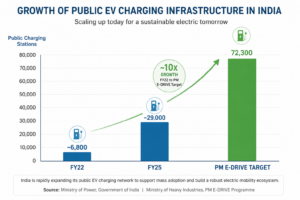
Source: Ministry of Power / PM E-DRIVE Programme
India’s charging infrastructure has expanded significantly, but industry stakeholders emphasize that reliability, interoperability, and service quality will define the next phase of deployment.
As Dr. Bharat Bhushan, Executive Director, Radius Synergies International, notes:
“Looking at it from a consumer’s perspective, the biggest focus area should be the establishment of an efficient, effective and robust public charging infrastructure, including complex aspects like grid stability.”
The challenge extends beyond simply installing chargers. Experts increasingly point toward smart charging systems, digital interoperability, renewable energy integration, and grid modernization as essential components of a scalable charging ecosystem. Public-private partnerships are expected to play a central role in achieving these objectives.
The Evolution of EV Policy
India’s initial EV policies focused heavily on stimulating demand through subsidies and incentives. While these interventions helped create early momentum, the policy conversation is now evolving. (NITI Aayog – Electric Vehicles in India Report)
The focus is gradually shifting toward ecosystem development, infrastructure readiness, domestic manufacturing, and supply-chain resilience. Industry stakeholders believe future policy frameworks must create greater coordination between central and state governments to ensure consistency and predictability for investors.
Several states have introduced their own EV policies, creating pockets of success across the country. However, variations in incentives, regulations, and implementation frameworks have also created complexity for manufacturers and fleet operators operating across multiple regions.
A more harmonized policy approach could unlock greater investment and accelerate nationwide adoption.
The Semiconductor Imperative
The future of electric mobility is inseparable from semiconductors.
Modern EVs depend on advanced electronics for battery management systems, power electronics, motor control units, infotainment systems, connectivity solutions, and charging infrastructure. As EV penetration increases, semiconductor demand is expected to rise significantly.
India’s current dependence on imported semiconductors presents both an economic and strategic challenge. Recent global supply-chain disruptions highlighted the vulnerabilities associated with excessive import dependence and reinforced the need for domestic manufacturing capabilities.
Government initiatives such as the India Semiconductor Mission and production-linked incentive schemes are aimed at creating a domestic ecosystem that spans chip design, fabrication, assembly, testing, and packaging. (IISD – Policies for Electric Vehicles & Battery Manufacturing in India)
According to Mr. Rajesh Kaushal, Energy Infrastructure & Industrial Solutions (EIS) Business Group Head, India & SAARC, Delta Electronics India:
“Semiconductors will increasingly become the backbone of electric mobility, powering battery management systems, charging infrastructure, vehicle control systems, and connected mobility solutions. Building semiconductor capability is therefore not just an EV requirement but a strategic national capability.”
Industry observers believe that semiconductor manufacturing could become one of the most important determinants of India’s EV competitiveness over the next decade.
Localization: From Assembly to Value Creation
Localization has emerged as one of the most important themes shaping India’s EV future.
While vehicle assembly capabilities have expanded rapidly, true competitiveness will depend on domestic production of batteries, motors, power electronics, semiconductors, and critical components. The objective is not merely to manufacture vehicles in India but to create a complete value chain that generates economic benefits across the ecosystem.
A stronger localization ecosystem can reduce costs, improve supply-chain resilience, create jobs, and support exports.
Policy initiatives such as PLI schemes for Advanced Chemistry Cells (ACC), electronics manufacturing, and semiconductor development are expected to play a crucial role in this transition.
Battery Safety
No technology transition can succeed without consumer confidence.
Battery safety has become one of the most closely watched aspects of India’s EV ecosystem following several high-profile incidents involving thermal runaway and battery fires. Although such incidents remain relatively limited, they have reinforced the importance of rigorous safety standards and testing protocols.
India has responded through stricter regulations, including AIS-156 and AIS-038 Rev 3 standards, which place greater emphasis on battery testing, thermal propagation resistance, and battery management systems.
Modern thermal management systems are becoming increasingly sophisticated, incorporating advanced cooling technologies, predictive algorithms, and intelligent battery monitoring capabilities.
Mr. Vinkesh Gulati, Chairperson, Automotive Skills Development Council, emphasizes:
“Battery safety and thermal management are the non-negotiable pillars of building consumer trust and accelerating widespread EV adoption.”
Beyond regulations, experts also stress the importance of technician training, consumer awareness, and standardized safety practices throughout the EV lifecycle.
Building EVs for Indian Conditions
One of the unique aspects of India’s EV journey is the operating environment.
Vehicles must function across extreme temperatures, monsoon conditions, congested urban traffic, and diverse road infrastructure. Technologies developed for European or North American markets often require adaptation to perform reliably under Indian conditions.
This reality is driving increased focus on India-specific innovation in batteries, thermal management systems, charging solutions, and fleet management technologies.
The country’s large domestic market provides a valuable testing ground for solutions that can later be exported to other emerging economies facing similar challenges.
Can India Become a Global EV Hub by 2030?
The possibility is increasingly realistic.
India already possesses several structural advantages, including a large manufacturing base, a skilled engineering workforce, growing domestic demand, and strong government support. These advantages have helped establish the country as a major player in automotive manufacturing, and many believe similar success is achievable in electric mobility.
However, becoming a global EV hub will require progress across multiple fronts:
Key Priorities for the Next Five Years
- Scale domestic battery manufacturing
- Expand public charging infrastructure
- Strengthen semiconductor capabilities
- Improve localization levels
- Invest in R&D and innovation
- Develop EV-focused skill ecosystems
- Enhance policy consistency
- Promote export competitiveness
- Success will depend not only on manufacturing volume but also on innovation, technology leadership, and value creation.
The Road Ahead
India’s EV transition is entering a defining decade. The conversation is no longer limited to vehicle sales or subsidy programs. Instead, it encompasses infrastructure, manufacturing, semiconductors, battery safety, localization, workforce development, and global competitiveness.
The foundations are being laid through policy initiatives, industry investments, and technological innovation. Yet the ultimate success of EV Policy 2026 will depend on how effectively these elements come together to create a cohesive and resilient ecosystem.
If charging infrastructure becomes ubiquitous, semiconductor manufacturing gains momentum, localization deepens, and safety standards continue to strengthen, India could emerge not only as one of the world’s largest EV markets but also as a major global center for electric mobility innovation and manufacturing by 2030.