Market Summary
According to our Growth Market Report, the global EV test equipment market size reached USD 1,490 million in 2025, reflecting robust industry expansion driven by the rapid adoption of electric vehicles worldwide. The market is expected to grow at a compelling CAGR of 11.7% from 2026 to 2034, projecting a value of approximately USD 4,030 million by 2034. This impressive growth trajectory is propelled by stringent regulatory standards, technological advancements in EV powertrains and batteries, and the increasing demand for reliable and efficient EV testing solutions to ensure quality, safety, and performance in electric vehicles. The scope of battery-focused test and validation systems has expanded considerably, reflecting how central energy storage performance has become to overall vehicle certification.
Introduction: Why EV Test Equipment Is Becoming the Backbone of Electric Mobility
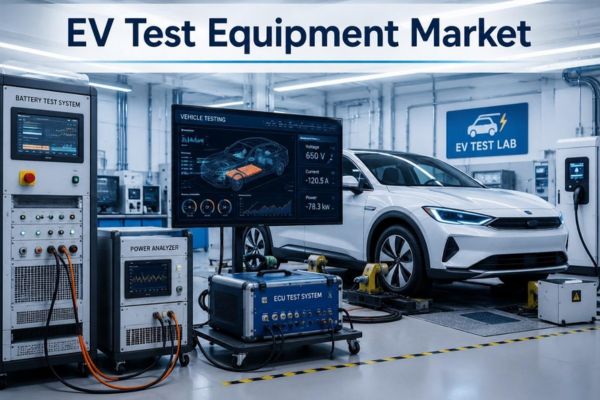
The rapid transition toward electric mobility is transforming the global automotive landscape, but behind every successful electric vehicle lies an ecosystem of sophisticated testing technologies. The EV Test Equipment Market has emerged as one of the most critical segments supporting this transformation by ensuring that electric vehicles, batteries, charging systems, power electronics, and electrical components meet stringent safety, reliability, and performance standards before reaching consumers.
As governments promote zero-emission transportation and manufacturers race to develop longer-range, faster-charging electric vehicles, the complexity of vehicle electronics continues to increase. Consequently, testing is no longer a final quality checkpoint—it has become an integrated process throughout product design, manufacturing, and lifecycle management. The growing dependence on precision measurement, simulation, validation, and automated diagnostics positions EV test equipment as an indispensable component of the global electric vehicle value chain.
What Is EV Test Equipment?
EV test equipment refers to specialized instruments, software platforms, and automated systems designed to evaluate the performance, efficiency, durability, and safety of electric vehicle components and complete vehicles. These solutions help engineers verify electrical integrity, battery efficiency, motor performance, charging compatibility, electromagnetic compliance, thermal stability, insulation resistance, and communication protocols.
Unlike conventional automotive testing, EV testing combines electrical engineering, electronics, software validation, mechanical performance evaluation, and cybersecurity testing into a unified quality assurance framework. Modern test laboratories increasingly rely on intelligent automation, digital twins, and AI-assisted diagnostics to shorten development cycles while improving testing accuracy.
Why Is EV Test Equipment Becoming More Important?
The evolution of electric vehicles has dramatically increased the need for comprehensive testing. Modern EVs contain thousands of interconnected electronic components that must operate flawlessly under varying environmental conditions.
Battery packs require validation for temperature fluctuations, charging cycles, vibration resistance, and long-term degradation. Electric motors need efficiency analysis under diverse operating loads. Charging infrastructure must ensure compatibility across multiple international standards while maintaining user safety.
Furthermore, autonomous driving functions, over-the-air software updates, and connected vehicle technologies introduce additional layers of testing requirements that extend beyond traditional automotive engineering.
The result is a rapidly expanding demand for advanced testing ecosystems capable of validating both hardware and software throughout the vehicle lifecycle.
Key Components Tested in Electric Vehicles
Battery Testing
Battery testing remains the largest application area within the EV Test Equipment Market. Engineers evaluate charging efficiency, energy density, thermal behavior, cycle life, short-circuit resistance, abuse tolerance, and overall battery health. Advanced battery analytics also support predictive maintenance and second-life battery applications.
Electric Motor Testing
Electric motors undergo torque measurement, efficiency mapping, thermal analysis, vibration monitoring, acoustic evaluation, and endurance testing. These assessments ensure maximum energy conversion with minimal power loss.
Power Electronics Testing
Inverters, converters, onboard chargers, and semiconductor devices require precise electrical measurements to validate voltage stability, current control, switching performance, and heat dissipation.
Charging System Testing
Charging stations and onboard charging systems must be tested for communication protocols, interoperability, charging speed, insulation resistance, connector durability, and fault protection mechanisms.
Vehicle-Level Testing
Complete electric vehicles undergo performance evaluation, road simulation, regenerative braking assessment, energy consumption analysis, environmental testing, and electromagnetic compatibility verification before commercialization.
Emerging Technologies Reshaping the EV Test Equipment Market
Artificial Intelligence in Automated Testing
Artificial intelligence is transforming test automation by detecting anomalies, identifying hidden failure patterns, and optimizing testing procedures in real time. AI-powered analytics reduce manual inspection while improving predictive accuracy.
Digital Twin Technology
Virtual replicas of batteries, motors, and complete vehicles enable engineers to simulate real-world operating conditions before physical prototypes are manufactured. This significantly reduces development costs while accelerating product innovation.
Cloud-Based Testing Platforms
Remote monitoring and cloud-enabled data analytics allow engineers across multiple facilities to collaborate on testing projects simultaneously. Centralized databases improve traceability, compliance reporting, and predictive maintenance.
High-Power Testing Infrastructure
The introduction of ultra-fast charging systems and high-voltage vehicle architectures requires testing equipment capable of safely handling increasingly higher voltages and power levels while maintaining exceptional measurement precision.
Robotics and Automated Test Cells
Robotic systems perform repetitive validation procedures with consistent accuracy, reducing human error while increasing productivity across manufacturing facilities.
Market Drivers Accelerating Global Growth
Several powerful factors are contributing to the expansion of the EV Test Equipment Market.
Growing electric vehicle adoption worldwide is significantly increasing testing requirements across manufacturing facilities. Governments continue introducing stricter vehicle safety regulations, emission reduction targets, and battery certification standards. Automakers are investing heavily in research and development to improve battery performance, charging speed, and vehicle intelligence, creating greater demand for advanced validation technologies.
The rapid expansion of EV charging infrastructure also requires continuous testing to ensure interoperability, operational safety, and long-term reliability. Additionally, increasing investments in battery gigafactories and semiconductor manufacturing further strengthen demand for specialized electrical testing systems
Challenges Facing the Industry
Although the market demonstrates strong growth potential, manufacturers face several operational challenges.
High initial investment costs often limit adoption among smaller testing laboratories and emerging manufacturers. Rapid technological evolution requires continuous upgrades to testing platforms, software, and measurement capabilities. A shortage of highly skilled engineers capable of operating sophisticated testing systems also remains a global concern.
Furthermore, evolving international standards require testing organizations to frequently update procedures, certifications, and compliance documentation to remain competitive.
Sustainability Is Changing Testing Priorities
Environmental responsibility has become a defining factor in EV testing strategies. Manufacturers increasingly evaluate battery recycling efficiency, energy consumption, lifecycle emissions, and material sustainability during product development.
Testing laboratories are also adopting energy-efficient equipment, renewable power sources, and digital workflows that reduce waste while improving operational efficiency. Circular economy principles are encouraging manufacturers to validate battery refurbishment, remanufacturing, and second-life applications using specialized testing methodologies.
Opportunities Creating the Next Wave of Innovation
The future of the EV Test Equipment Market extends beyond traditional automotive applications.
Wireless charging validation, solid-state battery testing, hydrogen-electric hybrid systems, autonomous mobility platforms, smart grid integration, vehicle-to-grid communication, cybersecurity verification, and software-defined vehicle validation are expected to create entirely new testing requirements.
Companies capable of delivering modular, AI-powered, cloud-connected, and highly automated testing ecosystems will be well positioned to support the next generation of electric transportation technologies.
Future Outlook: EV Test Equipment Will Define the Quality of Tomorrow’s Mobility
According to our Growth Market Report, The future of the EV Test Equipment Market is closely tied to the evolution of intelligent transportation. As electric vehicles become more connected, autonomous, software-driven, and energy-efficient, testing will evolve from a quality control function into a strategic innovation platform.
Next-generation testing environments will combine artificial intelligence, digital twins, cloud computing, robotics, predictive analytics, and real-time data intelligence to validate increasingly complex vehicle ecosystems. High-voltage architectures, ultra-fast charging, solid-state batteries, and vehicle-to-grid technologies will require unprecedented levels of precision, safety, and automation.