The Autonomous Vehicle Damage Detection Market is moving from an emerging automotive-AI application toward a critical layer of digital vehicle operations. What began largely as image-based damage recognition for insurance claims is expanding into fleet management, vehicle remarketing, rental and leasing, dealership operations, collision repair, logistics and OEM quality control.
The underlying shift is straightforward: vehicles are becoming more digitally connected, while the traditional walk-around inspection remains labor-intensive, subjective and difficult to scale. Artificial intelligence (AI), computer vision, LiDAR, radar, 3D imaging and sensor fusion are changing that equation by turning vehicle condition into structured, machine-readable data.
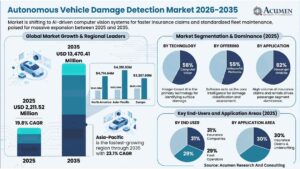
According to Acumen Research and Consulting, the Global Autonomous Vehicle Damage Detection Market was valued at USD 2.21 billion in 2025 and is projected to reach USD 13.47 billion by 2035, representing a 19.8% CAGR from 2026 to 2035.
What Is Autonomous Vehicle Damage Detection?
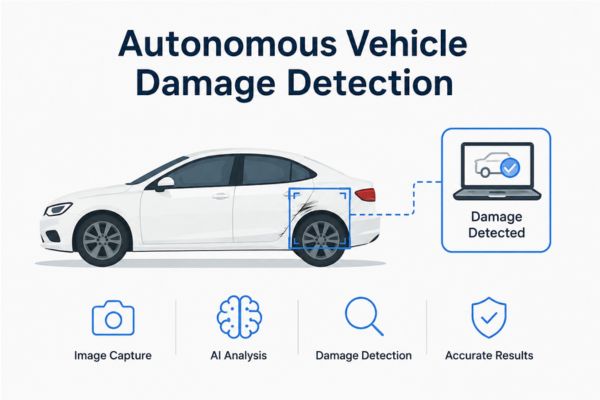
Autonomous vehicle damage detection uses AI, computer vision and imaging or sensor technologies to automatically identify, classify and assess vehicle damage with limited human intervention.
Depending on the system, inputs can include smartphone photographs, 360-degree video, fixed cameras, LiDAR, radar, ultrasonic sensors and vehicle data. AI models can then identify dents, scratches, cracks, broken components, paint damage and other anomalies, while more advanced platforms can estimate severity, compare vehicle condition over time and support repair or claims decisions.
The distinction between damage detection and damage assessment is increasingly important. Detecting a dent is only the first step. The commercial value comes from connecting that detection to questions such as:
- Is the damage new or pre-existing?
- Is the component repairable or replaceable?
- How severe is the damage?
- What repair operation is required?
- What is the estimated repair cost?
- Should the vehicle be repaired or declared a total loss?
- Can the inspection be automatically documented for an insurer, fleet operator or buyer?
This transition from image recognition to decision intelligence is one of the defining developments in the Autonomous Vehicle Damage Detection Market.
Key Trends Driving the Autonomous Vehicle Damage Detection Market
1. Computer vision remains the core growth engine
Computer vision is currently the dominant technology in the market. Acumen Research and Consulting estimates that computer vision/image-based AI accounted for 58% of the market in 2025.
The reason is practical. Cameras are comparatively accessible, smartphone cameras can support remote inspections, and image-based AI can be integrated into existing claims, rental and fleet workflows without necessarily requiring dedicated inspection infrastructure.
The next competitive frontier is therefore not simply recognizing visible damage. It is improving performance across poor lighting, unusual angles, different vehicle designs, weather conditions and increasingly complex vehicle architectures.
2. Sensor fusion is moving inspection beyond cosmetic damage
Multimodal inspection is becoming increasingly important. Acumen estimates that multimodal/sensor-fusion technology represented 20% of the market in 2025.
Combining cameras with LiDAR, radar, ultrasonic sensors, vehicle diagnostics and other data sources can provide a more comprehensive representation of vehicle condition.
This matters particularly for advanced driver-assistance systems and autonomous vehicles. A collision can affect sensors, cameras, calibration and electronic systems even when exterior damage appears relatively minor.
3. Insurance is the largest immediate commercial use case
Insurance claims and underwriting represented approximately 30% of the Autonomous Vehicle Damage Detection Market in 2025, according to Acumen Research and Consulting.
AI-powered inspection can shorten first-notice-of-loss workflows, automate damage triage, improve consistency and potentially identify suspicious or duplicate damage.
The competitive advantage is increasingly shifting from standalone damage recognition to integration with claims platforms, estimating databases and repair networks.
For example, Mitchell says its Intelligent Damage Analysis technology can process vehicle photographs using computer vision and machine learning and identify damaged components for collision-claim workflows. Its platform reports recognition across more than 700 internal and external parts.
Similarly, CCC Intelligent Solutions has developed AI-powered computer-vision capabilities for analyzing vehicle damage photographs within the broader automotive claims ecosystem.
4. Fleet and mobility operators are becoming major buyers
Fleet and mobility operations accounted for 25% of the market in 2025, according to Acumen.
For rental fleets, ride-hailing operators, logistics companies and leasing businesses, the economic proposition is compelling: inspect thousands of vehicles consistently without requiring an expert inspector at every location.
The ability to compare a vehicle’s condition at check-in and check-out is particularly valuable. It creates a digital chain of evidence for identifying newly incurred damage and assigning responsibility.
5. Cloud and mobile inspection are lowering adoption barriers
Cloud deployment represented 42% of the market in 2025, while hybrid deployment accounted for another 40%, according to Acumen Research and Consulting.
This reflects a broader architectural choice facing buyers. Cloud systems offer scalability and centralized analytics, whereas hybrid and on-premises architectures can provide greater control over sensitive vehicle and customer data.
At the same time, mobile-first inspection is making the technology accessible without expensive physical infrastructure.
Click-Ins, for example, combines computer vision, photogrammetry, 3D modelling and synthetic data and supports vehicle inspections using smartphone cameras.
Who Are the Leading Companies in the Autonomous Vehicle Damage Detection Market?
The competitive landscape spans three broad groups: AI-native inspection companies, automotive claims technology providers and automated hardware/scanning specialists.
Key companies identified by Acumen Research and Consulting include Tractable, Click-Ins, UVeye, Mitchell, CCC Intelligent Solutions, Solera, ProovStation, Claim Genius, ControlExpert, Audatex, ClickMotive and Deepomatic.
Several deserve particular attention.
Tractable has built a strong position around visual AI for vehicle damage assessment and accident recovery. The London-based company focuses on applying computer vision and machine learning to damage appraisal and related workflows.
UVeye represents the hardware-plus-AI approach. Its automated systems use imaging and AI to inspect vehicle exteriors, tires and underbodies. The company reports more than 700 customer locations and more than 3 million monthly scans.
Solera/Audatex has an important advantage in automotive claims because damage detection is integrated into a much broader repair and claims data ecosystem. Its Qapter platform includes AI-enabled intelligent damage detection and estimating, supported by a database containing billions of vehicle images.
Claim Genius takes a software-centric approach, positioning AI as an intelligence layer capable of processing images and video from smartphones or automated inspection systems.
Ravin AI is another notable competitor combining mobile inspection, fixed-camera scanning and AI-based damage assessment for insurance, fleet, service-center and remarketing applications.
Inspektlabs focuses on software-driven vehicle inspection and reports AI-based detection across 163 vehicle parts, supporting insurance, fleet, rental and remarketing workflows.
The strategic lesson is clear: the market is not converging around one inspection model. Mobile AI, fixed scanners, claims platforms and multimodal systems can all coexist.
Which Countries Have the Highest Concentration of Autonomous Vehicle Damage Detection Companies?
United States
The U.S. is arguably the most important commercial hub because of its enormous automotive and insurance ecosystems. Major players and operations include CCC Intelligent Solutions, Mitchell, Claim Genius and Ravin AI, while several international companies have established U.S. operations.
Israel
Israel has an unusually strong concentration of automotive computer-vision startups. UVeye and Click-Ins are notable examples. UVeye was founded in Israel and maintains operations in both Israel and the United States.
United Kingdom
The U.K. is particularly significant for AI-native automotive software. Tractable, headquartered in London, is the clearest example.
France
France has developed a meaningful automated-inspection ecosystem, including ProovStation and Tchek. ProovStation is based in Lyon and has marketed automated vehicle inspection technology across Europe and the U.S.
Germany and broader Europe
Germany is important because of its insurance, automotive manufacturing and fleet ecosystem, with ControlExpert among the notable companies applying AI and automation to claims and vehicle-damage workflows.
The broader conclusion is that North America currently has the strongest commercial concentration, while Israel, the U.K., France and Germany provide important technology and innovation clusters.
North America Leads Today, but Asia-Pacific Could Reshape the Market
Acumen Research and Consulting estimates that North America held 38% of global market share in 2025, while Asia-Pacific is forecast to be the fastest-growing region, with a 23.1% CAGR through 2035.
That creates an important strategic tension.
North America benefits from mature insurance infrastructure, established claims technology and high AI adoption. Asia-Pacific, meanwhile, combines rapid automotive production, expanding vehicle fleets, increasing insurance penetration and accelerating digitalization.
China, India, Japan and South Korea are therefore likely to become increasingly important markets for automated inspection. The opportunity is particularly strong where high vehicle volumes collide with labor constraints and a need for standardized inspections.
What Could Hold the Autonomous Vehicle Damage Detection Market Back?
Growth is not guaranteed.
The first challenge is deployment economics. Advanced fixed inspection systems require cameras, sensors, computing infrastructure, installation and maintenance. Acumen identifies high initial investment and integration complexity as important restraints.
The second is data quality. AI models must perform across different vehicle models, lighting conditions, weather, camera positions and damage types. A model that performs well in controlled conditions can behave differently in the real world.
The third is trust and explainability. A false positive can lead to an unnecessary repair, disputed insurance claim or dissatisfied rental customer. As AI becomes involved in financial decisions, organizations will increasingly require audit trails, confidence scores, human review and transparent decision logic.
Finally, privacy and data governance will become more important as vehicle images can contain license plates, faces, locations and other potentially sensitive information.
The Next Competitive Battleground: From Detection to Vehicle Intelligence
The next phase of the Autonomous Vehicle Damage Detection Market will not be won simply by the company that detects the smallest scratch.
The stronger business model will combine perception + vehicle identity + damage history + repair intelligence + workflow automation.
Imagine a vehicle arriving at a service center. Cameras identify the vehicle, AI compares its present condition with historical scans, computer vision identifies new damage, sensor data highlights potential calibration issues, the system predicts repair requirements, and the resulting information flows directly into the insurer, dealer or repair shop’s workflow.
That is a fundamentally different proposition from automated inspection.
It turns the vehicle into a continuously updated digital condition record.
This is why the market’s future will increasingly overlap with connected vehicles, digital twins, predictive maintenance, autonomous driving, smart mobility and AI-powered insurance.
Autonomous Vehicle Damage Detection Market: Outlook to 2035
The numbers point toward a high-growth market, but the deeper opportunity is structural.
Acumen Research and Consulting projects the market to increase from USD 2.21 billion in 2025 to USD 13.47 billion by 2035, at a 19.8% CAGR. Software/AI platforms already represented 55% of market revenue in 2025, demonstrating that the intelligence layer is becoming more economically significant than inspection hardware alone.
The companies best positioned for the next decade will likely be those capable of solving three problems simultaneously:
- See the vehicle accurately.
- Understand what the observed damage means.
- Convert that understanding into an operational or financial decision.
That evolution could make autonomous damage detection one of the most important practical applications of computer vision in automotive.
Frequently Asked Questions
What is the Autonomous Vehicle Damage Detection Market?
The Autonomous Vehicle Damage Detection Market comprises AI-powered software, hardware and services used to automatically detect, classify and assess vehicle damage through technologies such as computer vision, LiDAR, radar, ultrasonic sensing and multimodal sensor fusion.
How big is the Autonomous Vehicle Damage Detection Market?
Acumen Research and Consulting estimates that the global market was worth USD 2.21 billion in 2025 and could reach USD 13.47 billion by 2035, growing at a 19.8% CAGR between 2026 and 2035.
Which technology leads the market?
Computer vision/image-based AI was the leading technology in 2025, with an estimated 58% market share, according to Acumen Research and Consulting.
Which application dominates the market?
Insurance claims and underwriting was the largest application in 2025, accounting for approximately 30% of market revenue, followed by fleet and mobility operations at 25%.
Which companies are major players?
Major companies include Tractable, Click-Ins, UVeye, Mitchell, CCC Intelligent Solutions, Solera/Audatex, Claim Genius, ControlExpert, Ravin AI and Inspektlabs, among others.
Which region currently leads the Autonomous Vehicle Damage Detection Market?
North America led the global market with an estimated 38% share in 2025, while Asia-Pacific is expected to be the fastest-growing region, with a projected 23.1% CAGR through 2035.