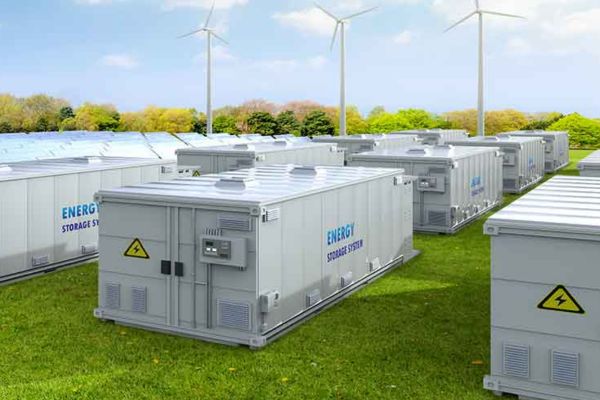
NLC India Renewables Limited (NIRL) has won the tender for a 265 MW/530 MWh standalone Battery Energy Storage System (BESS) project in Haryana. The project has been awarded by SJVN Limited at a tariff of ₹2.35 lakh per MW per month. SJVN is acting as the Renewable Energy Implementing Agency (REIA) for the project, which is being implemented for Uttar Haryana Bijli Vitran Nigam Limited (UHBVNL).
The Haryana BESS project will provide two hours of energy storage capacity and has been divided into two components. Project-1 comprises 250 MW/500 MWh, while Project-2 includes 15 MW/30 MWh. SJVN invited bids for the project in July 2026 under tariff-based competitive bidding, with the project supported through applicable Viability Gap Funding (VGF) schemes.
Under the project scope, NLC India Renewables will make the BESS capacity available to UHBVNL on an on-demand basis. The storage system will be used to meet the distribution utility’s peak and off-peak power requirements, enabling electricity to be stored and discharged according to the grid’s requirements.
The project is backed by VGF support. According to the tender details, Project-2’s 15 MW/30 MWh BESS is supported under the State Component of the VGF Scheme, with eligible support of up to ₹18 lakh per MWh or 30% of the capital cost, as applicable. The VGF is provided as a one-time, non-recurring expenditure under the applicable funding mechanism.
The tender attracted participation from several BESS developers, including Rama Reflection India, SolarWorld Energy, Pace Digitek, Sun Drop Energia and Oriana Power. The latest award follows SJVN’s earlier tender for a 250 MW/500 MWh standalone BESS project in Panipat, Haryana, which was awarded to Hardi Hydro Energy at a tariff of ₹1.97 lakh per MW per month.
The 265 MW/530 MWh Haryana BESS project adds another utility-scale energy storage project to NLC India Renewables’ growing storage portfolio. The project is designed to support UHBVNL’s peak and off-peak power requirements through on-demand battery storage, while the VGF mechanism is intended to support the deployment of large-scale BESS capacity in Haryana.