
Automotive Headlamp Reflector Market Statistics
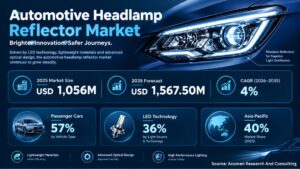
- Market Size (2025): USD 1,056 million
- Projected Market Size (2035): USD 1,567.50 million
- CAGR (2026–2035): 4%
- Leading Material Segment (2025): Thermoplastics, with a 42% share
- Leading Vehicle Type (2025): Passenger cars, with a 57% share
- Leading Light Source/Technology (2025): LED, with a 36% share
- Leading Reflector Design (2025): Parabolic reflectors, with a 45% share
- Leading Beam Function (2025): Low beam, with a 42% share
- Leading Sales Channel (2025): Original equipment manufacturers (OEMs), with a 72% share
- Leading Manufacturing Process (2025): Injection molding, with a 68% share
- Leading Region (2025): Asia-Pacific, with a 40% share
- Asia-Pacific Forecast CAGR (2026–2035): 5.1%
Automotive Headlamp Reflector Market Forecast: Growth Through Advanced Lighting and Precision Manufacturing
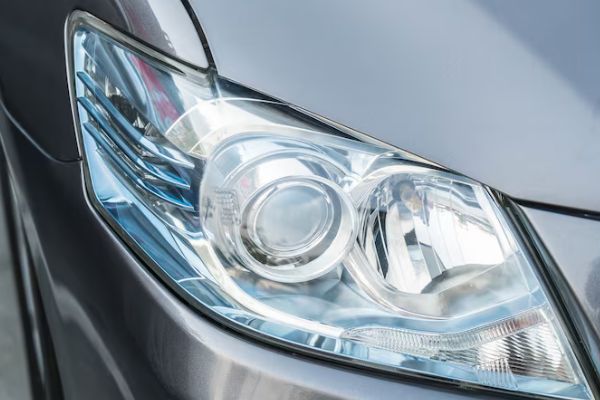
The global Automotive Headlamp Reflector Market is evolving as automakers prioritize lighting performance, vehicle styling, energy efficiency, and manufacturing precision. Headlamp reflectors are important optical components that help direct and distribute light from a vehicle’s headlamp to illuminate the road while supporting visibility and glare control.
According to Acumen Research And Consulting, the Global Automotive Headlamp Reflector Market was valued at USD 1,056 million in 2025 and is projected to reach USD 1,567.50 million by 2035, registering a compound annual growth rate (CAGR) of 4% from 2026 to 2035.
The Automotive Headlamp Reflector Market includes reflectors manufactured from thermoplastics, composites, aluminum, sheet steel, and other materials. These components are used across passenger cars and commercial vehicles, with demand influenced by vehicle production, headlamp technology, reflector geometry, and manufacturing requirements.
The transition toward LED lighting, increasingly compact headlamp assemblies, and more sophisticated optical designs is changing the requirements placed on reflector suppliers. Manufacturers must balance light distribution, durability, thermal performance, weight, cost, and production consistency.
Although reflector design varies with the light source and headlamp architecture, reflectors remain relevant to many automotive lighting systems. The automotive headlamp reflector market’s growth is therefore supported by both continued vehicle production and the evolution of automotive lighting components.
What Is Driving the Automotive Headlamp Reflector Market?
1. Increasing Adoption of LED Headlamps
LED technology is reshaping automotive lighting by enabling compact packaging, energy-efficient illumination, long operating life, and greater flexibility in headlamp styling.
LED accounted for 36% of the automotive headlamp reflector market’s light source and technology segment in 2025. Its adoption creates opportunities for reflectors and associated optical elements designed to work with the specific characteristics of LED light sources.
LED headlamp designs often require precise control of light distribution and careful integration of optical, thermal, and electronic components. Reflector suppliers must therefore collaborate with headlamp manufacturers to meet performance specifications within increasingly compact assemblies.
The continued development of adaptive lighting and advanced beam-control systems may further increase the importance of precision optical engineering. However, the reflector’s role varies by design, with some headlamp architectures relying more heavily on lenses, projectors, or other optical elements.
2. Growth in Global Vehicle Production
Passenger cars accounted for 57% of the automotive headlamp reflector market in 2025, making them the leading vehicle category.
Global vehicle manufacturing generates demand for headlamp assemblies and their constituent optical components. Each vehicle platform has its own lighting configuration, styling requirements, and technical specifications, creating opportunities for suppliers that can manufacture reflectors at scale.
Commercial vehicles also contribute to demand. Light commercial vehicles, medium-duty vehicles, and heavy-duty vehicles require lighting systems suitable for their operating conditions, vehicle dimensions, and regulatory requirements.
As automakers introduce new vehicle models and update existing platforms, reflector manufacturers can benefit from new sourcing programs, product redesigns, and production-volume requirements.
3. Lightweight Materials and Compact Design
Vehicle manufacturers are seeking opportunities to reduce weight while maintaining durability, safety, and manufacturing efficiency. Material selection is particularly important for lighting components because reflectors must maintain their shape and optical properties under operating conditions.
Thermoplastics represented 42% of the market’s material segment in 2025. Their lightweight characteristics, design flexibility, and compatibility with high-volume manufacturing make them relevant to many reflector applications.
Composites, aluminum, sheet steel, and other materials continue to serve specific requirements. The preferred material depends on optical geometry, thermal exposure, mechanical performance, coating compatibility, cost, and manufacturing process.
4. Precision Manufacturing and Optical Engineering
Modern headlamp designs increasingly rely on accurate reflector geometry and consistent surface quality. Small manufacturing variations can affect optical performance, making process control important for suppliers.
Injection molding accounted for 68% of the manufacturing process segment in 2025. It supports the production of complex shapes at scale and can deliver repeatable components when tooling, materials, and processing conditions are properly controlled.
Advances in tooling, surface finishing, reflective coatings, inspection systems, and automated manufacturing can help suppliers meet increasingly demanding specifications.
Thermoplastics Lead the Automotive Headlamp Reflector Market
Thermoplastics held a 42% share of the Automotive Headlamp Reflector Market’s material segment in 2025.
Their adoption reflects a combination of lightweight construction, design flexibility, and suitability for high-volume production. Thermoplastic materials can be molded into complex geometries, supporting reflector designs that must fit within compact headlamp assemblies.
Material selection is not based on weight alone. Reflectors must maintain dimensional stability, withstand relevant operating temperatures, and support the required surface finish and reflective coating. Manufacturers therefore evaluate the complete material and production system rather than considering resin properties in isolation.
Composites provide an alternative for applications requiring specific stiffness, strength, or thermal characteristics. Aluminum and sheet steel can also be used in selected designs depending on the optical, mechanical, and manufacturing requirements.
For suppliers, opportunities exist in material development, improved molding processes, coating technologies, and designs that simplify integration with LED modules and other headlamp components.
Passenger Cars Remain the Largest Vehicle Segment
Passenger cars accounted for 57% of the automotive headlamp reflector market in 2025.
Demand is supported by the large installed base of passenger vehicles and the continuing development of new models across conventional, hybrid, and electric vehicle categories. Lighting systems also play an important role in vehicle design, allowing manufacturers to differentiate front-end styling while meeting illumination requirements.
The shift toward electric vehicles can influence headlamp packaging and design as automakers develop distinctive lighting signatures and integrate lighting systems into more aerodynamic vehicle profiles. However, electric vehicles do not automatically require a specific reflector technology; requirements depend on the selected headlamp architecture.
Light commercial vehicles and medium- and heavy-duty commercial vehicles provide additional opportunities. These vehicles may require lighting systems designed for different dimensions, operating environments, and vehicle-specific standards.
LED Technology Expands Opportunities for Advanced Reflector Designs
LED accounted for 36% of the market’s light source and technology segment in 2025.
LED headlamps offer automakers flexibility in packaging and optical design. Reflectors used in LED systems may be shaped to distribute light in accordance with the requirements of a particular headlamp configuration.
Halogen technology continues to serve many vehicles, particularly in cost-sensitive applications and established vehicle platforms. Xenon or high-intensity discharge (HID) lighting and laser-based systems provide additional options for selected vehicle applications.
The shift between technologies is not uniform across all vehicle segments or regions. Cost, local vehicle regulations, consumer expectations, platform design, and the availability of compatible components all influence adoption.
For reflector manufacturers, maintaining expertise across different lighting architectures can help them serve a broad range of vehicle programs while developing specialized solutions for advanced systems.
Parabolic Reflectors Retain a Strong Market Position
Parabolic reflectors accounted for 45% of the reflector design segment in 2025.
Parabolic designs have an established role in automotive lighting because their geometry can be used to direct light from a source toward a defined illumination area. Their suitability depends on the light source, optical configuration, packaging constraints, and desired beam pattern.
Other reflector designs include ellipsoidal, freeform, and multifaceted or segmented reflectors. These configurations provide different approaches to controlling light distribution and integrating lighting functions within a headlamp assembly.
Freeform designs can offer flexibility when engineers need to shape the beam for specific illumination objectives. Multifaceted or segmented designs can support more complex optical arrangements, depending on how the light source and reflector surfaces are configured.
The continued evolution of headlamp technology is likely to sustain demand for optical engineering expertise, simulation, precision tooling, and accurate production processes.
Low-Beam Applications Lead Demand
Low-beam applications accounted for 42% of the beam function segment in 2025.
Low-beam headlamps are used extensively in routine driving conditions and must provide forward visibility while managing glare for other road users. Their design is influenced by applicable lighting standards, vehicle architecture, and the selected headlamp technology.
High-beam applications provide additional forward illumination where permitted by road conditions and applicable regulations. Combined low- and high-beam configurations integrate multiple functions within a headlamp system, while fog and cornering lighting address more specific visibility requirements.
For suppliers, beam-function requirements influence reflector geometry, surface characteristics, material selection, and integration with the wider optical assembly.
As lighting systems become more sophisticated, optical design and validation remain important for ensuring that reflectors perform as intended within complete headlamp systems.
OEMs Dominate the Sales Channel
Original equipment manufacturers accounted for 72% of the automotive headlamp reflector market’s sales channel segment in 2025.
OEM demand is supported by the integration of reflectors into new vehicle production programs. Automotive component suppliers typically need to meet automakers’ technical specifications, quality requirements, production schedules, and cost targets.
Long vehicle development cycles and platform-specific engineering can create opportunities for suppliers that establish early relationships with automakers and headlamp manufacturers. Successful sourcing relationships can lead to recurring production demand throughout a vehicle program.
The aftermarket accounted for the remaining 28% of the sales channel segment in 2025. Aftermarket demand is associated with replacement requirements arising from vehicle aging, damage, and maintenance. Reflectors may be supplied as individual components or as part of replacement headlamp assemblies, depending on the vehicle design and repair approach.
Injection Molding Supports High-Volume Manufacturing
Injection molding held a 68% share of the manufacturing process segment in 2025.
The process is widely suited to the production of complex thermoplastic components at high volumes. For automotive headlamp reflectors, its advantages can include repeatability, design flexibility, and compatibility with automated production workflows.
However, manufacturing performance depends on more than the molding process itself. Tooling accuracy, material preparation, process control, surface finishing, reflective coating, and quality inspection can all affect the final component.
Compression molding and other manufacturing processes remain relevant for particular materials and applications. Manufacturers select processes according to the required geometry, material characteristics, production volume, and cost structure.
As reflector designs become more demanding, investments in tooling, process monitoring, optical inspection, and production automation can help suppliers maintain consistent quality.
Regional Outlook: Asia-Pacific Leads the Market
Asia-Pacific
Asia-Pacific accounted for 40% of the global automotive headlamp reflector market in 2025 and is projected to grow at a CAGR of 5.1% from 2026 to 2035.
The region benefits from a substantial automotive manufacturing base, established component supply chains, and vehicle production across China, Japan, India, and South Korea. These factors support demand for headlamp reflectors and related optical components.
China’s automotive manufacturing scale and electric vehicle industry provide an important market for automotive lighting suppliers. Japan and South Korea contribute through established vehicle manufacturers, automotive technology capabilities, and component suppliers.
India also offers opportunities as vehicle production, domestic component manufacturing, and demand for modern vehicle features develop. Suppliers with localized manufacturing and strong relationships with automakers may be better positioned to meet cost, delivery, and engineering requirements.
North America
North America remains an important automotive lighting market because of its vehicle manufacturing activity, established supplier base, and demand for advanced vehicle features.
Opportunities include supplying components for new vehicle programs, improving production efficiency, and supporting the integration of advanced headlamp technologies. Automotive suppliers must also account for regional vehicle requirements and the sourcing strategies of manufacturers operating across North American production networks.
Europe
Europe is an important market for automotive lighting technology, supported by established automakers, premium vehicle manufacturing, and engineering capabilities.
Vehicle design, lighting performance, and the integration of advanced lighting functions create opportunities for optical component suppliers. Companies serving the region must meet applicable vehicle requirements while balancing performance, cost, and manufacturing efficiency.
Latin America and Middle East & Africa
Latin America accounted for 7% of the global automotive headlamp reflector market in 2025 and is projected to grow at a CAGR of 4.1% from 2026 to 2035.
Vehicle manufacturing and the installed vehicle base in countries such as Brazil and Mexico support OEM and replacement demand. Regional production networks and localization strategies can also influence component sourcing.
The Middle East & Africa region offers additional opportunities linked to vehicle demand, import and distribution networks, and the development of automotive supply chains. Growth will vary across countries according to vehicle production, market conditions, and the availability of automotive component manufacturing.
Competitive Landscape: Leading Automotive Headlamp Reflector Companies
The automotive headlamp reflector market includes specialist lighting manufacturers, optical component suppliers, and companies that develop complete automotive lighting systems.
Key companies operating across the broader automotive lighting and reflector ecosystem include:
- Koito Manufacturing Co., Ltd.: Automotive lighting systems and optical technologies.
- Valeo: Automotive lighting and advanced vehicle systems.
- Marelli: Automotive lighting technologies and component manufacturing.
- FORVIA HELLA: Automotive lighting and electronic systems.
- Stanley Electric Co., Ltd.: Automotive lighting and optical technologies.
- ZKW Group: Premium automotive lighting systems and headlamp technologies.
- Lumax Industries: Automotive lighting products and manufacturing, with a significant presence in India.
- Uno Minda: Automotive components, including lighting systems.
- Motherson: Automotive components and integrated manufacturing capabilities.
These companies participate in different parts of the automotive lighting value chain; their inclusion does not imply that every company derives a substantial share of revenue from standalone headlamp reflectors.
Competition is shaped by optical engineering, product quality, manufacturing scale, cost control, customer relationships, and the ability to support automakers throughout vehicle development and production.
As headlamp assemblies become more integrated, suppliers with capabilities spanning optical components, electronics, thermal management, and system-level design may find additional opportunities.
Key Challenges Facing the Automotive Headlamp Reflector Market
Despite steady projected growth, the Automotive Headlamp Reflector Market faces several challenges.
Pricing pressure: Automotive suppliers operate under strict cost targets and must balance material quality, manufacturing investment, and profitability.
Technical complexity: Advanced headlamp designs require accurate optical performance and consistent component quality.
Material and process requirements: Reflector materials must satisfy relevant thermal, mechanical, surface-finish, and coating requirements.
Technology transitions: Changes in light sources and headlamp architectures can require new tooling, validation, and supplier capabilities.
Supply chain considerations: Automotive manufacturers depend on reliable component delivery, consistent quality, and production capacity aligned with vehicle programs.
Regulatory compliance: Headlamp assemblies must meet applicable vehicle lighting and safety requirements in the markets where they are sold.
Companies that invest in manufacturing precision, engineering collaboration, and efficient production processes may be better positioned to address these challenges.
Future Outlook for the Automotive Headlamp Reflector Market
The automotive headlamp reflector market is expected to expand steadily through 2035 as vehicle production, LED adoption, and advanced lighting design support continued demand for optical components.
The projected increase from USD 1,056 million in 2025 to USD 1,567.50 million by 2035 highlights opportunities for suppliers serving both established vehicle platforms and newer lighting architectures.
Thermoplastics, passenger cars, LED technology, parabolic reflectors, and injection molding currently occupy leading positions across the market’s major segments. At the same time, changing vehicle designs and more sophisticated lighting systems are creating opportunities for improved materials, precision manufacturing, and optical engineering.
For component manufacturers, long-term competitiveness will depend on balancing cost efficiency with product performance, establishing strong OEM relationships, and adapting to changes in headlamp technology. Asia-Pacific is expected to remain particularly important, supported by its automotive manufacturing base and projected regional growth.
Frequently Asked Questions
1. What is the size of the Automotive Headlamp Reflector Market?
The global automotive headlamp reflector market was valued at USD 1,056 million in 2025, according to Acumen Research & Consulting.
2. What is the projected market size by 2035?
The market is projected to reach USD 1,567.50 million by 2035, registering a CAGR of 4% from 2026 to 2035.
3. What are the major drivers of the Automotive Headlamp Reflector Market?
Key drivers include vehicle production, LED headlamp adoption, demand for lightweight materials, advanced optical designs, and precision manufacturing.
4. Which material leads the market?
Thermoplastics led the material segment with a 42% share in 2025, supported by their lightweight characteristics and suitability for complex, high-volume molded components.
5. Which vehicle type accounts for the largest share?
Passenger cars led the vehicle type segment with a 57% share in 2025.
6. Which lighting technology leads the market?
LED accounted for 36% of the light source and technology segment in 2025.
7. Which region dominates the market?
Asia-Pacific led the market with a 40% share in 2025 and is projected to grow at a CAGR of 5.1% from 2026 to 2035.
8. What are the leading manufacturing processes?
Injection molding is the leading process, accounting for 68% of the manufacturing process segment in 2025. Compression molding and other processes also serve selected applications.
9. Who are the key companies in the automotive headlamp reflector ecosystem?
Companies include Koito Manufacturing, Valeo, Marelli, FORVIA HELLA, Stanley Electric, ZKW Group, Lumax Industries, Uno Minda, and Motherson.