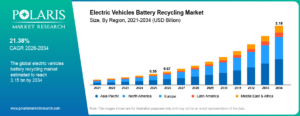
For years, the electric vehicle conversation has centered on what goes into a battery. A harder question is now rising up the agenda: what happens when it comes out? The electric vehicles battery recycling market was valued at USD 0.55 billion in 2025 and is projected to reach USD 3.15 billion by 2034, according to Polaris Market Research. It is small today, but it sits where automotive strategy, critical-mineral security and environmental regulation meet. Retired packs and factory scrap are becoming a raw-material source that automakers, cell producers and governments cannot ignore. The real issue is bigger than waste management: who will control the lithium, nickel and cobalt that tomorrow’s vehicles depend on?
The Industry Shift Behind EV Battery Recycling
Two forces are converging. The first is volume. As EV sales climb, so does the pipeline of batteries that will eventually need processing, and recyclers are expanding capacity and refining recovery techniques to prepare.
The second is regulation, which is turning good intentions into deadlines. Under the EU Batteries Regulation, recyclers must recover 90% of cobalt, copper and nickel by the end of 2027, and 50% of lithium. By the end of 2031 those figures rise to 95% and 80%. Mandatory digital battery passports arrive in February 2027, and minimum recycled-content rules for new batteries follow in 2031.
The message to the industry is that recovered material will soon be a compliance requirement, not a courtesy.
What the Market Means for Businesses
For manufacturers, recycling is becoming a question of supply strategy. Recovered metals offer a secondary source that can reduce exposure to mining and refining concentrated in a few countries. General Motors and its partners reached a milestone in September 2026, completing a pilot that built new EV cells with cathode active material made entirely from recycled nickel, cobalt and manganese. It shows how the loop can close.
The economics, though, are unforgiving. Special equipment, safety protocols, skilled labor and long-distance transport of spent packs all raise costs. Chemistry matters too. Lithium iron phosphate batteries contain no nickel or cobalt, so recyclers must lean on efficient lithium recovery to earn a return.
Opportunity is emerging at the edges. Second-life applications, such as stationary storage for buildings or renewable projects, reward companies that can test and grade used packs accurately. Early scrap is another opening. Production scrap held a 38.5% share in 2025 because factories generate known, traceable material immediately. End-of-life batteries, projected to grow at 24.3% annually, will take longer to arrive and depend on tracking packs after removal.
Regional Market Dynamics
Asia Pacific held 61.66% of the market in 2025, and the reasons are structural. China pairs a vast EV market with a mature battery manufacturing base and an established recovery network, while India’s expanding electric two-wheeler fleet is building future supply. Two-wheelers are projected to grow at 23.7% annually, helped by heavy commercial use and battery-swapping systems that return packs to a central point.
North America is projected to grow fastest among the major regions, at 22.6% annually. There, recycling is as much about supply security as sustainability, giving automakers and battery producers a domestic route to lithium and nickel. Europe, with 11.4% of the 2025 market, is shaped most by regulation, with Germany and France anchoring activity.
For businesses, the lesson is that there is no single global playbook. Volume favors Asia, policy pressure favors Europe, and strategic autonomy drives North America.