
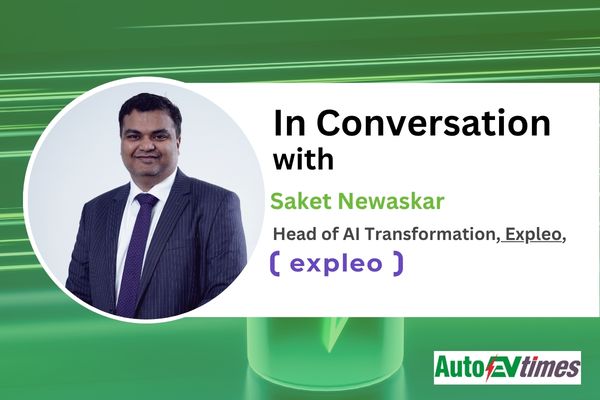
In an exclusive interview with AutoEV Times, Saket Newaskar, Head of AI Transformation, Expleo, discusses how the automotive industry is in the middle of a software revolution, with user expectations and digital engineering accelerating the shift toward intelligent, connected, and continuously evolving mobility systems.
Read the full interview here:
1. How is AI transforming the way automotive products are conceptualised, engineered, and continuously improved across their lifecycle?
Saket: The shift we are seeing today is really being driven by how people want to interact with their vehicles. Look at what happened in banking. Customers wanted to transfer money instantly, and the entire system evolved around that. Something similar is happening in the automotive industry, where the driver’s experience is now the product. Customers want personalisation, real-time responsiveness, software updates like smartphone updates, and an intuitive experience. The software-defined vehicle is the industry’s response to that demand.
What AI brings to this is the ability to shift from a one-time hardware delivery to a continuous software evolution model. In the concept phase, generative engineering tools allow teams to explore multiple design options early, reducing reliance on physical prototypes. During development, automated coding, intelligent debugging, and AI-driven scenario generation for ADAS testing significantly reduce timelines.
Post-launch, real-world data feeds back into engineering systems through over-the-air (OTA) updates, creating a continuous improvement loop.
Your vehicle today is no longer a finished product. It is a platform that keeps getting better.
2. How is data intelligence enabling real-time decision-making, safety, and long-term reliability in EVs and autonomous systems?
Saket: In the automotive world, a ton of data is generated throughout the entire process, from design and simulation to production and the way vehicles perform on the road. However, simply having raw data locked away doesn’t do much good. Its true power emerges only when that data is connected and made usable.
When it comes to real-time operations, the combination of information from cameras, radar, and lidar gives vehicles a clear picture of their surroundings, which is essential for advanced driver assistance systems (ADAS) and autonomous driving. By adding a predictive analytics layer to this data, manufacturers can foresee potential risks, allowing the vehicle to adapt with features such as automatic braking, steering adjustments, and route corrections. In electric vehicles specifically, the continuous data flow helps maximise battery efficiency, enhance driving range, and manage temperature levels effectively.
From a safety perspective, these systems can recognise unusual patterns and switch to safer modes when uncertainty arises, adhering to important standards such as ISO 26262 and SOTIF. The industry is witnessing significant change, through integrated platforms that unify engineering, vehicle, and customer data into a single, cohesive view. This is when data transforms from just a byproduct of operations into a proactive force that drives product decisions.
3. What makes India an increasingly strategic hub for global automotive and mobility innovation?
Saket: India is viewed as a strategic hub for global automotive and mobility innovation due to its unique mix of scale, speed, and talent. The country has been offering OEMs the platform to quickly build, test, and deploy solutions, with the benefit of having skilled workforces in AI, data engineering, and software development. The role of India is evolving; they are not merely executing tasks but are actively involved in architecture, validation, and AI platform development for global projects. The advancements in high-tech infrastructure and a more mature regulatory environment are further enhancing India’s attractiveness as an engineering and intelligence hub for the global automotive value chain. The evolution is intended towards strongly supporting Atmanirbhar and Viksit Bharat goals by prioritising indigenous capability development reducing reliance on imported technology.
4. How are AI-powered engineering tools helping automotive companies compress development timelines while adhering to safety, compliance, and quality benchmarks?
Saket: The sector has always experienced the pressure to deliver faster, often at the cost of quality. What’s changed is that AI is favouring the manufacturers to bridge this gap. With AI-assisted coding, automated test generation, and advanced simulations for crash, thermal, and battery performance, teams can explore a myriad of design options without needing to create a prototype for each. Take ADAS, for example. AI-driven scenario generation uncovers edge cases that traditional on-road testing often misses, and it also makes fixes to be simpler and cost-effective. Add to this digital factories and digital twins, which allow teams to model and optimise before deployment, reducing risk and improving decision-making. Interestigly, all of these aligns with compliance standards like ISO 26262 and ASPICE. The outcome: faster time-to-market without compromising safety or quality.
5. Predictive analytics is increasingly becoming a competitive differentiator. How can automotive players utilise it not just for failure prediction, but also for optimising performance, maintenance cycles, and customer experience?
Saket: That’s true. Predictive analytics has moved well beyond being a diagnostic tool to a real value creator for manufacturers. The advanced analytics capability helps improve energy efficiency and overall driving dynamics. Take electric vehicles, it helps in improving battery use and extending range. On the service side, we are shifting from routine standard check-ups to condition-based maintenance. With real-time monitoring early signs of wear or system issues can be spotted sooner, repairs can be planned smarter, downtime can be reduced and overall product reliability improves. For customers, this means smarter vehicles that adapt to individual preferences and provide timely alerts. Overall, predictive analytics is helping the automotive industry move from reactive to delivering an assured and more proactive, data-driven ownership experience.
6. As connected vehicle ecosystems expand, how can organisations balance innovation with responsible governance and sustainability goals?
Saket: As vehicles collect more and more data about their behaviour from how they are driven, having strong data governance becomes non-negotiable. Cybersecurity sits at the heart of it and measures like data encryption, secure communication, zero-trust architectures and continuous monitoring are essential to protect vehicle systems and user information. At the same time, ensuring AI models are transparent and reliable in every safety-critical situation. This is where AI assurance comes in, making sure the AI systems meet regulatory, safety and ethical standards.
Data governance is critical with clear rules around ownership, access and consent. On the sustainability side, the rapid growth of electric vehicles and battery manufacturing brings new engineering challenges. AI is helping here too, optimising battery chemistry, improving factory yields and reducing waste, all of which directly support ESG goals.
The takeaway is simple: ethics, AI assurance, and sustainability enable innovation to scale with confidence.
Engineering builds the product, but intelligence is what keeps it relevant.