The most critical technology in modern electric vehicles remains largely invisible to consumers, rarely mentioned in marketing materials, and often overlooked in enthusiast discussions focused on horsepower, acceleration, and driving range specifications. Yet thermal management—controlling heat generation, transfer, and dissipation throughout the vehicle—may be more important to EV success than any other single engineering factor. Understanding this becomes immediately apparent when examining real-world EV ownership experiences. It determines whether a battery pack delivers promised range in winter conditions or loses 40% of its capacity. It defines whether a vehicle can sustain high performance driving without thermal throttling reducing power mid-acceleration. It ultimately determines whether an EV battery lasts a decade or fails prematurely, transforming a $10,000 component into expensive waste. The difference between excellent thermal management and poor thermal design represents the gap between vehicles that owners love and vehicles they regret purchasing.
The thermal management challenge in electric vehicles is fundamentally different from thermal management in traditional internal combustion engine vehicles. Gasoline engines waste approximately 60% of fuel energy as heat, creating an enormous thermal challenge requiring sophisticated cooling systems. Ironically, this waste heat enabled simple cabin heating—opening a valve to engine coolant warmed the cabin efficiently. Electric vehicles waste far less energy as heat in their drivetrain (motors are 85-95% efficient compared to engines at 30-35%), creating less waste heat but simultaneously eliminating the convenient heat source for cabin warming.
More critically, EV batteries are thermally sensitive in ways internal combustion engines are not. Temperature directly affects battery chemistry fundamentally. Every 10°C increase in operating temperature reduces lithium-ion battery lifespan by approximately 50%, according to Arrhenius equation modeling of battery chemistry. A battery operating at 25°C might retain 90% of capacity after 10 years; that same battery at 35°C might retain only 75% capacity. A battery at 45°C might degrade to 60% capacity in the same timeframe. This thermal sensitivity means that thermal management directly translates to battery longevity and vehicle value retention.
Furthermore, cold weather fundamentally impairs battery performance. Lithium-ion cell chemistry exhibits dramatically reduced power output and energy availability at low temperatures. A battery pack at 0°C might deliver only 70% of its nominal power and 80% of its nominal energy capacity. At -20°C, these figures might drop to 50% and 60% respectively. For EVs operating in northern climates, thermal management directly determines whether vehicles are usable during winter months.
The engineers designing EV thermal management systems face extraordinarily complex challenges: maintaining battery packs in an optimal temperature window (typically 15-35°C) during both charging and discharging, warming frozen batteries for winter operation, cooling overheating batteries during fast charging or aggressive driving, managing motor heat during continuous high-power operation, and conditioning cabin air without waste engine heat. Since every watt used for thermal management reduces range, engineers must carefully balance thermal needs against efficiency requirements.
This article examines thermal management technologies, strategies, and trade-offs defining next-generation EV performance and reliability.
The Thermal Challenges Unique to Electric Vehicles
To understand EV thermal management solutions, we must first understand the unique thermal challenges that EVs face, quite distinct from traditional automotive thermal problems and requiring fundamentally different engineering approaches.
Battery Chemistry and Temperature Sensitivity
Lithium-ion batteries are chemical systems where temperature directly affects reaction rates. The fundamental electrochemistry enabling charge storage and release—lithium ions moving between anode and cathode through electrolyte—operates faster at higher temperatures. This seems beneficial, but it comes with severe consequences for battery longevity. The relationship between temperature and battery degradation follows well-established chemical kinetics principles where higher temperatures accelerate undesired side reactions exponentially.
Higher temperatures accelerate unwanted side reactions: the solid electrolyte interphase (SEI) layer degrading, electrolyte decomposition, structural changes in cathode and anode materials, and other chemical processes that irreversibly reduce battery capacity. These degradation mechanisms operate exponentially with temperature. Industry data consistently shows battery capacity retention following degradation curves where every 10°C increase roughly halves remaining lifespan. A battery operating at 25°C retains approximately 85-90% capacity after 8 years, while the same battery at 35°C retains 75-80% capacity. At 45°C, capacity retention drops to 60-70%. For battery packs costing $10,000-$15,000, these differences represent vehicle viability and resale value.
Cold Weather Performance Degradation
The opposite extreme—cold temperatures—presents equally severe challenges through different mechanisms. Lithium-ion batteries rely on ion movement through electrolyte for charge transfer. At low temperatures, electrolyte viscosity increases dramatically, reducing ion mobility. Additionally, charge transfer resistance at electrode interfaces increases exponentially. A battery delivering 300 kW at 25°C might deliver only 150 kW at 0°C and 75 kW at -20°C. Energy capacity reduction is equally severe. A vehicle with 400 km range at 25°C might provide 300 km at 0°C and only 200 km at -20°C. For northern climate users, this represents lived experience, not theory.
Fast Charging Thermal Stress
Fast charging—delivering high power into batteries in short timeframes—creates extraordinary thermal stress. A 250 kW charger means approximately 50-60 kW converts to heat within the battery due to internal resistance, causing temperatures to rise 1-2°C per minute if unmanaged. Left unchecked, fast charging can drive battery temperatures into dangerous zones (above 55-60°C) within minutes. High temperatures during charging are particularly damaging because they combine high current flows with elevated temperatures—the worst condition for battery degradation. Manufacturers must carefully limit fast charging power, reducing charging speed. Thermal management enables faster charging by actively cooling batteries while maintaining safe temperatures.
Motor and Power Electronics Thermal Challenges
Beyond batteries, electric motors and power electronics (inverters, DC-DC converters) generate substantial heat that must be managed continuously. Modern EV motors operate at high efficiency (85-95%), but the 5-15% of input energy that doesn’t produce propulsion becomes heat that accumulates in motor windings. A motor producing 200 kW of power continuously might generate 15-30 kW of waste heat. Power electronics converting power between different voltages and managing charging can generate 5-10 kW of additional waste heat.
This heat must be removed continuously during operation to prevent catastrophic failure. Motor windings have maximum temperature limits (typically 130-150°C for insulation limits). Semiconductor junctions in power electronics have similar limits around 125-150°C. Exceeding these limits causes irreversible degradation or immediate failure. Furthermore, these components must operate at specific temperatures for optimal efficiency—motor efficiency varies slightly with winding temperature, and power electronics efficiency similarly depends on junction temperature. Maintaining optimal temperatures requires active thermal management, not passive heat dissipation alone.
Cabin Climate Control Without Waste Heat
Traditional vehicles solved cabin heating trivially and elegantly: engine coolant flows through a heater core, cabin air passes through the core, and cabin air is warmed by engine waste heat with no additional energy consumption beyond the tiny fan motor. This simple approach worked because engines generate enormous waste heat requiring dissipation anyway. The heating system essentially achieved energy for free as a byproduct of engine operation inefficiency.
EVs cannot use this approach—they don’t have engine waste heat to leverage for cabin heating. This represents one of the most underappreciated thermal challenges in EV design. Cabin heating must come from one of three primary sources: resistive heaters (electric resistors converting electricity directly to heat, effective but energy-intensive, consuming 5-7 kW of power continuously and directly reducing driving range by 15-25% in cold climates), heat pump systems (using refrigeration cycle principles to extract heat from outdoor air and transfer to cabin air with coefficient of performance of 2-3, delivering multiple units of heat output for each unit of electrical input), or waste heat recovery from motors and batteries (capturing otherwise-wasted heat and redirecting it to cabin climate control systems).
Modern premium EVs increasingly use sophisticated heat pump systems because they enable winter operation without excessive range loss compared to resistive heating alone. A heat pump reduces heating energy consumption by 40-50% compared to resistive heating, translating to 5-10% range improvement in winter conditions. For northern climate customers, this efficiency improvement justifies the $2,000-$3,000 added system cost through reduced electricity consumption over vehicle ownership lifetime.
Passive vs. Active Thermal Management Trade-offs
Early EVs like the Nissan Leaf used passive battery cooling—batteries dissipate heat to ambient air through cell-to-cell contact. Passive cooling is mechanically simple with no parasitic power consumption but cannot remove heat faster than ambient temperature differential allows, limiting charging speed and performance driving duration.
Modern EV designers recognize that active cooling’s modest parasitic power consumption (typically 500-2000 watts) provides substantial benefits by enabling faster charging, higher continuous power delivery, and extending battery lifespan. The range loss from active cooling (2-5%) is far outweighed by benefits in charging speed, performance, and battery longevity. The mathematics clearly favor active thermal management for most use cases.
Liquid Cooling Systems: The Industry Standard
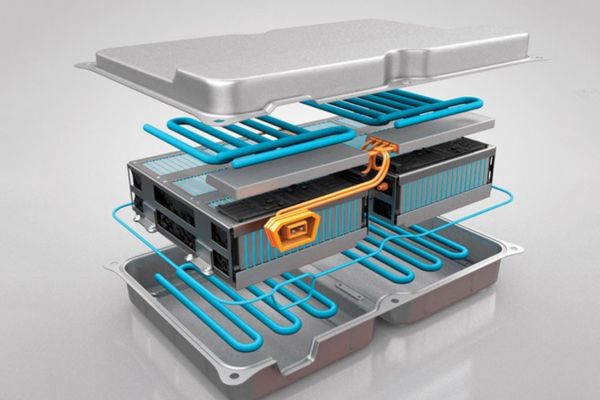
The majority of modern EVs employ liquid cooling systems for batteries, where specialized heat transfer fluid circulates through cooling channels integrated into battery packs. This approach offers several advantages: rapid heat removal at 50-100 kW rates, uniform temperature distribution through strategic channel routing, active temperature control via thermostatic valves and intelligent pump management, and integrated system efficiency enabling waste heat recovery.
Advanced Coolant Formulations and Materials
The heat transfer fluids used in EV cooling systems are highly engineered materials balancing competing requirements: thermal conductivity, electrical insulation properties, chemical stability over vehicle lifespans, appropriate viscosity for channel flow, and temperature compatibility from -40°C to +60°C. Manufacturers develop proprietary coolant formulations, with Tesla using custom glycol-water mixtures and Volkswagen developing proprietary formulations for MEB platforms.
Thermoelectric Cooling: Supplementary Technology
Some advanced EV thermal systems supplement liquid cooling with thermoelectric (Peltier) coolers—solid-state devices transferring heat with electrical current. These offer precise local cooling without moving parts, but suffer from lower efficiency with coefficient of performance of 0.5-1.5, making them useful for supplementary rather than primary cooling.
Heat Recovery and Integrated Thermal Systems
The most advanced EV thermal systems intelligently recover waste heat from motors and power electronics—typically 10-50 kW depending on driving conditions and power output—and redistribute it strategically to battery preheating in cold weather, cabin heating, or fast charging thermal management. This waste heat recovery represents one of the most effective efficiency improvements available, improving overall winter efficiency by 10-15% compared to systems without recovery. A vehicle driving on a cold winter highway can capture motor waste heat and redirect it to both battery thermal conditioning and cabin climate control, achieving dual benefits from a single heat source.
Advanced EV thermal systems employ integrated networks where multiple thermal loops interconnect with intelligent control systems managing heat distribution dynamically based on real-time conditions. High-temperature loops cool power electronics and motors at 40-60°C, medium-temperature loops manage battery cooling at 20-35°C, and low-temperature loops handle cabin climate control between 16-22°C. Intelligent thermal management systems transfer heat between loops using predictive algorithms that anticipate upcoming driving patterns, machine learning optimization based on historical vehicle data, and real-time thermal sensing from hundreds of temperature sensors distributed throughout the vehicle. This level of sophistication represents a remarkable engineering achievement, coordinating thermal flows across multiple systems through sophisticated software control algorithms that adjust thermal management strategy continuously as conditions change.
Cold Weather Thermal Management: Winter Performance Solutions
Preconditioning: Warming Before Departure
The simplest cold weather solution is preconditioning—warming the battery and cabin while connected to charging infrastructure. This requires 10-30 minutes depending on ambient temperature, but results in vehicles achieving 85% of rated range in -20°C conditions versus only 65-70% for unprepared vehicles.
Heat Pump Systems for Winter Efficiency
Modern EV heat pumps operate by circulating cold refrigerant through outdoor heat exchangers to absorb ambient air heat, compressing it to increase temperature, transferring heat to cabin air through condensers, and depressurizing through expansion valves. This achieves coefficient of performance of 2-3, translating to 20-30% range improvements in winter conditions, justifying added costs of $1,500-$3,000.
Battery Pack Insulation and Thermal Barriers
Cold weather performance improvements employ passive thermal management through aerogel insulation surrounding battery packs, thermal barriers separating cold components from sensitive ones, and enclosed underbody designs shielding batteries from cold airflow.
Immersion and Direct Cell Cooling
Next-generation thermal management approaches submerge battery cells directly in specialized heat transfer fluids, enabling more efficient cooling than conventional systems. Immersion cooling offers advantages: intimate contact between fluid and cell surfaces, uniformly distributed temperatures eliminating thermal gradients, and simplified packaging. However, challenges include fluid selection (must be electrically insulating while thermally conductive), component compatibility (electrical connections must be immersion-resistant), and fluid management (thermal expansion requires careful design). BMW and others have deployed immersion cooling in research vehicles. Future production systems may expand this technology as compatibility improves.
Motor cooling approaches include oil cooling through motor housings, where cooling fluid circulates through motor end housings or directly sprays windings to transfer heat efficiently, water jacket cooling integrating channels into housings for heat transfer to the main cooling loop, and advanced hairpin winding designs with higher surface-area ratios enabling better dissipation. Modern EV motors designed specifically for electric applications incorporate thermal design principles absent in traditional automotive motors. Advanced power electronics employ silicon carbide (SiC) semiconductors that operate at higher temperatures while generating significantly less heat compared to conventional silicon components, improving overall thermal efficiency and reducing cooling system complexity. Gallium nitride (GaN) semiconductors represent the cutting edge of power electronics innovation, offering superior efficiency and temperature tolerance compared to SiC. These advanced semiconductor technologies enable reduced cooling system complexity and parasitic power consumption, representing the frontier of power electronics thermal innovation for next-generation vehicles.
Thermal Management System Complexity and Cost Trade-offs
Sophisticated thermal management adds significant complexity and cost to vehicles, creating engineering trade-offs manufacturers must carefully navigate. A comprehensive liquid cooling system for batteries, motors, and power electronics adds $2,000-$5,000 to vehicle cost depending on sophistication level and integration depth. Heat pump climate control systems add $1,500-$3,000 to total vehicle cost. Advanced thermal sensors and real-time control electronics add an additional $500-$1,500. Total comprehensive thermal management system cost for premium implementations can reach $4,000-$9,500.
These investments create fundamental engineering trade-offs between performance and efficiency, cost and capability, and complexity and reliability. More aggressive cooling improves continuous performance but increases parasitic power consumption. Advanced thermal systems provide better winter performance and battery longevity but introduce additional failure points and complexity. Greater packaging efficiency and cooling capacity sometimes requires careful space optimization that constrains other vehicle design choices. For mass-market EVs targeting lower price points, manufacturers often implement simplified thermal systems: passive battery cooling with limited liquid cooling for motors, resistive heating instead of heat pumps, and basic thermal sensors. This approach reduces system cost to $1,000-$2,000 but compromises cold weather performance and battery longevity. These trade-off decisions explain why thermal management varies substantially across EV manufacturers worldwide.
Real-World Thermal Performance: Case Studies
Tesla’s comprehensive thermal management enables winter performance rivaling warmer climates more effectively than competitors. Published data from independent testers shows that preheated Tesla vehicles in -20°C conditions achieve approximately 85% of rated range, while unprepared vehicles achieve only 65-70% of rated range. Tesla’s sophisticated thermal management enables 250 kW charging even in sub-zero temperatures, while competitors often reduce charging to 100-150 kW in cold weather conditions. Models equipped with heat pumps achieve 25-30% range improvement in winter driving compared to resistive heating models. Tesla’s investment in thermal management engineering—custom coolants, integrated thermal networks, and predictive preconditioning algorithms—demonstrates the business case: customers perceive strong winter performance as core competitive advantage.
Volkswagen’s MEB platform incorporates sophisticated thermal management from first engineering principles. The platform features automatic battery thermal preconditioning when fast charging is approached, enabled by real-time navigation awareness that predicts charger arrival. Integrated thermal loops enable motor waste heat recovery and integrated cabin conditioning. Independent testing shows ID.4 vehicles delivering approximately 80% of rated range in -10°C driving versus 70-75% for competitors without sophisticated thermal management. This 5-10% difference translates to 20-30 km of additional practical winter range—meaningful for real-world daily usability and customer satisfaction.
Chinese manufacturers designing vehicles entirely for modern EV architectures without legacy internal combustion engine constraints have aggressively innovated in thermal management. BYD’s blade batteries incorporate integrated thermal channels achieving excellent temperature uniformity. NIO’s mobile application enables remote battery preconditioning, critical for cold climate customers. Li Auto demonstrates sophisticated waste heat recovery from internal combustion engines complementing electric motor waste heat capture.
Future Thermal Management Technologies: Next Frontiers
Advanced thermal materials are enabling dramatic improvements in thermal performance. Graphene-enhanced cooling fluids incorporate nanoparticles of graphene that enhance thermal conductivity of cooling fluids while maintaining electrical insulation properties critical for safety. Phase change materials use capsules containing materials that absorb heat at specific temperature thresholds and release it as temperatures drop, providing thermal buffering and reducing temperature fluctuations within battery packs. Ceramic thermal management materials with high thermal conductivity are finding application in thermal interface materials and insulation components, improving overall system efficiency.
Solid-state batteries, discussed extensively in EV development, will have different thermal characteristics than conventional lithium-ion batteries. Solid electrolytes enable higher operating temperatures with less degradation compared to liquid electrolytes, potentially simplifying thermal management requirements. However, solid-state batteries present new thermal management challenges including interface thermal resistance at boundaries between solid electrolyte and electrodes, and manufacturing process sensitivity to temperature variations. Thermal management for solid-state batteries will likely focus on maintaining optimal manufacturing conditions and managing novel thermal phenomena emerging from solid electrolyte chemistry.
Artificial intelligence and machine learning are enabling thermal management optimization impossible with conventional control algorithms. Predictive thermal management systems use neural networks trained on historical vehicle data to predict thermal states minutes or hours in advance, enabling proactive cooling and heating rather than reactive responses. Route-aware thermal optimization integrates with navigation systems to optimize thermal management based on anticipated driving profiles—aggressive acceleration requires different thermal strategy than highway cruising. Vehicle-to-vehicle learning enables fleet data from millions of vehicles worldwide to continuously improve thermal models, with Tesla and other connected vehicle manufacturers leveraging anonymized data for global thermal optimization.
Integration with Autonomous Driving
As autonomous driving capabilities advance, entirely new thermal management opportunities emerge. Autonomous systems can modulate acceleration and speed profiles to optimize thermal management, maintaining battery temperature in optimal windows throughout journeys. Autonomous vehicles can intelligently schedule battery preconditioning based on predicted usage patterns, ensuring vehicles are thermally prepared for upcoming driving. Thermal-aware route planning can incorporate thermal considerations into navigation algorithms, avoiding aggressive acceleration patterns in hot weather while favoring efficient driving profiles in cold conditions to optimize battery thermal state.
Thermal management represents one of the most critical and often-overlooked engineering challenges in electric vehicle development. The sophistication of thermal systems in modern EVs rivals powertrain complexity, with integrated networks incorporating battery cooling, motor thermal management, power electronics cooling, cabin climate control, and waste heat recovery coordinated by real-time thermal control algorithms. The difference between thermal management excellence and mediocrity translates directly to winter driving capability, rapid charging speed, sustained continuous performance, and long-term battery longevity.
For consumers evaluating EVs, thermal management deserves equal attention to battery size and motor power. A vehicle with sophisticated thermal management delivers superior winter performance, longer battery lifespan, and better long-term value than competitors with equivalent specifications but mediocre thermal systems. Understanding thermal management is understanding what truly separates capable EVs from vehicles merely claiming electric motivation. The EV revolution will be won or lost in thermal management systems operating throughout vehicles, maintaining optimal temperatures, and enabling performance and longevity upon which EV adoption depends.