Electric Vehicle Charging Station Market Surges Amid Global EV Boom and Smart Infrastructure Revolution
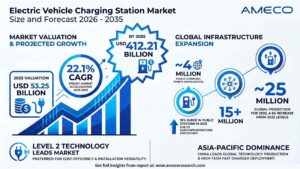
According to insights published by Ameco Research, the Global Electric Vehicle Charging Station Market Report projects the market will grow from USD 53.25 billion in 2025 to nearly USD 412.21 billion by 2035, registering a robust CAGR of 22.1% during the forecast period.
The global automotive industry is entering a defining era of electrification, where sustainability, digitalization, and energy innovation are reshaping the future of transportation. At the center of this transformation lies the rapidly expanding Electric Vehicle Charging Station Market, a critical ecosystem enabling the large-scale adoption of electric vehicles worldwide.
As governments tighten emission regulations and consumers increasingly shift toward cleaner mobility solutions, charging infrastructure has emerged as one of the most strategic investments in the global energy transition. From ultra-fast charging highways to smart urban charging hubs, the evolution of EV charging networks is accelerating at an unprecedented pace.
This explosive expansion reflects how EV charging infrastructure is no longer just a support system for electric mobility—it is becoming a foundational pillar of future smart cities and sustainable transportation ecosystems.
Why the Electric Vehicle Charging Station Market Is Expanding Rapidly
The primary driver behind the rapid growth of the Electric Vehicle Charging Station Market is the accelerating global adoption of electric vehicles across passenger, commercial, and public transportation segments.
Countries worldwide are aggressively promoting EV adoption through:
- Tax incentives
- Vehicle subsidies
- Zero-emission mandates
- Green mobility initiatives
- Fuel economy regulations
- Investments in clean energy infrastructure
At the same time, rising fuel prices and increasing consumer awareness about climate change are encouraging a massive transition away from traditional internal combustion engine vehicles.
The International Energy Agency (IEA) estimates that public charging stations globally could exceed 15 million by 2030 under current policy scenarios.
This growing dependence on charging infrastructure is creating enormous opportunities for companies operating within the Electric Vehicle Charging Station Market Analysis landscape.
Smart Charging Infrastructure Is Becoming the New Standard
One of the most significant Electric Vehicle Charging Station Market Trends is the rapid evolution from conventional charging systems to smart charging ecosystems.
Modern EV charging stations are increasingly integrated with advanced digital technologies such as:
- Artificial intelligence (AI)
- Internet of Things (IoT) connectivity
- Cloud-based energy management
- Mobile payment systems
- Predictive maintenance software
- Vehicle-to-grid (V2G) integration
Smart charging enables utilities to optimize electricity consumption while minimizing pressure on power grids during peak hours.
These intelligent systems are also improving user convenience by offering:
- Real-time charger availability
- Remote monitoring
- Dynamic pricing
- Faster authentication
- Energy usage analytics
As urban populations rise and smart city projects expand globally, smart charging technologies are expected to play a major role in the future of the Electric Vehicle Charging Station Market Growth trajectory.
DC Fast Charging Is Revolutionizing EV Mobility
Another transformative trend shaping the Electric Vehicle Charging Station Market Size is the growing deployment of DC fast charging infrastructure.
While Level 1 and Level 2 chargers remain essential for residential and workplace charging, consumers increasingly demand rapid charging solutions that minimize downtime during travel.
DC fast chargers can recharge EV batteries up to 80% within approximately 20–30 minutes, significantly reducing range anxiety for drivers.
Governments and private companies are aggressively investing in highway fast-charging corridors to support long-distance EV travel.
The market is witnessing increasing deployment of:
- 150 kW chargers
- 250 kW chargers
- 350 kW ultra-fast charging systems
This shift is especially critical for:
- Commercial fleet operators
- Electric buses
- Logistics companies
- Ride-sharing platforms
- Intercity transportation networks
As battery technologies improve and charging times decrease, fast-charging infrastructure will become one of the strongest competitive differentiators in the Electric Vehicle Charging Station Market Share landscape.
Case Study: Tesla’s Supercharger Network Driving Industry Standards
One of the most influential examples in the global Electric Vehicle Charging Station Market is Tesla’s Supercharger ecosystem.
Tesla has transformed charging infrastructure from a support utility into a powerful competitive advantage. The company’s global Supercharger network now spans thousands of stations across North America, Europe, Asia-Pacific, and emerging markets.
Tesla’s strategy focused on solving one of the biggest barriers to EV adoption—range anxiety.
Key highlights of Tesla’s charging infrastructure strategy include:
- High-speed DC fast charging deployment
- Seamless app integration
- Proprietary software optimization
- Strategic highway corridor placement
- Expansion into third-party EV compatibility
The company’s decision to gradually open parts of its Supercharger network to non-Tesla vehicles is also reshaping industry interoperability standards.
Industry analysts believe Tesla’s infrastructure-first approach significantly accelerated consumer confidence in EV ownership globally. This case demonstrates how charging accessibility can directly influence EV market penetration and long-term consumer adoption.
Asia-Pacific Continues Dominating the Market
The Asia-Pacific region currently commands the largest Electric Vehicle Charging Station Market Share, primarily driven by China’s aggressive electrification policies and infrastructure investments.
China remains the world’s largest EV market and has built one of the most extensive public charging networks globally.
The region’s growth is fueled by:
- Strong government subsidies
- Domestic EV manufacturing leadership
- Urban air pollution concerns
- Expansion of public charging corridors
- Smart city initiatives
In Southeast Asia, companies are also rapidly expanding cross-border EV charging networks.
According to industry reports, Charge+ launched a 5,000-kilometer EV charging highway across Singapore, Malaysia, Thailand, Cambodia, and Vietnam, establishing one of Southeast Asia’s largest interconnected charging corridors.
India is also emerging as a high-potential market due to rising fuel costs, urban congestion, and increasing government support for EV adoption.
Case Study: ChargePoint Expands Intelligent Charging Ecosystems
Another notable development within the Electric Vehicle Charging Station Market Trends ecosystem is the strategic expansion of ChargePoint.
ChargePoint has emerged as one of the world’s leading EV charging network providers by focusing heavily on cloud-based charging management solutions and scalable commercial infrastructure.
The company’s strategy includes:
- Smart fleet charging platforms
- AI-enabled charging optimization
- Commercial workplace charging systems
- Subscription-based charging services
- Software-driven energy management
Unlike traditional infrastructure providers, ChargePoint positioned itself as both a hardware and software ecosystem player.
This business model has enabled the company to build recurring revenue streams while supporting enterprises transitioning toward electric mobility.
ChargePoint’s partnerships with automakers, fleet operators, retailers, and municipalities illustrate how collaboration is becoming essential for scaling the global Electric Vehicle Charging Station Market efficiently.
Renewable Energy Integration Is Reshaping Charging Infrastructure
One of the most promising Electric Vehicle Charging Station Market Trends involves integrating renewable energy systems with EV charging stations.
Solar-powered charging stations are becoming increasingly popular as businesses and governments seek to reduce dependency on fossil-fuel-generated electricity.
Renewable-integrated charging systems offer several advantages:
- Reduced operating costs
- Lower carbon emissions
- Improved grid resilience
- Energy independence
- Sustainable charging ecosystems
Battery storage integration is also gaining traction, enabling charging stations to store excess renewable power during low-demand periods.
This evolution aligns with broader global net-zero emission goals while improving long-term infrastructure sustainability.
North America and Europe Intensify Infrastructure Investments
North America is witnessing substantial growth in the Electric Vehicle Charging Station Market Analysis landscape due to rising EV sales and major public-private infrastructure partnerships.
The United States government continues investing heavily in nationwide EV charging corridors to improve accessibility and accelerate transportation electrification.
Similarly, Europe remains a major growth engine for EV charging deployment.
Countries including:
- Germany
- Norway
- France
- Netherlands
- United Kingdom
are aggressively expanding public charging networks while implementing ambitious carbon neutrality targets.
The European Union’s push toward banning internal combustion engine vehicles in the coming decades is expected to further strengthen long-term market demand.
Commercial Charging Infrastructure Becoming a High-Growth Segment
Commercial charging infrastructure is emerging as one of the fastest-growing areas within the Electric Vehicle Charging Station Market Growth ecosystem.
Businesses are increasingly deploying EV charging stations across:
- Shopping malls
- Airports
- Hotels
- Corporate offices
- Retail chains
- Parking facilities
- Residential complexes
Commercial fleet electrification is also creating significant opportunities for dedicated charging depots.
Electric buses, delivery fleets, ride-sharing vehicles, and logistics operations require large-scale charging capabilities that can support high daily vehicle utilization rates.
This trend is expected to generate strong revenue opportunities for charging infrastructure providers over the next decade.
Emerging Technologies Will Define the Future Market
The future of the Electric Vehicle Charging Station Market will be heavily influenced by technological innovation.
Several emerging technologies are expected to reshape the industry, including:
Wireless Charging
Wireless EV charging systems could eliminate cables entirely, improving convenience and reducing urban infrastructure clutter.
Vehicle-to-Grid (V2G)
V2G technology enables EVs to send stored electricity back into the grid during peak demand periods, effectively transforming vehicles into mobile energy assets.
AI-Based Predictive Maintenance
AI-powered systems can identify charger failures before they occur, minimizing downtime and improving operational efficiency.
Autonomous Charging Systems
As autonomous vehicles evolve, robotic charging systems may become increasingly important for fully automated transportation ecosystems.
These innovations are likely to create new competitive opportunities while accelerating the long-term evolution of the Electric Vehicle Charging Station Market Size.
Challenges Still Impacting the Market
Despite impressive expansion, several barriers continue affecting the global Electric Vehicle Charging Station Market.
High Infrastructure Costs
Building large-scale fast-charging networks requires significant investments in hardware, land acquisition, electrical upgrades, and maintenance.
Grid Capacity Constraints
Rapid EV adoption may strain electricity grids, especially in densely populated urban regions.
Interoperability Challenges
Different charging standards and connector types across regions continue creating compatibility issues for consumers.
Uneven Rural Infrastructure Deployment
While urban charging infrastructure is expanding rapidly, many rural regions still lack sufficient charging accessibility.
However, continued government support and technological innovation are expected to gradually address these challenges.
Future Outlook of the Electric Vehicle Charging Station Market
The long-term outlook for the Electric Vehicle Charging Station Market remains exceptionally strong.
As EV adoption accelerates globally, charging infrastructure will become increasingly essential to:
- Sustainable transportation
- Smart city ecosystems
- Renewable energy integration
- Energy storage networks
- Autonomous mobility systems
Analysts at Ameco Research anticipate charging stations will evolve into intelligent energy hubs capable of supporting multiple transportation and grid management functions simultaneously.
According to Ameco Research insights, the market’s projected expansion toward USD 412.21 billion by 2035 reflects the extraordinary pace of transformation currently reshaping global mobility infrastructure.
The global transition toward electric mobility is creating unprecedented momentum within the Electric Vehicle Charging Station Market. As governments, automakers, utilities, and technology companies intensify investments in charging infrastructure, the market is entering a period of sustained long-term growth.
From smart charging systems and ultra-fast charging corridors to renewable-powered charging hubs and AI-driven infrastructure management, the industry is rapidly evolving beyond conventional energy delivery models.
The next decade will likely determine how effectively countries can scale charging ecosystems to support mass EV adoption and achieve global decarbonization goals.