Market Summary
According to our Growth Market Report, the global DC Fast Charging Station market size reached USD 8.3 billion in 2024, demonstrating robust expansion fueled by the accelerating adoption of electric vehicles (EVs) worldwide. The market is projected to exhibit a remarkable CAGR of 21.7% from 2025 to 2033, with the total market size forecasted to reach USD 59.9 billion by 2033. This unprecedented growth is primarily driven by increasing environmental regulations, substantial investments in EV infrastructure, and rising consumer demand for rapid, convenient charging solutions across major economies.
Introduction
The DC Fast Charging Station Market has emerged as one of the most critical pillars supporting the global transition toward electric mobility. As electric vehicles (EVs) become increasingly mainstream, the demand for rapid, reliable, and accessible charging infrastructure continues to accelerate. Unlike conventional charging systems, DC fast charging stations significantly reduce charging times, enabling drivers to recharge their vehicles within minutes rather than hours. This capability is reshaping transportation ecosystems, enhancing consumer confidence, and accelerating the adoption of sustainable mobility solutions worldwide.
The expansion of fast-charging networks is no longer merely a convenience; it has become a strategic necessity for governments, businesses, and energy providers seeking to build a low-carbon future.
What Are DC Fast Charging Stations?
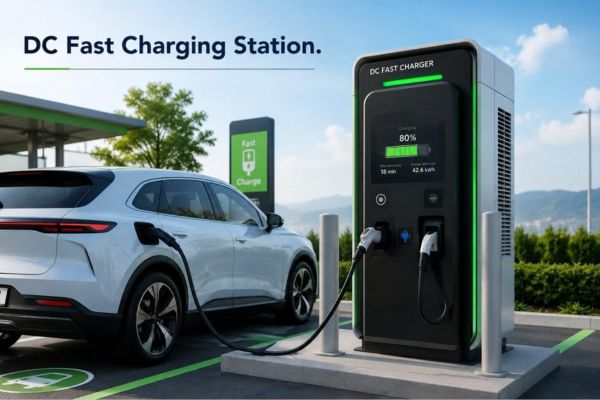
DC fast charging stations are advanced charging systems that deliver direct current (DC) electricity directly to an electric vehicle’s battery. Unlike AC chargers, which rely on the vehicle’s onboard converter to transform electricity, DC chargers bypass this process and supply power directly, resulting in substantially faster charging speeds.
Modern DC fast chargers can replenish a significant portion of an EV battery in less than 30 minutes, depending on battery capacity and charger output. These stations are commonly found along highways, urban transit hubs, commercial centers, and fleet depots where minimizing vehicle downtime is essential.
Why Is the DC Fast Charging Station Market Growing Rapidly?
The market’s rapid growth stems from a combination of technological, environmental, and economic factors. Governments worldwide are implementing ambitious carbon-reduction targets and promoting EV adoption through incentives, infrastructure investments, and regulatory frameworks.
At the same time, automotive manufacturers are launching a wider variety of electric vehicles with longer driving ranges and improved battery technologies. As EV ownership expands, consumers increasingly expect charging experiences comparable to conventional refueling, driving demand for ultra-fast charging solutions.
Furthermore, rising fuel prices and growing awareness of environmental sustainability continue to motivate both individual consumers and commercial fleet operators to transition toward electric transportation.
The Role of Fast Charging in Eliminating Range Anxiety
One of the most significant barriers to EV adoption has traditionally been range anxiety—the concern that a vehicle may run out of battery power before reaching a charging point.
DC fast charging stations directly address this challenge by enabling rapid energy replenishment during long-distance travel. Drivers can charge their vehicles during short breaks, making electric mobility practical for daily commuting as well as intercity transportation.
As charging networks become denser and more strategically located, consumer confidence continues to rise, encouraging broader EV adoption across diverse geographic regions.
Key Technologies Transforming the Industry
Ultra-High-Power Charging Systems
Charging technology is evolving rapidly, with manufacturers introducing systems capable of delivering hundreds of kilowatts of power. These ultra-high-power chargers significantly reduce charging durations and support next-generation electric vehicles equipped with advanced battery architectures.
Smart Charging and Digital Connectivity
Modern charging stations increasingly incorporate intelligent software platforms that optimize energy distribution, monitor station performance, and provide real-time availability updates to drivers.
Connected charging infrastructure improves user convenience while enabling operators to maximize efficiency and reduce operational costs.
Renewable Energy Integration
Many charging operators are integrating solar power, wind energy, and battery storage systems into charging networks. This approach helps reduce grid dependence while enhancing the environmental benefits of electric transportation.
The combination of renewable energy and fast charging creates a more sustainable and resilient energy ecosystem.
Commercial Opportunities Across Industries
The DC Fast Charging Station Market extends far beyond passenger vehicles. Numerous industries are recognizing the strategic value of rapid charging infrastructure.
Public Transportation
Electric buses require fast charging capabilities to maintain operational schedules and maximize fleet utilization. Municipal transit authorities are increasingly deploying high-capacity charging hubs to support electrified transportation systems.
Logistics and Freight
E-commerce growth has accelerated demand for electric delivery vehicles and commercial fleets. Fast charging stations help logistics companies minimize downtime and improve operational efficiency.
Retail and Hospitality
Shopping centers, restaurants, hotels, and entertainment venues are installing charging stations to attract EV-driving customers. Charging services are evolving into valuable customer engagement tools that enhance visitor experiences and generate additional revenue opportunities.
Challenges Facing the Market
Despite strong growth prospects, several challenges remain.
High installation costs continue to pose barriers for some operators. Fast charging stations require substantial electrical infrastructure, grid upgrades, and ongoing maintenance investments.
Power grid capacity is another important consideration. As charging demand increases, utilities must modernize infrastructure to ensure reliable energy delivery without compromising grid stability.
Additionally, standardization across charging technologies, connectors, and payment systems remains an ongoing industry objective.
How Artificial Intelligence Is Enhancing Charging Networks
Artificial intelligence is becoming increasingly important in charging infrastructure management. AI-powered platforms can predict charging demand, optimize station utilization, and improve maintenance scheduling.
Predictive analytics helps operators identify potential equipment failures before they occur, reducing downtime and improving customer satisfaction.
AI also enables dynamic energy management strategies that balance electricity demand, reduce operational expenses, and support grid stability.
The Future Outlook of the DC Fast Charging Station Market
According to our Growth Market Report, The future of the DC Fast Charging Station Market is closely linked to the global electrification of transportation. As battery technologies improve and charging speeds continue to increase, charging experiences will become faster, more seamless, and more convenient.
Future charging ecosystems may include autonomous charging solutions, wireless charging technologies, vehicle-to-grid integration, and AI-driven energy optimization. These innovations will transform charging infrastructure from a simple utility service into an intelligent component of the broader energy and transportation network.