According to our Growth Market Report, the global Isolator and Optocoupler for Automotive market size reached USD 1.61 billion in 2025, driven by increasing adoption of advanced safety and connectivity solutions in modern vehicles. The market is expected to expand at a robust CAGR of 8.6% from 2026 to 2034, reaching a forecasted value of USD 3.38 billion by 2034. This growth is primarily fueled by the rapid electrification of vehicles, rising integration of digital electronics in automotive design, and stringent regulatory standards for vehicle safety and emissions.
Introduction: Why Isolators and Optocouplers Are Becoming Critical in Modern Vehicles
The automotive industry is undergoing one of the most significant technological transformations in its history. Electric vehicles (EVs), advanced driver assistance systems (ADAS), connected mobility, autonomous driving, and intelligent battery management are reshaping how vehicles are designed and operated. While much attention is given to batteries, processors, and sensors, one group of electronic components quietly ensures these sophisticated systems operate safely and reliably—automotive isolators and optocouplers.
These components provide electrical isolation between different sections of a vehicle’s electronic architecture, protecting sensitive circuits from voltage spikes, electromagnetic interference (EMI), ground loops, and electrical faults. As vehicle electronics become more interconnected and high-voltage platforms become the industry standard, the Isolator and Optocoupler for Automotive Market is emerging as an indispensable segment supporting next-generation mobility.
What Are Automotive Isolators and Optocouplers?
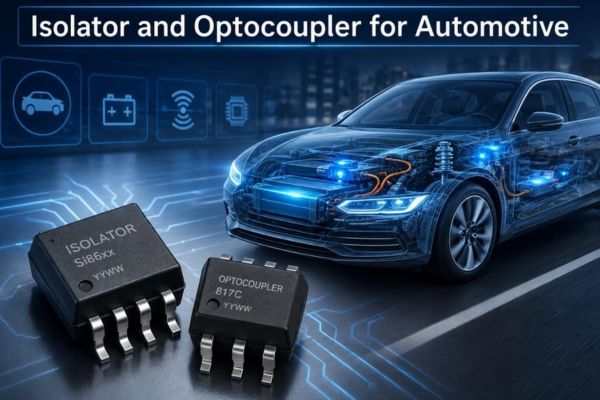
Automotive isolators and optocouplers are semiconductor devices that enable signals to pass between two circuits while preventing direct electrical current flow between them.
An optocoupler, also known as an optical isolator, transfers electrical signals using light. It contains an LED and a photodetector enclosed within the same package. When current passes through the LED, it emits light, which activates the photodetector without any physical electrical connection.
Digital isolators achieve similar isolation using magnetic or capacitive coupling instead of light, providing higher speed, lower power consumption, and greater durability for modern automotive electronics.
Both technologies protect critical systems from electrical disturbances while maintaining reliable communication between high-voltage and low-voltage circuits.
Why Electrical Isolation Matters More Than Ever
Today’s vehicles contain hundreds of electronic control units (ECUs), sophisticated communication networks, high-voltage battery systems, electric motors, and multiple sensors operating simultaneously.
Without proper isolation:
- High voltages could damage sensitive microcontrollers.
- Electrical noise could interfere with communication systems.
- Safety-critical functions could experience failures.
- Battery management systems could become inaccurate.
- Charging systems could face reliability issues.
Electrical isolation acts as a protective barrier, ensuring different systems communicate safely even under harsh automotive conditions involving vibration, temperature fluctuations, moisture, and voltage transients.
Market Evolution Driven by Vehicle Electrification
The rapid transition toward electrified transportation is fundamentally changing semiconductor requirements.
Traditional internal combustion vehicles primarily relied on low-voltage electronics. Modern battery electric vehicles (BEVs), plug-in hybrid electric vehicles (PHEVs), and fuel cell electric vehicles (FCEVs) operate with battery packs reaching 400V, 800V, and even higher voltages.
These architectures require numerous isolated communication channels between:
- Battery Management Systems (BMS)
- Inverters
- DC-DC converters
- On-board chargers
- Motor control units
- Charging interfaces
- Power distribution systems
Consequently, every new generation of electric vehicle increases the demand for reliable isolation technologies.
Key Market Drivers
Electrification of Passenger and Commercial Vehicles
The worldwide adoption of electric mobility represents the strongest growth driver for automotive isolators and optocouplers.
As manufacturers introduce higher-voltage battery systems and faster charging technologies, isolation becomes mandatory rather than optional, creating sustained market demand across passenger cars, buses, trucks, and specialty vehicles.
Growth of Advanced Driver Assistance Systems (ADAS)
Modern ADAS platforms process enormous amounts of data from radar, cameras, ultrasonic sensors, and LiDAR.
Reliable signal isolation ensures uninterrupted communication between processing units while protecting safety-critical electronics from voltage disturbances.
As vehicles progress toward higher levels of driving automation, the complexity of isolated communication networks will continue expanding.
Increasing Automotive Safety Standards
Global automotive regulations increasingly emphasize functional safety.
Manufacturers are designing redundant electronic architectures capable of maintaining operation even when faults occur.
Isolators contribute significantly by preventing fault propagation across electronic subsystems, helping manufacturers meet stringent automotive safety requirements.
Expansion of High-Speed Automotive Communication
Automotive communication protocols continue evolving toward higher bandwidth.
Modern vehicles use networks such as:
- CAN FD
- Automotive Ethernet
- SPI
- UART
- LIN
High-speed digital isolators enable these interfaces to operate reliably in electrically noisy automotive environments.
Emerging Technology Trends
Digital Isolators Replacing Traditional Optocouplers
Although optocouplers remain widely used, digital isolators are gaining significant momentum due to several advantages.
These include:
- Faster data transmission
- Lower power consumption
- Longer operational lifespan
- Better temperature performance
- Higher reliability
- Smaller footprints
As automotive systems become increasingly digital, digital isolation solutions are expected to capture a larger market share.
Wide Bandgap Semiconductor Integration
The adoption of silicon carbide (SiC) and gallium nitride (GaN) power devices is driving demand for advanced isolation technologies.
These power semiconductors switch at much higher frequencies than conventional silicon devices, requiring isolators capable of handling faster switching speeds while maintaining signal integrity.
Compact Electronic Architectures
Automotive manufacturers continue reducing component sizes while increasing functionality.
Isolation devices are therefore evolving toward:
- Higher channel density
- Miniaturized packages
- Lower heat generation
- Reduced power consumption
These innovations help optimize vehicle space without compromising performance.
Major Application Areas
Battery Management Systems
Battery Management Systems represent one of the largest applications for automotive isolators.
They monitor:
- Cell voltage
- Temperature
- Charging balance
- Battery health
- Safety conditions
Accurate isolated communication ensures both measurement precision and passenger safety.
On-Board Chargers
Electric vehicles require isolated communication between high-voltage charging circuits and low-voltage control electronics.
Reliable isolation improves charging efficiency while protecting sensitive electronic components during high-power charging operations.
Motor Control Systems
Electric traction motors rely on sophisticated inverter electronics.
Isolators protect motor controllers from high switching voltages while enabling precise communication between control processors and power stages.
Powertrain Electronics
Modern hybrid and electric powertrains integrate numerous converters, controllers, and monitoring systems.
Electrical isolation ensures these subsystems interact without exposing low-voltage electronics to potentially damaging high-voltage conditions.
Automotive Lighting Systems
Advanced LED matrix headlights, adaptive lighting systems, and intelligent illumination modules increasingly utilize isolated control interfaces for improved reliability
Competitive Landscape
- Texas Instruments
- Broadcom Inc.
- ON Semiconductor
- Toshiba Corporation
- Renesas Electronics Corporation
- Vishay Intertechnology
- Infineon Technologies AG
- Panasonic Corporation
- Lite-On Technology Corporation
- Sharp Corporation
- Everlight Electronics Co., Ltd.
- Standex Electronics
- IXYS Corporation (a Littelfuse company)
- Skyworks Solutions, Inc.
- Isocom Components
- TT Electronics
- Silicon Labs
- Murata Manufacturing Co., Ltd.
Future Outlook: The Next Decade of Automotive Isolation Technology
According to our Growth Market Report, The future of the Isolator and Optocoupler for Automotive Market is closely tied to the evolution of intelligent transportation. As software-defined vehicles, zonal electronic architectures, 800V battery platforms, and autonomous driving systems become mainstream, the need for robust electrical isolation will expand significantly.
Future devices are expected to integrate higher channel counts, built-in diagnostics, functional safety features, and compatibility with artificial intelligence-driven vehicle control systems. They will also support faster communication protocols, higher power densities, and more compact designs, enabling manufacturers to build lighter, safer, and more energy-efficient vehicles.