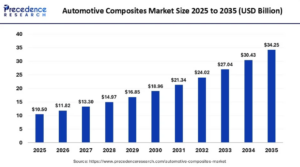
The global automotive composites market size was valued at USD 10.50 billion in 2025 and is projected to grow from USD 11.82 billion in 2026 to approximately USD 34.25 billion by 2035, registering a CAGR of 12.55% during the forecast period from 2026 to 2035. This growth is driven by increasing vehicle lightweighting initiatives and continuous advancements in high-performance automotive manufacturing technologies.
Key Takeaways
- Asia-Pacific dominated the automotive composites market with 34% of the market share in 2025 and is expected to sustain its position as a leader with a CAGR of 15.6% in the upcoming period.
- Europe held the second-largest market share of 31% in 2025.
- By resin type, the thermoset composites segment contributed the highest market share of 61% in 2025.
- By vehicle type, the passenger cars segment held a major market share of 47% in 2025.
- By application, the exterior components segment contributed the automotive composites highest market share of 31% in 2025.
- By composite type, the glass fiber reinforced polymer (GFRP) segment contributed the highest market share of 52% in 2025.
- By end user, the OEMs segment contributed the highest market share of 86% in 2025 and is expected to sustain as a leader with a CAGR of 12.9% in the upcoming period.
Automotive Composites Market Overview
The growing demand for lightweight, fuel-efficient, and longer-range electric vehicles is driving the expansion of the automotive composites market. Automotive composites, made from reinforcing fibers such as carbon, glass, or natural fibers combined with polymer resins, offer an exceptional combination of high strength and low weight. Their superior structural integrity, load-bearing capacity, and corrosion resistance make them ideal for applications including body panels, battery enclosures, chassis, and interior components. Moreover, leading manufacturers such as Toray Industries, Hexcel, Teijin, SGL Carbon, Syensqo, and BASF are investing in the development of recyclable composite materials, further supporting market growth over the forecast period.
Impact of Artificial Intelligence on the Automotive Composites Market
Artificial intelligence (AI) is playing a pivotal role in advancing innovation in automotive composites by accelerating the development of next-generation materials and optimizing manufacturing processes. Manufacturers are leveraging AI to model material properties, evaluate multiple material combinations, and predict performance, significantly reducing development time and costs compared to traditional methods. Additionally, AI-powered computer vision systems enhance quality control by detecting defects such as voids, fiber misalignment, and delamination in composite components, improving product reliability and manufacturing efficiency.
Regional Outlook of the Automotive Composites Market
North America
North America accounted for 28% of the global automotive composites market in 2025 and is projected to grow at a CAGR of 11.4% from 2026 to 2035. Market growth is driven by substantial investments in electric vehicle (EV) programs and the rapid commercialization of lightweight material technologies. Automotive composites are increasingly replacing conventional materials in critical vehicle components, including battery enclosures, body panels, and structural assemblies, to improve energy efficiency and vehicle performance. In addition, ongoing investments in manufacturing modernization and advanced production capabilities continue to strengthen regional demand for high-performance automotive composites.
Asia Pacific
Asia Pacific dominated the global automotive composites market, accounting for 34% of the revenue share in 2025, and is projected to register the fastest CAGR of 15.6% during the forecast period. The region’s growth is driven by its large-scale automotive production and export activities, along with substantial investments in carbon fiber manufacturing. China remains a key contributor, with vehicle production and sales reaching approximately 31 million units in 2024, according to the China Association of Automobile Manufacturers (CAAM). This surge in automotive manufacturing has significantly increased the demand for high-performance composite materials. Additionally, supportive government initiatives promoting domestic production of advanced composite materials are further strengthening the automotive composites market across the region.
Europe
Europe accounted for the second-largest share of the global automotive composites market, capturing 31% of the revenue in 2025, and is expected to expand at a robust CAGR of 11.8% during the forecast period. The regional market is driven by the growing emphasis on sustainable composite technologies and stringent environmental regulations promoting lightweight, low-emission vehicles. The adoption of advanced manufacturing techniques that reduce carbon emissions has accelerated the use of recyclable thermoplastic composites across the automotive industry. Furthermore, significant investments by leading automotive manufacturers in next-generation composite materials and production technologies continue to strengthen the growth of the automotive composites market in Europe.
Automotive Composites Market Companies
Formaplex
Formaplex specializes in the design and manufacture of advanced composite components for the automotive industry, supporting lightweight vehicle development. The company focuses on high-performance composite solutions that improve structural efficiency and fuel economy.
GMS Composites
GMS Composites develops custom composite materials and engineered components for automotive and industrial applications. Its innovative manufacturing capabilities help automakers reduce vehicle weight while maintaining durability and performance.
Gurit
Gurit is a leading global supplier of advanced composite materials, engineering services, and manufacturing technologies for the automotive sector. The company supports lightweight vehicle production through high-performance prepregs, core materials, and structural composite solutions.
Hexcel Corporation
Hexcel Corporation is a major manufacturer of carbon fiber, prepregs, and engineered composite materials used in automotive lightweighting. Its advanced composite technologies enable improved fuel efficiency, reduced emissions, and enhanced vehicle performance.
IDI Composites International
IDI Composites International produces thermoset composite materials designed for lightweight, high-strength automotive applications. The company’s innovative molding compounds help manufacturers achieve greater design flexibility and improved production efficiency.
Johns Manville
Johns Manville manufactures high-performance glass fiber reinforcement materials used in automotive composite applications. Its advanced material solutions enhance component strength, durability, and lightweight performance while supporting sustainable vehicle manufacturing.
Segmental Insights of the Automotive Composites Market
Resin Type Insights
The thermoset composites segment dominated the automotive composites market with a share of 61% in 2025, due to its high strength and thermal stability. These advantages are essential for structural body parts, battery enclosures, and underbody assemblies. Furthermore, the lightweight thermoset lines are introduced frequently for wider end-users by Hexcel, Syensqo, Huntsman Corporation, Owens Corning, and SGL Carbon, creating wider opportunities for the market in the coming years.
Vehicle Type Insights
The passenger cars segment dominated the automotive composites market with a share of 47% in 2025, due to the industry’s focus on reducing vehicle weight without compromising safety or performance. Composite constructions enhance crash energy absorption, corrosion resistance, and overall durability in various driving scenarios. Glass fiber and carbon fiber composites continued to be used in high-volume production of passenger vehicles. Furthermore, the growing number of passenger vehicle production is expected to fuel the market in the coming years. European Automobile Manufacturers’ Association (ACEA) estimates Europe’s 2024 production of passenger cars is around 10.63 million.
Application Insights
The exterior components segment led the automotive composites market with a share of 31% in 2025, as diversified body structures are going lightweight across both passenger and electric car segments. Companies are increasingly using composites to replace traditional exterior metal panels for their vehicle for good aerodynamic performance and car efficiency. The battery enclosures segment held 11% of the market share in 2025 and is expected to grow at the highest CAGR of 19.2% between 2026 and 2035, supported by growing concerns about the protection of high-voltage battery systems and the reduction of overall vehicle weight. The use of advanced composites offers improved thermal insulation and structural integrity. Furthermore, the launch of new EV battery-specific composites is expected to fuel market growth in the coming years.
Composite Type Insights
The glass fiber reinforced polymer (GFRP) segment held the largest revenue share of 52% in the automotive composites market in 2025, as they offer extreme operating conditions over time, dimensional stability, and crash energy absorption. Industrial uptake was further bolstered by the very broad applicability to compression molding, resin transfer molding, and injection molding.
End User Insights
The OEMs segment dominated the automotive composites market with a share of 86% in 2025 and is expected to sustain as a leader with a CAGR of 12.9% in the upcoming period, as they heavily integrate advanced composites technologies in cars’ design and production. Composite suppliers closely collaborate with OEM engineering teams. They are scaling up production and deployment of these composite materials in multiple vehicle platforms. The extensive use of factory-installed composite systems enabled OEMs to maintain their leadership in this industry around the world.