
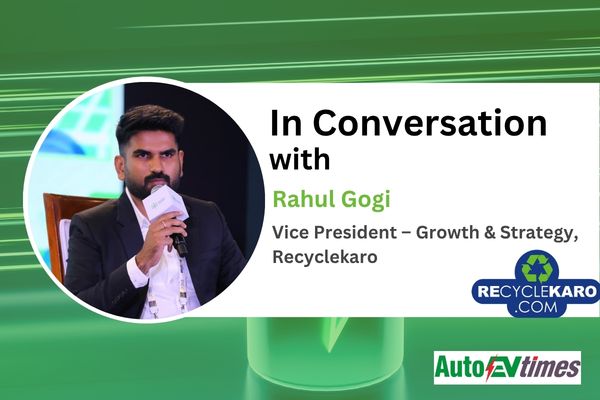
In an interview with AutoEV Times, Rahul Gogi, Vice President – Growth & Strategy, Recyclekaro, speaks about the growing role of battery recycling in India’s clean mobility journey. He discusses critical mineral recovery, resource security, evolving battery chemistries, policy support, technological advancements, and Recyclekaro’s long-term vision for building a circular, resilient, and self-reliant battery value chain that supports sustainable EV growth across the country.
Read the full interview here:
AET: India’s EV market is expanding rapidly. How do you see battery recycling evolving as a critical pillar of the country’s clean mobility ecosystem over the next five years?
Rahul: Battery recycling will move beyond being an end-of-life compliance requirement. It will become an integral part of India’s clean-mobility infrastructure. Over the next five years, the ecosystem is likely to become more organised, covering collection, safe transport, testing, second-life assessment, dismantling and material recovery.
For now, manufacturing scrap, consumer batteries and the earliest streams of EV batteries will account for much of the feedstock. But as the EV fleet matures, end-of-life vehicle batteries will become a substantial resource base. We are already seeing the first significant wave of lithium-ion batteries deployed between 2018 and 2020 reach our facilities and collection centres. Given the rapid expansion of vehicle electrification since then, battery and e-waste volumes could rise at least fivefold over the next five years.
The opportunity extends well beyond waste management. A robust recycling ecosystem can recover valuable materials and return them to domestic value chains, reducing dependence on virgin extraction and building a circular economy. Batteries that retain adequate performance can be repurposed for stationary energy storage. Those that cannot be reused should be recycled responsibly.
This transition will require traceable collection systems, rigorous safety standards, high recovery efficiency and reliable battery-grade outputs. If industry and policy work in step, recycling can make clean mobility more resource-efficient, resilient and sustainable.
AET: Critical minerals such as lithium, cobalt, nickel, and copper are becoming increasingly strategic. How can domestic battery recycling help India strengthen its resource security and reduce import dependence?
Rahul: India’s energy transition will require assured access to lithium, cobalt, nickel, manganese, copper and other strategic materials. At present, India is largely import dependent for the minerals that underpin batteries and clean-energy technologies. Even copper and aluminium, where the country was once self-sufficient, are increasingly imported.
Mining and international sourcing will remain necessary, including the development of overseas assets. But neither can bridge the gap quickly enough or shield India from price volatility, supply disruptions and geopolitical concentration. Recycling is the one part of this equation that India can build and control within its own borders.
Used batteries, manufacturing scrap and end-of-life electronics are an urban mine. Instead of allowing valuable materials to be lost after a product’s first life, they can be recovered, refined and reintegrated into domestic value chains. India’s large and rapidly growing electronics market makes this especially significant. With formal collection and recovery systems, recycling could meet an estimated 10 to 30 per cent of India’s critical-mineral demand within the next five years.
The gains are strategic as well as economic. Domestic recovery reduces the need for imports, retains value within India, and supports local refining, advanced manufacturing, skilled employment and technology development. Import dependence will not disappear overnight, particularly while the domestic battery stock is still building. But every tonne of material recovered is a tonne that need not be imported. The larger objective should be to retain and recover every possible gram of critical material already within the Indian economy.
AET: What are the biggest technological and operational challenges in extracting high-purity critical minerals from end-of-life EV batteries, and how is Recyclekaro addressing them?
Rahul: Recovering high-purity materials from EV batteries is technically demanding because batteries are not uniform. Packs vary by chemistry, format, age, state of health and design. Safe discharge, dismantling and segregation are critical, since damaged batteries can pose thermal and fire risks.
After processing, black mass contains a complex mix of lithium, nickel, cobalt, manganese, graphite and impurities from aluminium, copper, binders and electrolytes. Separating these materials efficiently while protecting quality and yield, and managing effluents responsibly, is a major challenge.
Recycling is both a technology and an economics business. The value recovered must exceed the energy and processing cost of recovery. As operations scale, maintaining recovery efficiency and purity becomes harder. This is why the entry barrier remains high.
At Recyclekaro, we use a process-led approach that combines careful mechanical pre-processing with hydrometallurgical recovery. Our in-house R&D focuses on improving separation efficiency, adapting processes to different feedstocks, and increasing the purity and consistency of recovered materials.
Data is equally important. Over the past decade, Recyclekaro has built a database of nearly 16,000 e-waste and battery SKUs. It helps us assess composition and material value quickly, make fair procurement decisions, and enable OEM partners to dispose of e-waste faster and in compliance with norms. Our facilities also use zero-disposal liquid treatment, including multi-effect evaporator technology to neutralise hazardous elements before by-products are released. Recovery cannot come at an environmental cost.
AET: Policy initiatives are increasingly promoting circular economy practices. What additional regulatory or industry measures would further accelerate battery recycling and responsible e-waste management in India?
Rahul: India has made meaningful progress through Extended Producer Responsibility and battery-waste-management frameworks. The country has one of the stronger EPR frameworks globally. The next task is to improve implementation, verification and scale on the ground.
A robust digital traceability system, from manufacture and sale to collection, reuse and recycling, would help prevent material from entering unsafe channels and improve accountability. A battery passport or standardised digital record could track chemistry, ownership, state of health and the end-of-life route.
Regulation must also reward quality, not just quantity. It is important to measure and incentivise the amount of critical minerals a recycler actually recovers, along with the volume of battery and electronic waste processed. The current system can favour throughput over recovery outcomes. Formal collection must be strengthened so that feedstock reaches compliant facilities rather than informal channels. The logistics of safely aggregating batteries from the point of generation also need to become easier.
The Government’s Incentive Scheme for Promotion of Critical Mineral Recycling is therefore a timely confidence-building measure. Under the National Critical Mineral Mission, the ₹1,500 crore grant programme for selected Indian recyclers can support investment in advanced black-mass processing. Much of the industry currently stops at this stage. Recovering critical minerals from black mass sustainably requires sophisticated in-house technology. Targeted support can help more Indian companies close that gap and strengthen the circular economy.
AET: As battery technologies continue to evolve, from LFP to NMC and beyond, how is the recycling industry preparing to adapt to changing battery chemistries and future demand?
Rahul: The recycling industry must be chemistry-agnostic in its outlook but chemistry-specific in its processes. NMC batteries contain relatively high-value nickel and cobalt, while LFP batteries have a different material profile and economics. Their use cases are evolving rapidly. A recycling process designed for only one chemistry will not be adequate.
At Recyclekaro, our focus is on adaptable processing, in-house R&D and continuous improvement in recovery methods. We are working with institutions such as IIT Bombay, IIT Kanpur and IIT Hyderabad, while engaging with other research organisations to assess promising lab-developed technologies. We also work with industry partners in Japan and South Korea on technologies that can advance recovery in India. The aim is to recover every possible gram of critical material using the least possible energy.
Close engagement with battery manufacturers and OEMs will be equally important. Early visibility into new chemistries and pack designs allows recyclers to develop safe and efficient recovery routes before volumes reach end of life. It can also encourage more recovery-friendly design practices at the manufacturing stage. Flexibility will be the sector’s defining capability.
AET: Looking ahead, what role do you envision Recyclekaro playing in building a sustainable and self-reliant battery value chain, and what key trends should the industry watch over the coming years?
Rahul: Recyclekaro’s role is to help close the loop between battery use and material supply. We aim to be a reliable link in India’s circular battery value chain by processing lithium-ion battery waste and e-waste responsibly, recovering critical materials, and supporting their return to productive use. That requires scalable and compliant recycling capacity, a strong collection network, safe handling, transparent operations and continued technology development.
We are investing around ₹300 crore to expand processing capacity from 34,500 metric tonnes to 50,000 metric tonnes. We also plan to invest a further ₹500 crore by 2030 in advanced material-recovery technologies. Alongside this, we are strengthening our pan-India collection network, including through partnerships in regions where direct procurement is less practical.
The industry will need to watch three linked trends closely: the rise of EV and stationary energy-storage batteries; the growing diversity of battery chemistries; and the evolution of EPR, traceability, recycled-content requirements and incentives for domestic critical-mineral recovery. Partnerships among battery makers, vehicle manufacturers, fleet operators, insurers, logistics providers and recyclers will be critical to reverse logistics and material offtake.
Looking ahead, India could build critical-mineral recovery capacity of around one million metric tonnes by 2036-37 if current commitments hold. This is both an industrial and an environmental imperative. Batteries and e-waste are hazardous materials and cannot be dumped or processed crudely. India’s success will depend on converting them into high-quality secondary resources safely, efficiently and at scale, so that clean mobility also strengthens national resource resilience.