

In an interview with Shrikant Acharya, Co-Founder and Chief Technology Officer, Excelfore Corporation, AutoEV Times, discusses the evolution of Software-Defined Vehicles, over-the-air updates, Edge AI, connected vehicle ecosystems, cybersecurity, and India’s growing role in automotive software innovation. Acharya explains how open standards, intelligent connectivity, and scalable digital platforms are reshaping vehicle ownership, customer engagement, and the future of sustainable, software-driven mobility worldwide.
Read the full interview here:
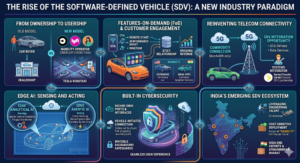
AET: The automotive industry is rapidly moving toward Software-Defined Vehicles (SDVs). How is this shift changing the way automakers think about vehicle ownership, customer engagement, and long-term revenue generation through features-on-demand?
- The first big shift is in ownership itself. The rise of shared mobility — Uber, Lyft, and now autonomous ride-hailing — is steadily loosening the link between using a car and owning one. And OEMs won’t sit on the sidelines of that business; they’ll be in it. Tesla launched its own robotaxi service in Austin and has since expanded it to other Texas cities, which tells you the manufacturer-as-mobility-operator model is already here, not theoretical.
- The second shift is in how automakers stay connected to the customer over the life of the vehicle. Features-on-demand (FoD) creates stickiness — the ability to deliver something new, even when it’s free, keeps the vehicle feeling fresh and gives the OEM a reason to keep communicating with the owner. That ongoing relationship is itself valuable.
- Monetizing it, though, is harder than it sounds. Even in the US, getting customers to pay for new features isn’t easy — the feature has to be genuinely compelling. And the model has to be tuned to the market. In India, where the consumer is highly price-sensitive, FoD has to be low-cost and can be thinly featured to be accepted. The winning approach is many small features sliced at very thin price points: a ringtone for a few rupees works, but hundreds of ringtones bundled for hundreds of rupees won’t.
- The throughline is that SDV isn’t really about the spec sheet. Applied well, it makes the customer experience measurably better over time — and that superior experience, more than any single paid feature, is what makes the brand sticky.
AET: Over-the-air (OTA) updates have become a critical capability for modern vehicles. How is Excelfore helping automakers implement secure, scalable, and standards-based OTA solutions, and what role does the eSync Alliance play in driving industry-wide standardization?
- Excelfore is the leading independent provider of OTA solutions globally, with deployments across major automakers including Audi, VinFast, Tata, and Hero. What sets that footprint apart is the foundation it’s built on.
- Excelfore implements its solution on the eSync Alliance standard. Most other OTA solutions in the market are proprietary — closed systems that lock an automaker into a single vendor. The eSync approach is open and transparent, and that’s precisely what major OEMs want. It’s a large part of why they’ve adopted it: they get a production-proven solution without sacrificing control or visibility.
- In the Excelfore implementation, the Security is built into the design. With the eSync Alliance, scalability is not bolted on, it is built into the specification and it keeps evolving through the contributions of the Alliance’s membership. With more than 30 members whose aggregate market capitalization approaches $750 billion, there is serious industry weight behind this standard. It isn’t one company’s roadmap; it’s a collective one.
- That’s the role the eSync Alliance plays: it continues to democratize OTA and data solutions for the benefit of its members and the broader industry, publishing evolving standards that address real, emerging needs. Excelfore, as the standard’s primary author and a founding contributor, turns that openness into deployed, secure, scalable reality on the road today
- Due to its openness and consequent OEM adoption, eSync Alliance is a rapidly growing organization
AET: Connected vehicles rely heavily on cloud-to-car and car-to-cloud communication. How do telecom networks and connectivity infrastructure enable the next generation of intelligent, autonomous, and software-defined vehicles?
- Today, telecom networks are still seen mostly as connectivity infrastructure providers. Integration tends to happen late — during the rollout phase rather than at design and deployment — so the carrier is brought in to connect a vehicle that’s already been architected, not to help shape it.
- That positioning is becoming a problem for the telecoms themselves. Margins are getting squeezed as automakers demand more for less, and simply offering speeds and feeds won’t sustain the business. Connectivity alone is becoming a commodity.
- SDV is where the real opportunity lies. It gives telecom providers a chance to integrate upstream and downstream — to move beyond the pipe and into the data services that ride on it, like OTA delivery and data aggregation. This isn’t unprecedented: Sprint and Chrysler built a strategic partnership back in 2012, with Sprint acting as the systems integrator for the Uconnect Access system, providing embedded cellular connectivity and telematics services such as one-button 9-1-1 access and in-vehicle Wi-Fi. The model worked because it was integrated, not just connected.
- The lesson is that an ecosystem play beats a bandwidth play. Telecoms that offer an integrated, evolving service — rather than raw connectivity — will be far more valuable to automakers. The key is a scalable architecture that can keep pace with the fast evolution of telecom technology while still meeting the needs of automakers, who may not move at that same speed. Bridging those two clock speeds is exactly where the next generation of connected-vehicle infrastructure will be won.
AET: AI is increasingly being deployed at the edge inside vehicles for real-time decision-making and predictive maintenance. How do Edge Analytical AI and Edge Agentic AI enhance vehicle intelligence, and what practical benefits do they deliver to automakers and drivers?
- The two work as a pair — sensing and acting. Edge Analytical AI gives the vehicle awareness: instead of waiting for a trouble code to fire, it learns the car’s normal operating signature and flags deviations the moment they appear
- Edge Agentic AI then closes the loop, deciding what actually matters — selecting the relevant signals, reconfiguring the data pipeline, and escalating only what’s needed to the cloud for deeper, fleet-wide learning.
- For automakers, that means predictive maintenance that’s truly predictive: catching issues before they become warranty claims or recalls, and slashing the cost of data moved off-vehicle. Paired with OTA updates, an OEM can detect a condition, validate a fix in the cloud, and deploy it across the fleet — no service appointment required.
- For drivers, it means fewer surprises and less downtime: a car that looks after itself and keeps getting smarter over the air.
AET: As vehicles become more connected and software-driven, cybersecurity concerns are growing. How can automakers ensure that connected vehicles remain protected from cyberattacks, malware, and unauthorized access while maintaining a seamless user experience?
- You have to look at every place where an intrusion can happen and build safeguards around it. That starts with the obvious entry points — protecting keys and login credentials — but it extends to every attack surface on the vehicle. Every port, the OBD connector, any interface that touches the outside world needs to be reviewed carefully and locked down. Security isn’t a single feature; it’s a discipline applied at every point of exposure.
- From the vehicle’s point of view, some of the most important protection comes from design decisions about how the car communicates. The vehicle should reach out to the cloud at a pre-programmed destination, on its own terms, rather than listening for and accepting incoming connections. It calls out; it doesn’t answer. And it shouldn’t broadcast a URL or expose an address that an attacker could target. By controlling who initiates the conversation and where it goes, you close off a whole category of attacks before they can start.
- Done well, all of this is invisible to the driver. The safeguards run quietly in the background, so the experience stays seamless while the vehicle stays protected.
AET: India is emerging as a major automotive and EV market. How do you assess the adoption of SDV, OTA, connected vehicle technologies, and autonomous capabilities in India compared to global markets, and what opportunities do you see for the country over the next five years?
- For years, India served as the low-cost engineering center that delivered software and systems expertise to global automakers. That same delivery capability can now be turned inward — applied to India’s own OEMs rather than only to manufacturers abroad. The talent and the execution discipline are already here.
- So India is well positioned to execute, with one important caveat: cost. The Indian consumer is price-sensitive, and cost can balloon quickly if a vehicle is made too feature-rich. The answer is to deploy on the basis of usability, not feature count — capabilities that earn their place by delivering real value to the driver and the operator, rather than a long spec sheet that inflates the price.
- High-end vehicles will carry the most advanced capabilities first and, over the coming years, can support export markets as well. And Atmanirbhar Bharat is providing the impetus to look inward — to develop products built for India, with a clear eye on the global market too.