
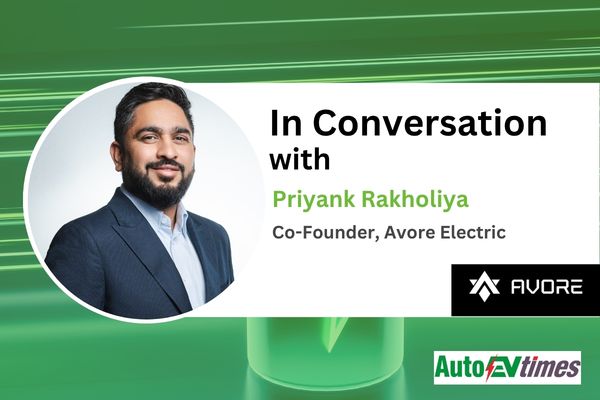
In an interview with Priyank Rakholiya, Co-Founder, Avore Electric, spoke about India’s evolving electric mobility landscape, the growing opportunity in electric motorcycles, and the technologies shaping the next phase of adoption. He highlighted the importance of battery intelligence, AI-driven BMS, localisation, charging infrastructure, after-sales support, financing and recycling, while outlining Avore Electric’s approach to developing indigenous EV technologies for Indian riders.
Read the full interview here:
AET: As India’s EV market continues to mature, how would you assess the current state of electric mobility in the country, and what are the biggest factors that will determine the pace of adoption over the next few years?
Priyank: India’s electric mobility market is at an important stage of growth. We have seen strong adoption of electric scooters, but electric motorcycles are still at a very early stage. This is where we see a significant opportunity, especially in the 125cc–200cc commuter segment. It is one of India’s largest two-wheeler categories, but EV penetration in this segment is still negligible.
We believe the next phase of EV adoption will be driven by product quality, technology, performance, reliability and the overall ownership experience. Customers want an EV that can meet their everyday needs without making compromises. Range, battery life, charging, safety, after-sales service and affordability will all play an important role. Government support will continue to help the industry, but over time, EVs will need to stand on their own value proposition. At Avore Electric, our focus has always been on engineering before marketing and building technology that is designed for Indian riders.
AET: Range anxiety, battery life and charging availability remain key concerns for EV buyers. What technological and infrastructure developments do you believe are needed to address these challenges and make EVs more convenient for everyday users?
Priyank: We believe range anxiety cannot be addressed only by increasing battery size. The battery, BMS (Battery Management System), motor, power electronics and software all need to work together as one intelligent system. This is why we developed our battery pack and patented BMS in-house. Our BMS uses region-wise and age-wise AI-driven optimisation, while the battery pack has four-way active cooling and IPU-X Shield protection. This allows the system to respond to different Indian riding and environmental conditions. The battery pack is NATRAX homologated and the BMS is ICAT validated.
Charging also needs to be simple and practical for everyday users. The Avore EX comes with a 1500W onboard fast charger that can work with a standard 5A or 15A household socket. It can charge from 20% to 80% in approximately two hours, while a full 0–100% charge takes around four hours. Along with this, India needs a stronger charging infrastructure across cities, residential areas and highways. Better battery intelligence, convenient charging and wider infrastructure will together help reduce range anxiety and make EV ownership more practical.
AET: Battery technology is becoming increasingly important to EV performance, safety and ownership costs. How do you see AI-driven Battery Management Systems (BMS), thermal management and battery intelligence shaping the next generation of electric vehicles?
Priyank: We believe battery intelligence will become one of the most important parts of the next generation of electric vehicles. A BMS should not only monitor the battery. It should understand how the vehicle is being used, where it is being used and how the battery is ageing, and then optimise the system accordingly. At Avore Electric, we developed our BMS in-house with region-wise and age-wise AI-driven optimisation and 400 mA passive cell balancing. Our battery pack also uses four-way active cooling and IPU-X Shield protection. These technologies are designed to support battery safety, performance and long-term reliability.
Our approach is to build intelligence into the vehicle from the beginning rather than adding it as a feature later. In the future, AI-driven BMS technology can help with battery health, charging optimisation, early problem detection and predictive maintenance. This can improve battery life, safety and reliability and, ultimately, give customers greater confidence in electric mobility.
AET: India is placing greater emphasis on localising EV technology and manufacturing. What role can indigenous development of motors, controllers, battery systems and other critical components play in making India’s EV ecosystem more competitive and self-reliant?
Priyank: For us, localisation is not just about assembling a vehicle in India. It is about developing the core technology in India and building the capabilities needed to own that technology. This is central to our Make in India and Atmanirbhar Bharat approach. Over the past three years, our team has developed more than nine critical vehicle systems in-house. These include our BMS, battery pack, motor, motor controller, power control module, DC-DC converter, onboard fast charger, display system and proprietary operating system. We have also filed more than 120 intellectual property applications. Our motor is designed to be rare-earth-free. This was a deliberate engineering decision made well before the current rare-earth supply disruption. India has a meaningful share of global rare-earth reserves, but reserves alone do not guarantee supply security. Mining, processing and magnet manufacturing are also important. By developing a rare-earth-free motor and our other critical systems in-house, we can reduce supply-chain dependence and have greater control over technology, quality and future innovation. If more Indian EV companies develop core technologies instead of simply assembling systems developed elsewhere, it can create deeper R&D capabilities, more intellectual property and a stronger technology and manufacturing ecosystem in India.
AET: Beyond vehicle sales, what changes are needed across charging infrastructure, after-sales service, battery recycling and financing to create a more mature and sustainable EV ecosystem in India?
Priyank: A mature EV ecosystem needs to focus on the complete ownership experience, not only on vehicle sales. Charging infrastructure is an important part of this. Customers need reliable and convenient charging at home, at workplaces, in cities and on highways. After-sales service is equally important because trust is a major part of EV adoption. Customers need confidence that if there is an issue, the vehicle can be diagnosed and repaired quickly. At Avore Electric, we built diagnostics and predictive maintenance into the product from the start. Our aim is to use technology to identify issues early and reduce downtime. Battery recycling and end-of-life management will also become increasingly important as EV adoption grows. India will need stronger systems for battery collection, reuse and recycling. Financing is another important area, particularly for commuter customers. The customer looks not only at the upfront price but also at the monthly cost and total cost of ownership. Better financing options can therefore help make EVs more accessible. Ultimately, charging, service, battery lifecycle management, financing and vehicle technology all need to develop together to build long-term trust in electric mobility.
AET: What do you expect the Indian EV industry to look like by 2030, and what innovations or trends do you believe could have the biggest impact on the next phase of electric mobility?
Priyank: By 2030, we expect India’s EV industry to be much more technology-driven and locally developed. We believe industry will gradually move from being driven mainly by purchase incentives to being driven by product innovation, technology, performance, reliability and overall value. Electric motorcycles will have an important role in this growth because motorcycles are central to everyday mobility in India. We also expect to see greater development of indigenous motors, battery systems, power electronics and software. AI-driven battery management, better thermal management, predictive diagnostics, OTA updates, intelligent rider assistance and more convenient charging could have a major impact on the next phase of electric mobility. Software will also become increasingly important because it allows the vehicle to continue improving after the sale. This is the thinking behind Avore Electric. Our AVORE Source technology stack and AVR vehicle platform have been developed to bring hardware and software together, while AVORE SENSE, AVA and Avore Synapse bring intelligence into the rider experience. The Avore EX is the beginning of our journey. Going forward, our focus will remain on greater intelligence, improved performance, reliability and localisation, while developing technologies that make electric mobility more accessible and practical for Indian riders.