
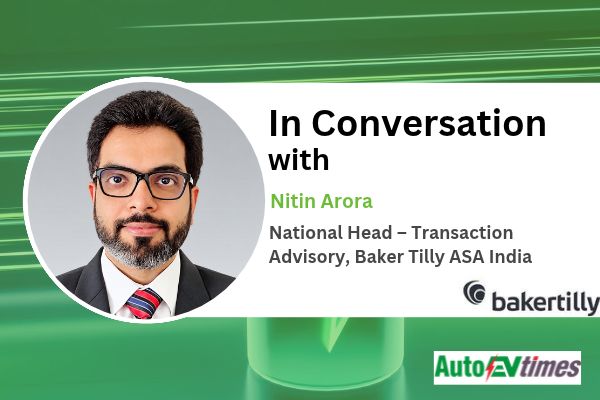
In an interview with AutoEV Times, Nitin Arora, National Head – Transaction Advisory at Baker Tilly ASA India, shares his insights on the evolving M&A landscape in India’s automotive and electric vehicle industries. He discusses strategic acquisitions, technology-led investments, cross-border expansion, financial due diligence and the challenges of evaluating emerging EV businesses. He also highlights the importance of post-acquisition integration in delivering sustainable growth and long-term business value.
Read the full interview here:
AET: How do you see the balance between strategic acquisitions, technology-led investments and consolidation shaping the next phase of M&A in India’s automotive and EV industries?
Nitin: India’s automotive sector recorded 33 deals worth US$1.7 billion in Q3 2026, including 12 M&A transactions valued at US$389 million. This points to renewed deal activity, although investment remains selective. I expect consolidation among traditional component manufacturers to coexist with technology-led acquisitions in battery management, power electronics and vehicle software. Buyers are increasingly interested in capabilities that can strengthen their position across multiple vehicle platforms. However, acquiring technology is not the same as commercialising it. The next phase of M&A will depend on whether investors can integrate these capabilities, secure customers and generate sustainable returns.
AET: Mid-market automotive and EV businesses often have strong growth potential but varying levels of financial and operational maturity. What factors should investors assess to distinguish scalable businesses from those carrying significant transaction risks?
Nitin: India’s auto-component industry reached a turnover of ₹7.59 lakh crore in FY2025–26, growing 12.7%. While this reflects a growing market, sector growth should not be confused with individual business quality. Investors must examine earnings sustainability, customer concentration, working capital cycles and the capital expenditure needed to fulfil orders. For EV businesses, battery warranties, imported component dependencies and product-development costs deserve particular scrutiny. Manufacturing yields, quality certifications and management capability are equally important. A scalable business should demonstrate that higher volumes improve cash generation and operating efficiency, rather than merely increasing its dependence on external funding.
AET: As Indian automotive and EV companies explore international expansion, which capabilities, technologies or market access opportunities are most likely to drive cross-border acquisitions and strategic partnerships?
Nitin: India exported approximately US$24 billion worth of auto components in FY2025–26, while imports reached US$25.4 billion. This illustrates both the industry’s international reach and its continuing need for specialised technologies. Cross-border acquisitions can help Indian manufacturers access advanced electronics, battery technologies, engineering capabilities and established global OEM relationships. Product certifications, intellectual property and customer approvals may be as valuable as physical assets. However, investors must assess whether technology can be transferred and commercialised across markets. Where integration or regulatory risks are substantial, joint ventures and licensing arrangements may offer a more efficient route than outright acquisitions.
AET: With rapid changes in battery technology, charging infrastructure and EV business models, how can investors assess the long-term commercial viability of a target company beyond its current financial performance?
Nitin: India’s electric passenger vehicle retail sales reached 36,108 units in September 2026, nearly doubling year-on-year, according to FADA. Growing demand is encouraging, but it does not guarantee the viability of every EV business model. Investors should assess technology ownership, battery degradation, warranty exposure, replacement costs and the capital required for future upgrades. For charging operators, utilisation and contribution margins per location are more meaningful than installation counts. Financial projections should be tested against declining battery prices, changing technical standards and reduced incentives. Ultimately, commercial viability depends on whether the business can remain competitive as the technology and market mature.
AET: How is Baker Tilly ASA India leveraging its transaction advisory expertise to help automotive and EV companies identify promising opportunities, navigate deal complexities and make well-informed acquisition and investment decisions?
Nitin: Transaction advisory in the automotive and EV sectors increasingly requires an assessment of financial performance alongside technology, operating risks and future capital requirements. At Baker Tilly ASA India, the evaluation of acquisition opportunities considers strategic fit, earnings sustainability, customer concentration, working capital, valuation assumptions and potential liabilities. Particular attention is necessary where businesses depend on a limited number of OEM customers, imported components, emerging technologies or government incentives. Financial due diligence also needs to identify risks that may not be evident from reported profitability, including warranty provisions, capital expenditure commitments and contingent obligations. These findings inform valuation, deal structuring, contractual protections and investment decisions.
AET: Beyond completing a transaction, what steps should automotive and EV companies prioritise after an acquisition to integrate operations, capture synergies and translate the deal into sustainable business value?
Nitin: Post-acquisition integration should begin before deal completion, with clearly identified synergies, realistic timelines and accountable teams. Automotive businesses must carefully manage supplier relationships, OEM approvals, production quality and customer delivery commitments. EV acquisitions introduce additional considerations around technology integration, intellectual property and retention of specialist engineering talent. Investors should distinguish cost savings achievable through procurement or operational efficiencies from revenue synergies that depend on customer acceptance and product development. Integration costs, working capital and capital expenditure must also be tracked against the acquisition model. The true measure of a successful transaction is not the projected synergy at signing, but the cash flow and operating performance delivered afterwards.