
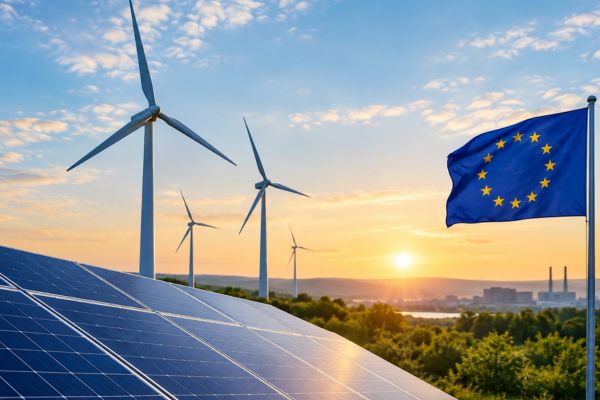
Europe’s power grid will surpass 80% zero-carbon generation by 2030. It will still miss its flagship renewables target by the same date, but will eventually accelerate over the coming decades, expanding power demand by 66% by 2050. That gap between progress and ambition sits at the centre of Wood Mackenzie’s Europe Power Markets Strategic Planning Outlook 2026, covering 35 national markets through 2060.
Demand recovers, but the timing reshapes investment priorities
The transition does not unfold evenly. Total power demand reaches 4,103 TWh by 2030, 11% above 2025 levels, before climbing to 6,152 TWh by 2050, a 66% increase. Near term, data centres are the primary driver. From the 2030s, falling electricity prices shift the economics of electrification and a new growth wave takes over.
Electric vehicle adoption accelerates underpinned by bans on new sales of internal combustion vehicles as EV consumption grows from 39 TWh in 2025 to 577 TWh by 2050, a 15-fold increase. On-grid hydrogen scales from near zero to 417 TWh over the same period. Heat pump demand expands more than fivefold by 2060, though high upfront costs and unfavourable electricity-to-gas price ratios mean most markets fall short of national targets.
Northern Europe records the strongest absolute demand growth at 81% by 2050. Southern Europe trails at 52%. Overall demand sits around 2% lower than Wood Mackenzie’s previous forecast as heat and hydrogen electrification lag, though risk runs both ways: geopolitical uncertainty and commodity price headwinds could slow load growth, while prolonged fossil fuel disruption could accelerate it and trigger additional policies to accelerate decarbonization.
Rapid supply growth still falls short of policy targets
Solar PV capacity nearly doubles to 637 GWac by 2030, adding around 61 GW per year. Onshore wind adds 17 GW per year to reach 346 GW. Offshore wind grows to 73 GW by 2030 before accelerating to 148 GW by 2035, though supply chain pressures and investor uncertainty have delayed its trajectory. Renewables reach 65% of supply across the 35 markets by 2030 and 83% by 2050. On an EU27 basis, the 2030 share stands at 63.7%, below both the Fit-for-55 target of 65% and the REPowerEU goal of 69%.
Battery storage more than triples from 47 GW to 163 GW by 2030, one of the largest near-term capital deployment opportunities in the European energy sector. Germany, the UK, Italy and Poland account for over half that growth. Load growth from the second half of the 2030s will provide day-ahead price support, offering relief to renewable asset owners navigating low capture pricing as solar expands. Curtailment risks will rise where grid infrastructure lags capacity additions.
Gas runs higher than the previous forecast, before its long decline
The transformation of Europe’s energy mix has the largest effect on gas. Natural gas generation averages 6% higher between 2026 and 2040 than Wood Mackenzie’s prior forecast. The reason is structural: offshore wind downgrades created a supply gap and gas filled it. Capacity rises 5% to 273 GW by 2030, even as fleet utilisation falls from 27% to 22%. Gas is retained for flexibility rather than volume, with capacity mechanisms and flexibility revenues at the centre of the investment case.
Coal generation halves from 457 TWh in 2025 to 237 TWh by 2030. The EU27 fleet exits the mix by 2050. Nuclear is gaining ground in parallel; life extensions, new-build programmes and policy reversals in Switzerland and Serbia have strengthened its long-term role. As coal retreats and nuclear expands, gas bridges the gap until decarbonised alternatives become commercially viable. Gas volumes converge with the previous outlook by the mid-2040s, then fall. Power supply from gas declines 45% by 2060.
Mohammed Alraood, Research Analyst Europe Power at Wood Mackenzie, said: “Europe’s power transition is on track, but it is not evenly distributed. Rising emissions costs will force structural decisions that markets are only beginning to price in. Gas remains in the mix, not for volume but for the moments renewables cannot deliver. For developers and investors, the critical variable is not the direction of travel. It is which markets combine policy certainty, grid capacity and genuine load growth to make projects financeable.”
Whether the transition delivers on its projected timeline will depend on the pace of grid investment and interconnector expansion, two variables that no forecast can fully determine. Wood Mackenzie expects the region’s commitment to the energy transition to be sustained, although investment opportunities in new supply will not be uniform across markets. Developers and investors will need a clear understanding of where the most attractive market opportunities lie.