Automated Battery Swapping Is Becoming More Than an Alternative to EV Charging
Electric-vehicle infrastructure is entering a new phase in which charging speed is no longer the only way to reduce the time required to replenish an EV.
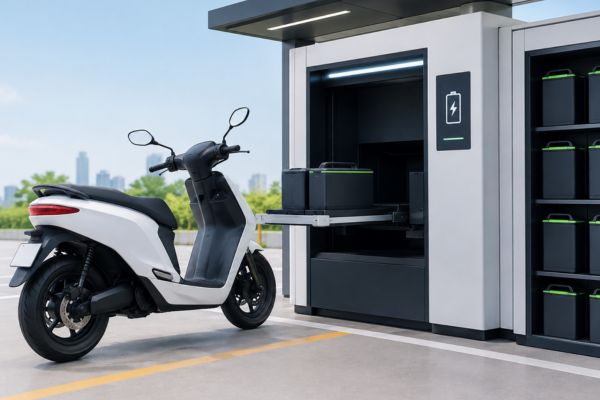
Automated battery swapping takes a fundamentally different approach: instead of waiting for a depleted battery to recharge inside the vehicle, an automated station removes the battery and replaces it with a charged pack.
What was once treated largely as a niche alternative to plug-in charging is developing into a broader infrastructure ecosystem encompassing robotic swapping stations, Battery-as-a-Service (BaaS), battery diagnostics, fleet management, energy management and increasingly interconnected swapping networks.
The commercial opportunity is expanding accordingly.
The global automated EV battery swapping market was valued at USD 992.80 million in 2025 and is expected to reach USD 13,612.22 million by 2035, representing a 29.9% CAGR from 2026 to 2035, according to Acumen Research and Consulting.
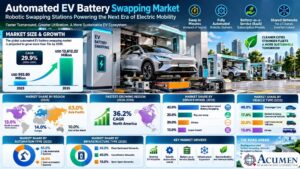
Asia Pacific accounted for 63% of the market in 2025, while North America is projected to register the fastest growth at a 36.2% CAGR through 2035.
Yet the most important change may not simply be the number of swapping stations being installed.
The industry is gradually confronting the problem that has historically limited battery swapping’s scalability: interoperability.
Partnerships involving battery manufacturers, automakers and energy-infrastructure companies increasingly point toward standardized batteries and shared swapping networks rather than isolated infrastructure designed for a single vehicle platform.
If that transition continues, automated swapping could evolve from an OEM-specific convenience into a distinct part of the EV energy-replenishment ecosystem.
What Is Automated EV Battery Swapping?
Automated EV battery swapping is a system that replaces a depleted electric-vehicle battery with a charged battery using automated or robotic equipment, significantly reducing direct human involvement.
A fully automated station can potentially coordinate several operations:
Vehicle identification → positioning → battery authentication → unlocking → removal → replacement → electrical connection → diagnostics
The vehicle can then leave with a charged battery while the depleted pack enters the station’s charging and battery-management cycle.
This makes automated swapping fundamentally different from manual swapping commonly associated with smaller electric two- and three-wheelers.
It is also different from conventional fast charging.
Fast charging attempts to put energy into the battery as quickly as possible. Battery swapping replaces the entire energy-storage unit.
The commercial question is therefore not simply whether swapping can be faster than charging. It is whether the savings in vehicle downtime can justify the additional infrastructure, battery inventory and standardization requirements.
That equation becomes particularly interesting for high-utilization vehicles.
Automated EV Battery Swapping Market Could Exceed $13.6 Billion by 2035
The global automated EV battery swapping market is forecast to increase from USD 992.80 million in 2025 to USD 13,612.22 million by 2035.
That represents a 29.9% CAGR during 2026–2035.
The projected expansion reflects several overlapping changes in electric mobility.
EV fleets are becoming larger. Commercial operators increasingly focus on vehicle utilization rather than simply acquisition cost. Battery-as-a-Service is separating battery ownership from vehicle ownership in some ecosystems. Automated stations are becoming more sophisticated, while battery diagnostics and software are improving operators’ ability to manage battery inventories.
Perhaps most importantly, the industry is increasingly recognizing that swapping economics depend heavily on utilization.
A station serving only occasional vehicles must carry expensive infrastructure and spare battery inventory despite limited transactions.
A station serving taxis, logistics fleets or other vehicles that repeatedly require energy replenishment can spread those fixed costs across substantially more swaps.
This helps explain why fleet operations are becoming strategically important to the automated swapping business model.
Fully Automated Systems Already Account for 65% of the Market
Fully automated battery swapping accounted for 65% of the automated EV battery swapping market in 2025, compared with 35% for semi-automated systems.
Automation addresses several practical challenges associated with handling large EV battery packs.
A fully automated station can integrate vehicle positioning, battery identification, locking and unlocking, pack removal, replacement, electrical reconnection and battery-health validation.
Reducing human intervention can also help improve consistency and throughput.
That becomes increasingly important as swapping networks scale. A demonstration station performing a handful of swaps has different operational requirements from infrastructure expected to process hundreds of vehicles every day.
NIO’s development provides an indication of this industrialization.
The company’s fourth-generation Power Swap Station has been designed around automated operation and can support as many as 480 swaps per day. Its infrastructure has progressed through multiple station generations as the company has expanded its network and increased automation.
The evolution illustrates an important trend: the competitive challenge is shifting from proving that a battery can be swapped toward proving that thousands or millions of swaps can be delivered reliably as an infrastructure service.
NIO’s 100 Millionth Swap Shows What Scale Can Look Like
One of the clearest demonstrations of commercial scale came in February 2026, when NIO completed its 100 millionth battery swap.
By that point, the company reported approximately 3,790 Power Swap Stations worldwide, including 1,020 stations positioned along major Chinese highways.
NIO also planned to add another 1,000 swapping stations during 2026.
The significance extends beyond the headline number.
A large installed network creates operational data around battery demand, station utilization, pack condition, vehicle behavior and energy management. That information can help operators optimize battery inventories and station locations while potentially improving the economics of the network.
It also demonstrates why automated swapping should increasingly be viewed as infrastructure rather than simply a vehicle feature.
The station, battery pool, software, vehicle architecture and service model must function as one coordinated system.
Battery-as-a-Service Changes the Economics of EV Ownership
One of the most important business-model developments supporting automated swapping is Battery-as-a-Service (BaaS).
Instead of treating the battery as an inseparable component purchased with the vehicle, BaaS can separate access to the battery from ownership of the vehicle.
That changes the economic relationship among the driver, battery, vehicle manufacturer and infrastructure operator.
The global automated EV battery swapping market reflects this shift. Subscription-based battery swapping represented 42% of market revenue in 2025, making it the largest service model.
Pay-per-swap accounted for another 25%.
Subscription models can combine battery access with services such as charging, maintenance, software and battery-health monitoring.
For infrastructure providers, subscriptions can also produce more predictable recurring revenue than purely transactional swapping.
For high-mileage customers, the proposition is different again. The value of swapping may come less from battery ownership economics and more from reducing the time during which the vehicle cannot generate revenue.
This makes BaaS and automated swapping particularly complementary for fleet operations.
Passenger Cars Hold 48%, but Commercial Vehicles Present a Different Economic Case
Passenger cars accounted for 48% of automated EV battery swapping market revenue in 2025, making them the largest vehicle category.
The appeal is straightforward: automated stations can offer drivers a highly convenient energy-replenishment experience without requiring them to physically handle the battery.
But medium and heavy commercial vehicles, which represented 17% of the market in 2025, highlight a different value proposition.
For commercial vehicles, downtime has a direct economic cost.
A delivery truck, taxi or logistics vehicle connected to a charger is temporarily unavailable for productive operation. Faster energy replenishment can therefore translate into higher asset utilization.
Commercial fleets also tend to operate along more predictable routes.
That creates natural locations for swapping infrastructure, including logistics centers, fleet depots, ports, distribution hubs and freight corridors.
The result is a potentially attractive combination:
High vehicle utilization + predictable routes + repeated energy demand + centralized fleet management
Those characteristics can make fleet swapping economics fundamentally different from those of a public station waiting for unpredictable consumer traffic.
Fleet-Dedicated Networks Lead With 45% Market Share
This economic advantage is already visible in the market structure.
Closed or fleet-dedicated networks held 45% of the automated EV battery swapping market in 2025, ahead of open/public networks at 40% and semi-open networks at 15%.
A fleet operator knows approximately how many vehicles need service, when they will arrive and what battery configuration they use.
That reduces several uncertainties associated with public infrastructure.
Battery inventory can be planned more precisely. Charging can be scheduled around fleet demand. Compatibility is easier because the operator controls the vehicles using the station.
But the relatively high 40% share held by open/public networks reveals where a larger long-term opportunity could emerge.
For public swapping to scale efficiently, stations need access to a sufficiently large pool of compatible vehicles.
And that brings the industry back to its biggest structural challenge.
Battery Standardization Could Determine Whether Public Networks Scale
Conventional fueling infrastructure succeeds partly because a station can serve vehicles from many manufacturers.
Automated battery swapping is considerably more complicated.
Vehicle platforms can differ in battery dimensions, mounting mechanisms, voltage architectures, cooling systems, electrical connectors, communication protocols and battery-management software.
A station designed around one proprietary battery architecture cannot automatically serve another.
This fragmentation can limit station utilization and force infrastructure providers to maintain different battery inventories and mechanical systems.
The industry’s growing emphasis on standardization is therefore strategically significant.
In March 2025, CATL and NIO announced a partnership intended to accelerate swapping-network development while improving battery compatibility and technical-standard alignment.
The partnership also included capital cooperation of up to RMB 2.5 billion, or approximately USD 345.6 million.
Rather than viewing battery swapping solely as competition between proprietary networks, the development points toward a potentially more important objective: creating infrastructure that can support a broader ecosystem of compatible vehicles.
CATL Is Turning Battery Swapping Into an Infrastructure Platform
CATL’s expansion provides another indication of where the automated EV battery swapping market may be heading.
Through its Choco-Swap ecosystem, the battery manufacturer is building swapping infrastructure while working with automotive partners around compatible battery platforms.
By 2026, the Choco-Swap ecosystem had reached approximately 1,470 stations across 99 cities, with plans targeting 4,000 integrated charging-and-swapping stations by the end of 2026.
CATL and Sinopec have also been developing swapping infrastructure together. Their announced collaboration targeted at least 500 battery-swapping stations during 2025, with a longer-term ambition of reaching 10,000 stations.
This is strategically important because energy companies bring something different from automakers: extensive physical infrastructure networks.
If existing fuel or energy locations can increasingly accommodate EV energy-replenishment services, swapping could benefit from established locations, customer traffic and energy-management capabilities.
The combination of battery manufacturers, automakers and energy-infrastructure operators therefore represents a potentially powerful ecosystem model.
Asia Pacific Commands 63% of the Automated EV Battery Swapping Market
Asia Pacific accounted for approximately 63% of global automated EV battery swapping revenue in 2025, significantly ahead of Europe at 14% and North America at 13%.
China’s commercial swapping ecosystem is a major reason.
The country combines large-scale EV manufacturing, battery production, vehicle deployment and infrastructure development.
Companies including NIO and CATL have moved beyond small pilot projects toward large networks, while other Asian markets are developing swapping models around different vehicle categories.
India presents a particularly interesting contrast.
While China’s passenger-car swapping ecosystem has attracted substantial attention, India’s battery-swapping opportunity has developed strongly around electric two- and three-wheelers and commercial mobility.
Battery Smart, for example, secured approximately ₹124 crore (around USD 13 million) in debt financing in July 2026 to support expansion of its Battery-as-a-Service network for electric two- and three-wheelers.
The different approaches demonstrate that there may be no single global battery-swapping model.
Vehicle type, battery size, urban density, labor costs, fleet structure and local infrastructure can all influence which architecture works best.
North America Could Become the Fastest-Growing Regional Market
North America accounted for approximately 13% of the automated EV battery swapping market in 2025, but is projected to register a 36.2% CAGR from 2026 through 2035.
Its share is projected to increase to approximately 20% by 2035.
The region is unlikely to replicate China’s ecosystem exactly.
Instead, high-utilization commercial applications could provide an important entry point.
Fleet operators can deploy swapping infrastructure around known routes and vehicle populations before attempting to build universal public networks.
Companies such as Ample have been developing modular automated swapping systems around this concept, demonstrating how robotic infrastructure could potentially be deployed without requiring every station to follow the same architecture used in China.
The North American opportunity therefore may depend less on replacing conventional public charging and more on identifying specific applications where downtime creates sufficient economic value to justify swapping.
Automated Swapping Is Not Simply Competing With Fast Charging
Battery swapping and fast charging are often presented as competing technologies.
In practice, the future EV infrastructure ecosystem is likely to contain both.
Charging has substantial advantages. It works with the battery already installed in the vehicle, does not require operators to maintain inventories of replacement batteries and benefits from rapidly expanding charging infrastructure.
Swapping offers a different set of advantages.
It can minimize vehicle downtime, allow batteries to be charged separately from the vehicle, facilitate centralized battery-health management and support service models where the user does not necessarily own the battery.
The most appropriate technology therefore depends heavily on the application.
A private passenger EV parked overnight may have little reason to swap its battery.
A high-mileage taxi or logistics vehicle that must remain productive for most of the day faces a completely different calculation.
This is why automated swapping is more likely to complement charging infrastructure than universally replace it.
Smart Charging Could Turn Swap Stations Into Energy Assets
Another opportunity lies inside the station itself.
A swapping facility can contain numerous batteries at different states of charge.
Unlike an EV arriving at a fast charger and demanding immediate energy, a swapping operator can potentially determine when stored batteries should be recharged, provided enough charged inventory remains available for incoming vehicles.
That flexibility could allow operators to schedule charging around electricity prices, local demand or grid conditions.
Over time, this could transform advanced swapping stations from simple battery-replacement facilities into managed energy assets combining battery inventory, charging infrastructure, software and grid interaction.
The opportunity becomes increasingly relevant as networks expand because larger battery inventories represent substantial distributed energy-storage capacity.
Realizing that value, however, requires sophisticated energy-management software, grid connectivity and appropriate regulatory frameworks.
High Capital Requirements Remain a Major Constraint
Despite its growth potential, automated battery swapping is infrastructure intensive.
An operator needs more than robotic equipment.
A commercial station may require land, grid connectivity, chargers, automation hardware, software, communications infrastructure and—most importantly—a sufficient inventory of batteries.
Those batteries represent significant capital tied up inside the network.
Utilization therefore becomes critical.
A station that processes large numbers of swaps can distribute its infrastructure costs across more transactions. A lightly used station risks leaving expensive robotic equipment and battery inventory idle.
This creates a network challenge similar to other infrastructure businesses: operators need enough stations to make the service useful, but enough compatible vehicles must exist to keep those stations economically productive.
Standardization, fleet contracts and partnerships can help reduce that risk.
The Competitive Advantage May Shift From Stations to Networks
The next phase of competition in automated EV battery swapping may not be determined simply by who owns the most stations.
More durable advantages could emerge from the broader ecosystem surrounding those stations.
That includes:
Compatible vehicles → standardized batteries → automated stations → battery inventory → software → BaaS → energy management → network coverage
A company controlling several of those layers may be able to create a stronger network effect.
More compatible vehicles increase station utilization. Greater utilization can justify additional infrastructure. More stations make swapping more attractive to drivers and fleets. Larger battery pools generate more operational data and potentially improve battery-management efficiency.
This helps explain why partnerships among automakers, battery manufacturers and infrastructure operators matter so much.
Automated swapping is gradually becoming a platform problem rather than merely a mechanical engineering problem.
What Comes Next for the Automated EV Battery Swapping Market?
Several developments will determine whether automated swapping becomes a significant global EV-infrastructure category.
The most important may be interoperability.
If swapping remains fragmented among proprietary battery formats, networks could struggle to achieve the utilization necessary for broad public deployment.
If common battery platforms and technical standards expand, the economics could change considerably.
Commercial fleets represent another major indicator to watch. Logistics vehicles, taxis and other high-utilization EVs provide a clearer financial rationale for minimizing downtime than many privately owned passenger cars.
Battery-as-a-Service will also remain central because it changes both vehicle economics and the recurring-revenue structure of swapping networks.
Finally, the industry must prove that large automated networks can deliver reliability, safety and attractive economics—not simply fast swap times.
The projected expansion from USD 992.80 million in 2025 to USD 13,612.22 million by 2035 shows the scale of the potential opportunity.
But the deeper transformation is structural.
Automated EV battery swapping is evolving from the idea of replacing one battery with another into an integrated infrastructure business connecting vehicles, batteries, robotics, software, energy and recurring services.
If standardization and utilization improve sufficiently, that combination could establish automated swapping as an important complement to conventional EV charging rather than merely an alternative to it.
Key Takeaways
- The global automated EV battery swapping market was valued at USD 992.80 million in 2025 and is projected to reach USD 13,612.22 million by 2035, growing at a 29.9% CAGR from 2026 to 2035.
- Asia Pacific commanded 63% of the global automated EV battery swapping market in 2025, supported by extensive EV manufacturing, battery production and swapping infrastructure.
- North America represented 13% in 2025 but is projected to record the fastest regional growth at a 36.2% CAGR through 2035.
- Subscription-based services accounted for 42% of the market, reinforcing the importance of recurring Battery-as-a-Service models.
- Passenger cars represented 48% of revenue, while medium and heavy commercial vehicles accounted for 17%.
- Fully automated systems commanded 65% of the automated EV battery swapping market, compared with 35% for semi-automated solutions.
- Fleet-dedicated networks led with 45% market share, but open/public networks were already close behind at 40%, making interoperability increasingly important.
Frequently Asked Questions
What is automated EV battery swapping?
Automated EV battery swapping uses robotic or automated equipment to remove a depleted EV battery and install a charged replacement. Advanced stations can automate vehicle positioning, battery identification, removal, installation, electrical connection and diagnostic checks.
How big is the automated EV battery swapping market?
The global automated EV battery swapping market was valued at USD 992.80 million in 2025 and is projected to reach USD 13,612.22 million by 2035, representing a 29.9% CAGR between 2026 and 2035.
Which region leads the automated EV battery swapping market?
Asia Pacific held approximately 63% of global market revenue in 2025, supported particularly by China’s large EV, battery-manufacturing and battery-swapping ecosystem.
Why is battery swapping attractive for commercial EV fleets?
Commercial vehicles generate revenue while operating, making charging downtime economically important. Swapping can reduce energy-replenishment time, while predictable fleet routes and centralized depots can also support higher station utilization.
Will battery swapping replace EV fast charging?
Battery swapping is more likely to complement charging than completely replace it. Charging is suitable for many private EV applications, while swapping can offer stronger economics in high-utilization fleets and other applications where minimizing vehicle downtime is especially valuable.