
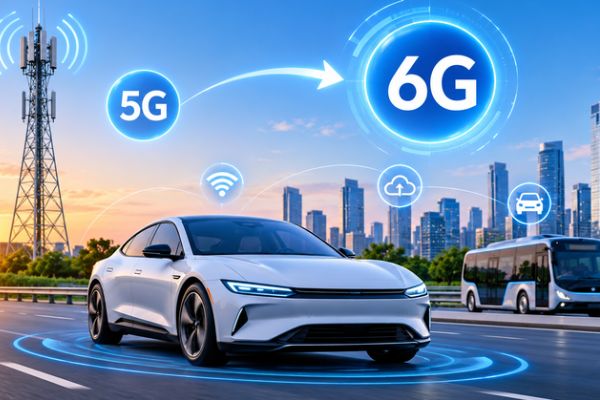
The automotive industry is currently showing a fast-paced development in with respect to the future that involves vehicles that will not only be a means of transport, but also a connected and smart platform. The current automobiles have the ability to communicate with each other, roadside infrastructures, cloud, pedestrians, cell phones, and transportation systems. These innovations are mainly driven by advancements in cellular communications, specifically in 5G technology, and 6G technology is anticipated to bring further improvements to the realm of autonomous and connected vehicles. Connectivity plays a crucial role in ADAS (Advanced Driver Assistance Systems), autonomous driving, smart traffic control, fleet management, and real-time vehicle service. The high-speed and low-latency connectivity can enable the automobiles to exchange information concerning the traffic status, road hazards, vehicle movements, and infrastructure status.
5G and the Connected Vehicle
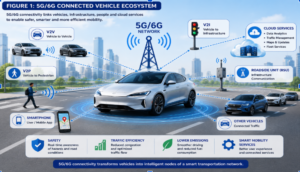
Several of 5G’s capabilities can be considered highly important for automotive applications, including high-speed communications, low latency, reliability, and support of the connection of large numbers of devices. One of the key applications enabled by 5G is Vehicle to Everything (V2X). It includes communications of the vehicle with other vehicles (V2V), with infrastructure (V2I), with pedestrians (V2P), and with network services (V2N).
Thus, for instance, the vehicle can receive information about other vehicles coming to the intersection, road construction, traffic jams, and emergency vehicles. It will complement the information provided by sensors of the vehicle and will help it have a better understanding of the situation.Thus, 5G can enable each vehicle to become a node in a networked intelligent transportation system.
The technology can be particularly useful for Advanced Driver Assistance Systems (ADAS). The modern vehicles have cameras, radar, LiDAR, ultrasonic sensors, and positioning systems to detect what is going on around them. However, they are limited in terms of being able to detect something that is out of the way. Imagine a vehicle that is going towards a blind curve. In this case, the sensors of the vehicle may fail to detect an approaching vehicle before it becomes visible. Thanks to V2X, such information can be received earlier by the ADAS system.
In addition, connected infrastructure can provide a vehicle with information about traffic lights, road conditions, construction sites, accidents, and other potential threats. This creates the possibility of cooperative perception, where vehicles and infrastructure share relevant information to improve situational awareness.
Edge Computing and Intelligent Mobility
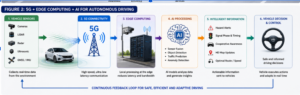
The process of autonomous driving demands fast information processing. A vehicle needs to constantly receive input from its environment, analyze the potential risks and make decisions extremely quickly. 5G’s low latency communication is suitable for the applications where fast information exchange matters.
Yet, the connection should be complementary to the on-board intelligence. The critical safety decisions will need to continue having their own local processing power in order not to become unsafe during the temporary outage of the network connection. This is when the role of edge computing appears. Not all requests need to be sent to a remote cloud data centre – some of the tasks can be processed in a closer proximity to the vehicle using roadside or edge infrastructure.
For instance, an edge platform at a crossroad will be able to collect the data from multiple connected cars, traffic lights, cameras and roadside sensors. It will be able to detect congestion or potential dangers and send relevant information to nearby cars without any delay in the communication. Artificial Intelligence may add value to this ecosystem. Machine learning will allow making predictions about the traffic, optimizing routes, analysing drivers’ behaviour, performing predictive maintenance, detecting anomalies and managing intelligent energy consumption.AI will allow integrating the information obtained through V2X with the on-board sensor information to create a holistic view of the environment.
From 5G to 6G
Whereas 5G is laying down the groundwork for connected cars, 6G will play a bigger part in the application of wireless networking in the future. The International Telecommunication Union has laid out its roadmap for the next 6G technology under the name IMT-2030, whose applications extend far beyond the traditional communication purposes. In the automotive sector, the future 6G network will integrate high-speed connectivity with positioning, sensing, artificial intelligence, and distributed computing functionalities.
It would allow cars to have more enriched interactions with their surroundings and each other. Rather than exchanging mere bits of information like speed or position data, future-connected cars could exchange more comprehensive environmental data. It means that the coming of 6G network should be understood not merely as a higher speed of the network but as a transition towards intelligent networks.
Cybersecurity, Privacy and the Road Ahead
Increased connectivity also increases the attack surface. Connected vehicles communicate with cellular networks, cloud platforms, roadside infrastructure, smartphones, charging infrastructure, and other vehicles.
The possible cybersecurity risks can be message spoofing, replay attack, Man-in-the-Middle attack, Denial-of-Service attack, location spoofing, unauthorized access and data manipulation.
Consequently, there must be several layers of security in the architecture of a connected vehicle. Encryption would provide security for communications while the authentication mechanism would allow verifying the identity of connected devices. PKI, digital certificates, secure gateway, intrusion detection system and secure software updates could further enhance the system.
Cybersecurity must be extended to edge infrastructure and cloud platforms because the connected vehicle ecosystem involves several external services.
Privacy is the third critical aspect. The connected vehicle generates large amounts of information including location, driving behaviour, vehicle diagnostics, and communication information. Encryption, access control, anonymization, data minimization, and retention policy could help to protect this information.
Though the advent of 5G and future 6G technologies brings many opportunities for connected mobility, there are still certain challenges associated with it. Network coverage, reliability, infrastructure costs, interoperability, spectrum availability, cybersecurity, privacy and regulatory compliance will affect the development of connected mobility.
It is essential that the vehicle retains adequate onboard sensing and decision-making capability so that a brief failure of communication does not lead to safety problem.
The development of connected vehicles from 5G to 6G will progressively transform them from an isolated intelligent machine to an active element of the larger transportation ecosystem. The true benefits will come from the convergence of 5G/6G connectivity, AI, edge computing, V2X, autonomous driving, and cybersecurity.
Thus, the development from 5G to 6G is much more than the change of generations of wireless technology. It is the transition towards the development of the transportation ecosystem where vehicles will have the ability to sense, communicate, cooperate and make intelligent decisions. With the development of the ecosystem, the secure and reliable connectivity will become one of the key elements of the future autonomous and connected vehicle.