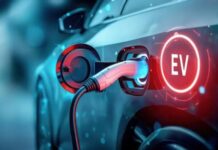

The electric mobility industry is moving beyond conventional charging as battery-swapping technology emerges as an alternative approach to reducing EV energy-replenishment time. Automated EV battery swapping combines robotics, battery management systems, connected software, and charging infrastructure to replace depleted battery packs with charged ones with minimal human intervention.
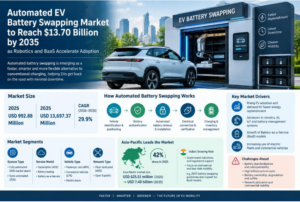
According to Cervicorn Consulting, the global Automated EV Battery Swapping Market was valued at approximately USD 992.88 million in 2025 and is projected to reach nearly USD 13.70 billion by 2035, expanding at a 29.9% CAGR between 2026 and 2035.
The market is gaining momentum as electric two-wheelers, three-wheelers, passenger EVs, commercial fleets, and logistics vehicles increasingly require faster and more predictable energy replenishment. The development of standardized batteries, Battery-as-a-Service (BaaS) models, IoT-enabled stations, and robotic swapping technologies is further supporting market expansion.
Automated Battery Swapping Is Redefining EV Energy Replenishment
Traditional EV charging requires the vehicle to remain connected to a charging system while energy is transferred to its battery. Depending on the charging technology and battery capacity, this process can take anywhere from several minutes to several hours.
Automated battery swapping takes a different approach.
Instead of charging the battery inside the vehicle, an automated station removes the depleted battery and installs a fully charged replacement. The depleted battery is then moved into the station’s charging and monitoring system for later use.
A typical automated swapping process can include:
- Vehicle identification and positioning
- Battery authentication
- Battery locking and unlocking
- Automated battery removal
- Installation of a charged battery
- Electrical connection
- Battery-health verification
- Charging and inventory management
This approach can substantially reduce vehicle downtime, particularly for high-utilization vehicles.
Market Expected to Reach Nearly $13.70 Billion by 2035
Cervicorn Consulting estimates that the global automated EV battery swapping market will increase from USD 992.88 million in 2025 to USD 13,697.37 million by 2035.
The market is expected to expand at a 29.9% CAGR from 2026 to 2035.
Several factors are contributing to this rapid growth. Increasing EV adoption is creating demand for faster energy replenishment, while commercial fleet operators are placing greater emphasis on vehicle utilization and minimizing operational downtime.
At the same time, advances in robotics, artificial intelligence, IoT connectivity, battery diagnostics, and battery-management systems are making automated swapping stations more sophisticated and efficient.
Fully Automated Systems Account for 65% of the Market
Fully automated battery-swapping systems represented approximately 65% of the market in 2025, while semi-automated systems accounted for the remaining 35%, according to Cervicorn Consulting.
Fully automated stations can coordinate the complete battery-exchange process with limited human involvement. Robotics can manage battery removal and installation, while sensors and software can identify the vehicle, verify battery compatibility, and monitor the condition of the replacement pack.
Automation also provides an important advantage as station utilization increases.
A station serving a small number of vehicles may be able to rely on manual processes. However, high-volume fleet operations require greater consistency, throughput, and battery-handling efficiency.
This makes automation particularly relevant for logistics hubs, fleet depots, delivery networks, and other high-utilization applications.
Battery-as-a-Service Creates New Business Models
Technology is only one part of the battery-swapping equation. The development of Battery-as-a-Service (BaaS) is also changing the economics of EV ownership.
Under a BaaS model, users can access battery capacity and swapping services without necessarily purchasing the battery together with the vehicle.
This can reduce the upfront cost of an EV while creating recurring revenue opportunities for battery and infrastructure providers.
Subscription-based services represented approximately 42% of automated EV battery swapping market revenue in 2025, making them the leading service model.
Battery leasing and Battery-as-a-Service represented another important segment and are expected to expand as EV users and fleet operators seek more flexible battery ownership arrangements.
The model can be particularly attractive for commercial operators, where reducing vehicle downtime can have a direct impact on revenue and fleet productivity.
Passenger Cars Currently Lead, While Commercial Fleets Offer Major Potential
Passenger cars represented approximately 48% of the automated EV battery swapping market in 2025, making them the largest vehicle segment.
For passenger EV users, automated swapping can provide a convenient alternative to waiting for a battery to recharge.
However, the commercial vehicle market presents a particularly strong economic case.
Delivery vehicles, taxis, logistics fleets, and other high-utilization EVs may operate for much of the day. Every additional hour spent charging can potentially reduce vehicle availability.
Battery swapping can address this challenge by enabling vehicles to return to operation quickly.
Medium and heavy commercial vehicles accounted for approximately 17% of the market in 2025, while electric buses are also emerging as an attractive application because of their high daily utilization and fixed operating routes.
Fleet-Dedicated Networks Lead the Market
Closed or fleet-dedicated networks represented approximately 45% of the automated EV battery swapping market in 2025.
Fleet-dedicated infrastructure offers operators greater control over station locations, battery inventory, vehicle schedules, and energy requirements.
For example, a logistics company operating a fleet of electric delivery vehicles can establish swapping facilities near distribution centers or along frequently used routes.
This creates a predictable demand pattern that can improve station utilization.
Open and public networks are also expanding as operators seek to make swapping infrastructure accessible to a wider range of EV users. However, interoperability and battery standardization remain important requirements for developing large-scale public networks.
Asia-Pacific Dominates Automated EV Battery Swapping
Asia-Pacific represented the largest regional market in 2025.
Cervicorn Consulting estimates that the Asia-Pacific automated EV battery swapping market was valued at approximately USD 625.51 million in 2025 and could reach nearly USD 7.40 billion by 2035.
The region benefits from several structural advantages, including large-scale EV manufacturing, battery production capabilities, growing urban mobility demand, and government support for electric transportation.
China is particularly important to the development of the battery-swapping ecosystem, with automakers, battery manufacturers, and infrastructure companies investing in automated swapping networks.
The region is also seeing increasing deployment of swapping solutions for electric two-wheelers, three-wheelers, passenger vehicles, logistics fleets, and other commercial applications.
India Emerges as an Important Market
India represents another significant opportunity for automated battery-swapping technology, particularly in commercial and last-mile mobility.
Electric two-wheelers and three-wheelers are increasingly used for delivery, passenger transportation, and urban logistics. These vehicles often operate for extended periods and therefore have a strong need for rapid energy replenishment.
Government initiatives are also helping establish a regulatory framework for battery swapping.
In January 2025, India’s Ministry of Power issued guidelines covering the installation and operation of battery-swapping and battery-charging stations. The framework supports battery swapping as an alternative energy-replenishment method and encourages Battery-as-a-Service models.
Technology developers are also working on automated swapping solutions for commercial applications. In March 2026, InfinityX Innovations received support from India’s Technology Development Board and Department of Science & Technology to commercialize and expand its IoT-enabled automated battery-swapping technology.
Robotics and IoT Are Making Swapping Stations Smarter
The next generation of battery-swapping infrastructure is expected to rely heavily on connected technologies.
IoT sensors can monitor battery location, temperature, state of charge, state of health, and other operational parameters. Artificial intelligence and data analytics can then be used to optimize battery inventory, predict maintenance requirements, and improve station utilization.
Connected platforms can also provide operators with real-time information about:
- Available charged batteries
- Battery health
- Station utilization
- Charging status
- Vehicle demand
- Energy consumption
- Maintenance requirements
This creates an integrated digital ecosystem linking EVs, batteries, swapping stations, charging infrastructure, and fleet-management platforms.
Battery Standardization Remains a Critical Challenge
Despite its growth potential, automated battery swapping faces several challenges.
The biggest is battery standardization and interoperability.
Different EV manufacturers can use batteries with different dimensions, capacities, connectors, cooling architectures, communication protocols, and battery-management systems. This makes it difficult to create a single swapping network that can accommodate multiple vehicle platforms.
Infrastructure costs are another challenge.
Automated swapping stations require investment in robotic equipment, battery inventory, charging systems, land, grid connections, software, and maintenance.
Battery ownership, degradation, safety, warranty responsibility, and residual value also need to be addressed as BaaS models expand.
The long-term success of the industry will therefore depend not only on improving automation but also on developing common standards and commercially viable network models.
Commercial Fleets Could Become a Major Growth Engine
The economics of automated battery swapping become particularly compelling when vehicle utilization is high.
A privately owned passenger EV may remain parked for several hours each day, allowing charging to take place without significantly affecting the driver’s schedule.
A delivery vehicle or taxi, however, can lose revenue every time it remains unavailable.
This creates a strong incentive for fleet operators to consider energy-replenishment solutions that minimize downtime.
As logistics companies, ride-hailing operators, delivery platforms, and public transportation providers electrify their fleets, automated swapping could become an important part of their energy infrastructure.
The Future of EV Energy Infrastructure Will Be More Diverse
Battery swapping is unlikely to completely replace conventional EV charging.
Instead, the two technologies are likely to serve different operating requirements.
Home and workplace charging can remain convenient for vehicles that are parked for extended periods, while DC fast charging can support drivers requiring rapid energy replenishment.
Automated battery swapping can offer a different value proposition for vehicles where downtime, utilization, and predictable operating schedules are critical.
The convergence of robotics, battery-management systems, IoT, artificial intelligence, standardized batteries, and BaaS models could therefore make automated swapping an increasingly important component of the global EV infrastructure ecosystem.
With the global market projected to expand from USD 992.88 million in 2025 to nearly USD 13.70 billion by 2035, automated EV battery swapping is moving from a niche technology toward a potentially significant part of the future electric-mobility landscape.
The ultimate opportunity will depend on whether the industry can solve interoperability, infrastructure cost, battery ownership, and network-utilization challenges while continuing to improve automation and battery technology.