
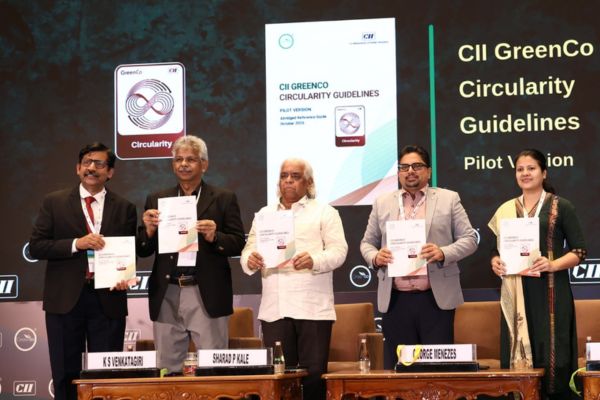
The Confederation of Indian Industry (CII) GreenCo Council launched the “CII GreenCo Circularity Guidelines – Pilot Version” at the 17th edition of the CII GreenCo Waste & Resource Management Summit 2026 in Chennai. Held under the theme “Accelerating Circular Economy through Resource Efficiency & Innovation,” the Summit brought together industry leaders, policymakers, technology experts and sustainability practitioners to deliberate on advancing circularity across Indian industry.
The launch marked an important step towards strengthening the adoption of circular economy principles in India’s manufacturing and process industries. As businesses seek to optimise resource consumption, minimize waste and reduce environmental impact, the guidelines provide a structured approach to assessing and strengthening circularity practices across industrial operations.
The guidelines and framework provide indices to assess circularity across key resource inputs, including raw materials, consumables and packaging, among other relevant areas. These indices are intended to help industries evaluate their existing practices, identify opportunities to improve resource productivity, and track progress towards more circular use of materials. A structured framework and credible certification pathway can also help establish measurable benchmarks, strengthen accountability and encourage continuous improvement across manufacturing and process industries.
Padma Shri Dr. Sharad P. Kale, Special Advisor to the Chief Minister, Government of Goa and former scientist at Bhabha Atomic Research Centre (BARC), said, “Circularity must begin with a fundamental change in how we view and manage resources. While technology and policy have important roles to play, every individual must recognize the need to reduce waste at source and make circularity a way of life. Responsible consumption, resource conservation and waste reduction must become integral to our daily practices, as well as to the way industries operate. A collective commitment to these principles will be essential to building a sustainable future.”
Mr. George Menezes, Adviser – Sustainability, Godrej Enterprises Group, said, “The CII GreenCo Circularity Guidelines – Pilot Version is an important initiative towards bringing greater structure and direction to circularity practices in Indian industry. Manufacturing and process industries need a common framework that can help them assess their current practices, identify improvement opportunities and measure progress towards circular resource use. A well-defined certification mechanism can further encourage accountability, consistency and continuous improvement. I urge industries to participate in the pilot, apply the guidelines within their operations and share feedback to help strengthen the framework for wider industry adoption.”
Mr. K. S. Venkatagiri, Executive Director, CII Green Business Centre, said, “Over the years, CII GreenCo has supported Indian industry in advancing environmental sustainability through several pioneering initiatives. From the GreenCo Rating System to Zero Waste to Landfill and Zero Liquid Discharge certifications, these initiatives have helped companies strengthen their sustainability practices and pursue measurable environmental improvements. The launch of the CII GreenCo Circularity Guidelines – Pilot Version builds on this journey by addressing the growing need to embed circularity into industrial operations. We invite manufacturing and process industries to participate in the pilot, engage with the framework and contribute their feedback as we work towards strengthening circularity practices across Indian industry.”
The Summit also featured discussions on “Waste to Wealth: Building India’s Circular Manufacturing Ecosystem,” highlighting how businesses could unlock value from waste through resource recovery, industrial symbiosis, circular product and process design, and collaboration across the value chain.
Technical sessions explored advanced recycling technologies, including mechanical, chemical, biological and thermal processes, as well as opportunities in biogas, Bio-CNG/CBG, waste-to-energy, e-waste recycling, electronics and battery circularity. Another session examined how digitalisation, artificial intelligence, smart sensors, automation and digital traceability could improve waste collection, segregation, recycling and resource recovery.
The need for the “CII GreenCo Circularity Guidelines” is particularly significant for manufacturing and process industries, where substantial quantities of raw materials, water and energy are consumed and a range of waste streams are generated. The pilot version offers an opportunity to test the framework in industrial settings, gather feedback and refine it for wider adoption.
CII GreenCo invites manufacturing and process industries to engage with the CII GreenCo, trial the framework in their operations and share feedback to support its further development. Industry participation will be important in ensuring that the guidelines are practical, measurable and relevant to the diverse resource-use and process requirements of Indian industry.



 GreenCo Council launched the “CII GreenCo Circularity Guidelines – Pilot Version” at the 17th edition.)