
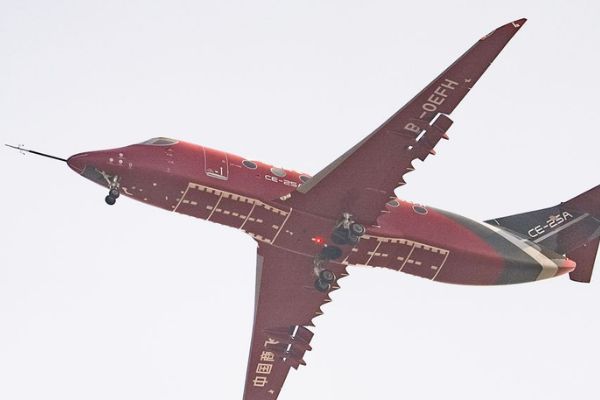
COMAC’s announcement that the electric CE-25A aircraft successfully completed a manned flight is exciting and an important step forward towards electrified passenger air travel; however, there is still a long way to go. The relatively low energy density of lithium-ion batteries is the primary barrier that passenger aviation faces as it attempts to electrify. High-nickel NMC cells for automotive applications offer around 250-300 Wh/kg at the cell level. Comparatively, jet fuel can provide around 10,000 Wh/kg. As a result, electric aircraft require a higher mass of batteries to achieve the same energy, meaning that a compromise must be made on overall range and payload. In this flight, for example, the pilot and 2 copilots were flown 60.4 km, which is a far cry from major long-haul flights that frequently transport more than 500 passengers thousands of kilometers. COMAC, like other electric aircraft developers, is focusing on smaller aircraft (the CE-25A being designed for 19 passengers) and shorter-range flights (regional and inter-city), to account for this lower range and limited payload.
In 2023, COMAC announced a partnership with battery manufacturer Contemporary Amperex Technology Co. Limited (CATL), one of the largest battery cell manufacturers in the world. In the same year, CATL launched its Condensed Battery, which it claims can achieve an energy density of up to 500 Wh/kg at the cell level – almost double that of conventional NMC cells (although pack-level energy density is likely closer to 350-400 Wh/kg). CATL have not disclosed the full technical details of the technology, but it is likely a form of semi-solid battery, i.e. using a gel or polymer electrolyte rather than conventional liquid electrolytes. Semi-solid electrolytes are more stable than liquid electrolytes, enabling utilization of higher-energy anodes, for example, silicon-based or lithium metal anodes. This enables the cell to have an overall higher energy density than would otherwise be possible. Compared with conventional liquid electrolytes, these electrolytes can also improve safety by helping to suppress thermal runaway and reduce the risk of internal short circuits, a particularly important consideration for electrified aviation.
This week’s news is important for both the future of electric passenger aviation and the potential role of next-generation battery technologies in enabling it. However, even though COMAC’s successful manned flight of the CE-25A 19-passenger aircraft is a major milestone, there remains a long journey ahead before large commercial passenger aircraft are entirely battery-powered, with many players instead pursuing hybrid systems or using hydrogen to counteract the limited maximum energy density of lithium-ion batteries.
IDTechEx offers a range of independent research covering technology innovations closely related to this development, including market and technology.