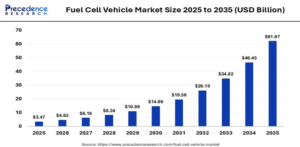
According to Precedence Research, the global fuel cell vehicle market size was calculated at USD 3.47 billion in 2025 and is predicted to increase from USD 4.63 billion in 2026 to approximately USD 61.97 billion by 2035, expanding at a CAGR of 33.41% from 2026 to 2035.
Fuel Cell Vehicle Market Key Insights
- Asia Pacific led the fuel cell vehicle market by holding the largest share of 53% in 2025.
- North America is expected to grow at a significant CAGR during the forecast period.
- By vehicle type, the passenger cars segment held the largest share of the market in 2025.
- By vehicle type, the light commercial vehicles (LCVs) segment is expected to grow at the highest CAGR between 2026 and 2035.
- By component, the fuel stack segment held the largest share of the market in 2025.
- By component, the humidifier segment is expected to expand at the fastest CAGR during the forecast period.
Fuel Cell Vehicle Market Overview
The fuel cell vehicle industry is a prominent segment of the automotive sector. This industry deals with the production and distribution of fuel cell vehicles across the globe. These vehicles are operated using various technologies, such as proton exchange membrane fuel cell, solid oxide fuel cell, alkaline fuel cell, and phosphoric acid fuel cell. The increasing demand for fuel cell vehicles from the commercial sector, along with research and development related to hydrogen fuel, is driving the market.
Regional Outlook for Fuel Cell Vehicle Market
North America: is expected to expand at a significant CAGR during the forecast period. The growing demand for hydrogen cars from the elite-class consumers in the U.S., Canada, and Mexico is boosting the market growth. Additionally, several government policies aimed at lowering emissions, along with technological advancements in the automotive sector, are positively contributing to the industry. Moreover, the presence of numerous market players, including General Motors, Nikola Corporation, Hyzon Motors, and Cummins, is expected to propel the growth of the market in this region.
Asia-Pacific: dominated the fuel cell vehicle market by capturing the largest share in 2025. The region’s dominance in the market is attributed to the increased sales of hydrogen trucks in several nations, including Japan, China, India, and South Korea.
Numerous government initiatives aimed at strengthening the hydrogen infrastructure, coupled with the rise in the number of automotive workshops, also bolstered the market in the region. Moreover, the presence of several market players, such as Hyundai, Nissan, and Toyota, focuses on innovation and research & development in hydrogen technology, which reinforces the region’s leadership in the market.
Europe: The European fuel cell vehicle market is being propelled by stringent emission regulations, strong government incentives, and ambitious decarbonization targets across the region. Investments in hydrogen infrastructure, including refueling stations and production facilities, are making FCVs more accessible and practical for consumers and commercial fleets. Additionally, Europe’s focus on sustainable mobility, coupled with significant R&D and pilot projects by automakers and energy companies, is accelerating technological innovation.
Market Scope
| Report Coverage | Details |
| Market Size in 2025 | USD 3.47 Billion |
| Market Size in 2026 | USD 4.63 Billion |
| Market Size by 2035 | USD 61.97 Billion |
| Market Growth Rate from 2026 to 2035 | CAGR of 33.41% |
| Dominating Region | Asia Pacific |
| Fastest Growing Region | North America |
| Base Year | 2025 |
| Forecast Period | 2026 to 2035 |
Segmental Outlook of Fuel Cell Vehicle Market
By Vehicle Type Insights
Why Did the Passenger Cars Segment Dominate the Fuel Cell Vehicle Market?
The passenger cars segment dominated the market while holding a major revenue share in 2025. This is mainly due to the increased sales of hydrogen-based passenger cars in several nations, including the U.S., Japan, Germany, Canada, Norway, India, and South Africa.
Additionally, the rapid investment by the automotive companies for opening new production units to increase the manufacturing of fuel cell passenger vehicles bolstered the segment. Moreover, the growing emphasis of several automakers, such as Toyota, General Motors, Hyundai, and Honda, on R&D and commercial launches for fuel cell passenger cars is expected to ensure the long-term growth of the segment.
By Component Insights
What Made Fuel Stack the Dominant Segment in the Fuel Cell Vehicle Market?
The fuel stack segment dominated the market with the largest share in 2025. This is because it is the core component in fuel cell vehicles to convert hydrogen directly into electrical energy for delivering power. Its numerous advantages include environmental benefits, high efficiency, superior power density, and enhanced reliability. Their critical role in vehicle operation and continuous improvements in efficiency and lifespan make this segment central to the market.
The humidifier segment is expected to grow at the fastest CAGR during the forecast period. This is mainly due to the growing application of a humidifier in FCVs to manage moisture levels in the fuel cell stack. Moreover, several functions of a humidifier, such as transferring water vapor, improving vehicle performance, protecting the membrane from dehydration, and enhancing the longevity of proton exchange membrane fuel cell (PEMFC) is expected to drive the growth of the segment.
Recent Developments
Video Games Market Companies
- In April 2026, Elemental Trucks Inc. (ETI) introduced North America’s first hydrogen fuel cell heavy-duty truck, weighing 63.5 tonnes, at Truck World 2026. Designed for Canada’s challenging conditions, it serves as a sustainable alternative to diesel and CNG in heavy-haul operations.
- In April 2026, BMW Group will begin series production of its iX5 Hydrogen FCEV in 2028, featuring a collaborative third-generation fuel cell with Toyota that enhances efficiency, output, and range while minimizing energy consumption and enabling compact integration.
Fuel Cell Vehicle Market Companies
Honda Motor Co., Ltd. – Honda develops hydrogen fuel cell vehicles and invests in clean mobility solutions through advanced fuel cell technology and strategic partnerships. The company aims to achieve carbon neutrality by expanding hydrogen-powered transportation and energy applications.
Nikola Corporation – Nikola specializes in hydrogen fuel cell and battery-electric commercial trucks designed for long-haul freight transportation. The company is also building hydrogen refueling infrastructure to support zero-emission logistics.
Toyota Motor Corporation – Toyota is a global leader in hydrogen mobility, with its Mirai fuel cell electric vehicle serving as a flagship model. The company continues to invest in hydrogen production, storage, and fuel cell technologies across multiple industries.
BMW AG – BMW is advancing hydrogen fuel cell technology through pilot projects such as the BMW iX5 Hydrogen. The company views hydrogen as a complementary solution to battery-electric vehicles, particularly for long-distance mobility.
AUDI AG – Audi is researching hydrogen fuel cell systems and sustainable mobility solutions as part of its long-term decarbonization strategy. The company focuses on innovative propulsion technologies to support future zero-emission transportation.
AB Volvo – AB Volvo develops hydrogen-powered trucks and heavy-duty transport solutions to reduce carbon emissions in commercial transportation. The company collaborates with industry partners to accelerate hydrogen infrastructure and fuel cell adoption.
General Motors – General Motors leverages its Hydrotec fuel cell technology for automotive, defense, rail, and stationary power applications. The company is expanding hydrogen-based solutions through collaborations aimed at decarbonizing multiple sectors.
Hyundai Motor Group – Hyundai is a pioneer in hydrogen mobility, offering fuel cell electric vehicles and commercial trucks under its HTWO hydrogen brand. The company invests heavily in hydrogen ecosystems, including production, storage, and distribution technologies.
Ballard Power Systems Inc. – Ballard Power Systems is a leading manufacturer of proton exchange membrane (PEM) fuel cell technologies for buses, trucks, trains, marine vessels, and stationary power. The company focuses on delivering clean hydrogen energy solutions for heavy-duty and industrial applications.