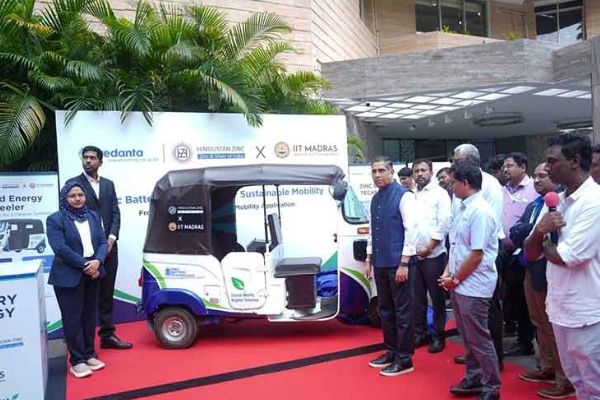
Hindustan Zinc, in collaboration with the Indian Institute of Technology Madras (IIT Madras), has unveiled an electric three-wheeler prototype integrated with an approximately 1 kWh zinc-air battery designed as a range extender for electric mobility applications. The development marks progress in the institutions’ research collaboration to advance indigenous zinc-based energy storage technologies and explore new applications for zinc in the electric mobility sector.
The prototype was unveiled during the IIT Madras Energy Summit 2026 in the presence of Praveen Chakravarthy, Member of Parliament (Rajya Sabha), Amarendu Prakash, CEO and Whole-time Director of Hindustan Zinc, Prof. Manu Santhanam, Dean (ICSR) at IIT Madras, and Dr. Aravind Kumar Chandiran from the Department of Chemical Engineering at IIT Madras, who led the project, along with other stakeholders.
The electric three-wheeler features a dual-battery configuration, with the zinc-air battery contributing nearly 10% of the vehicle’s total energy requirements. The existing lithium-ion battery supports acceleration and peak power requirements, while the zinc-air battery provides a steady supply of energy during vehicle operation. The configuration demonstrates the potential of zinc-based battery technologies to complement existing energy storage systems in electric mobility applications.
Zinc-air batteries generate electricity by utilising zinc and oxygen from the surrounding air. The technology uses a non-flammable, water-based electrolyte and an abundant, recyclable metal. These characteristics offer potential advantages in safety, affordability and environmental sustainability. India’s significant zinc resources also present an opportunity to strengthen domestic energy storage capabilities, support energy self-reliance and develop value-added applications for the metal.
The collaboration between Hindustan Zinc and IIT Madras was initiated in 2024 and has progressed from laboratory-scale research to a vehicle-level demonstration. Commenting on the development, Amarendu Prakash said the company is exploring new applications for zinc and indigenous energy storage solutions to create additional demand avenues for the metal. Prof. V. Kamakoti, Director of IIT Madras, highlighted the importance of research, development and commercialisation in energy generation, storage and distribution, particularly for renewable energy applications.
The collaboration forms part of Hindustan Zinc’s broader growth and diversification strategy under HZL 2.0, which focuses on exploring emerging applications of zinc and expanding its presence in value-added product segments. The company is exploring opportunities in renewable energy storage and electric mobility through zinc-based battery technologies. The vehicle-level demonstration marks progress in developing indigenous zinc-air battery technology and evaluating its potential for emerging energy storage applications.