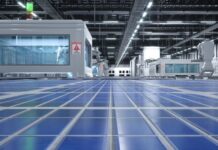

Masdar has achieved the financial closing of its landmark $6.1 billion renewable energy project in Abu Dhabi, marking a major milestone in the development of one of the world’s largest integrated solar and battery energy storage facilities. The project combines 5.2 GW of solar photovoltaic (PV) capacity with a 19 GWh Battery Energy Storage System (BESS) to deliver reliable clean energy on a massive scale.
The renewable energy project is being developed in partnership with the Emirates Water and Electricity Company (EWEC). A financing package worth $5.1 billion has been secured through a consortium of international and regional banks, while Masdar is investing $1 billion in equity. The financial close enables the project to move ahead at full pace toward construction and future operations.
Designed to provide 1 GW of uninterrupted clean electricity 24 hours a day, seven days a week, the project is expected to become the world’s first gigascale renewable energy facility capable of delivering round-the-clock power. By combining large-scale solar generation with advanced battery storage, the project addresses one of the biggest challenges of renewable energy—ensuring continuous power supply beyond daylight hours.
Construction of the project began in October 2025, and commercial operations are expected to commence in 2027. The large-scale deployment of battery storage technology will help stabilize electricity supply, improve grid reliability, and support the UAE’s long-term clean energy ambitions while reducing dependence on conventional power generation.
The project is also expected to strengthen Abu Dhabi’s position as a global leader in renewable energy and energy storage innovation. It reflects the growing trend of integrating utility-scale battery systems with renewable power plants to enhance energy security, improve flexibility, and accelerate the transition toward low-carbon electricity systems.
With financial closure now complete, Masdar and its partners are entering the next phase of project execution. Once operational, the solar-plus-storage facility is expected to set new global benchmarks for renewable energy infrastructure, demonstrating how large-scale battery storage can enable dependable, clean electricity while supporting sustainable economic growth and global decarburization goals.