
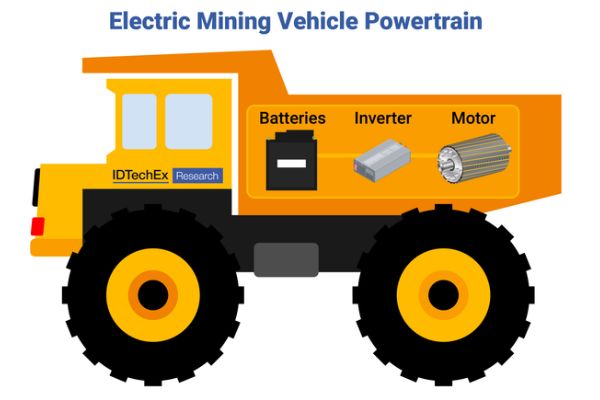
The mining industry is seeing a major surge in the electrification of its machines, due to the environmental, operational, and financial benefits that they can provide. However, electrification in mining is wholly different from what is seen in automotive or other heavy-duty transport sectors, as mining machines are significantly bigger, run for much longer, and need to operate in harsh environments across all weather conditions. This places unique demands on key powertrain components including batteries, motors, and inverters, all of which will need to be specialized for mining applications. IDTechEx’s new “Electric Vehicles in Mining 2027-2047: Technologies, Players, Forecasts” report dives deep into the powertrain innovations taking place that will fuel the adoption of electric mining machines and lead the market to grow to over US$27 billion in value by 2047.
Bigger battery packs and more diverse battery technologies
The sheer size of mining machines along with their intense operational duty cycles demand the installation of large battery packs. Most haul trucks weigh over 150 tonnes, with the largest ones reaching up to 350 tonnes, and will need to carry loads even heavier than themselves over a nearly 24/7 operational cycle – thus requiring MWh-scale batteries to enable such performance. Such large battery packs have only been commercialized in the last few years with the maturation of the battery industry and falling Li-ion cell prices. However, battery manufacturers and machine OEMs are already investing heavily in their ability to meet the needs of machines, and they are continuously increasing the size of battery packs used in new haul truck models. The largest battery pack used in a mining machine today reaches up to 2.4 MWh in capacity, up from 1.9 MWh as recently as 2024.
At the same time, the low downtime requirements of many machines mean they require fast charging at high C-rates. Modern charging systems on mines can now achieve 3 MW+ charging consistently, with development moving towards 6 MW charging. While this boosts the machine’s productivity, it comes with accelerated degradation of the battery and a subsequently limited cycle life. This poses a risk that a machine may require its battery to be replaced during its lifetime, incurring great expense that operators would prefer to avoid.
This is where diverse battery technologies such as LTO (lithium titanate oxide) anodes may play a role. The use of an LTO anode instead of graphite – typically paired with an NMC cathode – produces a cell with significantly lower energy density, but crucially undergoes very small volume changes during cycling. This leads to excellent cycle life of 20,000 to 60,000 cycles, as well as being more tolerant to fast charging at higher C-rates. The unique combination of parameters makes LTO packs a promising option for the future of electric mining machines, and one which is already beginning to see uptake. Additionally, the lower density and higher cost (~US$750/kWh) of these packs are of less concern for mining machines since they are already heavy to begin with and are able to recuperate high upfront costs through the enhanced productivity LTO can offer.
Efficiency and cost will drive motor & inverter design
IDTechEx’s report finds that efficiency and cost will be two parameters that OEMs aim to optimize in the design of motors and inverters for electric mining machines. While these factors are important to some extent for all mobility applications, they are especially important in the context of large mining machines, where even small enhancements in powertrain efficiency can lead to a significant reduction in battery size – which is often the main cost factor OEMs are concerned with.
Permanent magnet (PM) motors are generally the most efficient commercial motor construction. However, efficiency must also be balanced with cost, and PM motors suffer from the use of permanent magnets which contain costly and supply-constrained rare earth minerals. This has driven some manufacturers such as Caterpillar, Dana, and Turntide to consider alternatives such as switched reluctance motors (SRMs), which are cheaper and more durable but notably less efficient.
Similar tradeoffs between efficiency and cost are also seen in the inverters used for mining machines. Both Si IGBTs and SiC MOSFETs have been introduced to the mining market, with the former offering lower costs and the latter providing enhanced performance. Ultimately, the decision of what motor construction and inverter technology goes into a given machine will depend on its size, operational requirements, and cost considerations, as well as the technologies and supply relationships available to specific OEMs.
The mining market is also increasingly adopting the trend of powertrain integration seen in automotive & on-road sectors, where motors, inverters, axles, and more are integrated into a combined product. This helps OEMs reduce development costs while producing drivetrains that are both lower cost and more efficient, helping to accelerate the adoption of electric machines in mines globally.