
EV Charging Innovation Is Moving Inside the Vehicle
The electric vehicle charging conversation often focuses on what sits outside the vehicle: public charging stations, high-power DC chargers and expanding charging networks.
But an equally important transformation is occurring inside the EV.
The onboard charger, or OBC, converts alternating current supplied by the electricity network into direct current that can charge the vehicle’s high-voltage battery.
As electric vehicles become more sophisticated, this component is being asked to do substantially more.
Automakers want smaller power-electronics packages.
They want higher efficiency and power density.
They are moving toward 400 V and 800 V architectures.
They increasingly want bidirectional energy transfer.
And they are integrating previously separate power-electronics functions to reduce weight, wiring, components and packaging volume.
These trends are creating an important opportunity for single-stage onboard charger architectures.
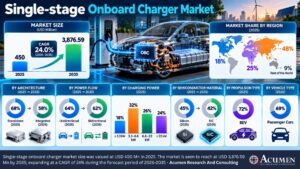
According to Acumen Research and Consulting, the global single-stage onboard charger market was valued at USD 450 million in 2025 and is projected to reach USD 3,876.59 million by 2035, representing a 24.0% CAGR during 2026–2035.
The opportunity, however, is about more than installing OBCs in a growing number of electric vehicles.
It represents a broader transition in EV power electronics:
Standalone → Integrated
Unidirectional → Bidirectional
Silicon → SiC and GaN
Lower power → Higher power density
400 V → 800 V
Together, these shifts could fundamentally change the role of the onboard charger.
What Is a Single-stage Onboard Charger?
An onboard charger converts AC electricity from a home, workplace or public AC charging point into regulated DC electricity suitable for the vehicle battery.
Conventional OBC architectures commonly use multiple power-conversion stages.
A typical approach separates power-factor correction from the DC-DC conversion function.
A single-stage onboard charger integrates more of this conversion process into a consolidated architecture.
The potential advantages include fewer conversion stages, lower component count, improved packaging efficiency and potentially higher power density.
The engineering trade-off is that single-stage systems can require more sophisticated topology and control optimization.
The architecture therefore is not automatically superior for every vehicle.
Its value depends on factors including charging power, battery voltage, bidirectional capability, isolation requirements, thermal performance, semiconductor selection, vehicle packaging and cost.
Modern OBCs span a wide range of power ratings. STMicroelectronics, for example, describes contemporary OBC applications ranging from approximately 3.6 kW single-phase systems to 22 kW three-phase converters, with efficiency, reliability, size and weight all critical design considerations.
Single-stage Onboard Charger Market Could Approach $3.88 Billion by 2035
The single-stage onboard charger market is projected to expand from USD 450 million in 2025 to USD 3,876.59 million by 2035.
That represents more than an eightfold expansion over ten years and a 24.0% CAGR between 2026 and 2035.
Several structural trends are converging to support this growth.
Global battery-electric vehicle production continues to expand.
Vehicle battery packs are becoming larger.
Higher-voltage electrical architectures are gaining adoption.
Automakers face persistent pressure to reduce vehicle weight and improve efficiency.
And consumers increasingly expect faster and more flexible charging.
These requirements place pressure on the OBC.
It must deliver more power without becoming disproportionately larger or heavier.
It must operate efficiently across different battery conditions.
And increasingly, it may need to move electricity in both directions.
This is why the next decade of OBC development will likely be shaped as much by power density and system integration as by charging power itself.
Standalone OBCs Lead Today, but Integrated Architectures Are Taking Over
Standalone single-stage OBCs represented 68% of market revenue in 2025, compared with 32% for integrated architectures.
That balance is projected to reverse.
Integrated single-stage OBCs are expected to reach 58% market share by 2035, expanding at approximately 26.0% CAGR during the forecast period.
This represents one of the most important changes occurring in the market.
EVs contain multiple power-conversion systems.
The OBC converts AC electricity into DC for battery charging.
A DC-DC converter typically steps high-voltage battery power down to lower voltages required by vehicle systems.
The traction inverter converts DC battery power into the AC electricity required by the electric motor.
Historically, these functions could be implemented using relatively distinct modules.
Increasingly, automakers and suppliers are exploring integrated architectures.
Combining an OBC with DC-DC conversion can eliminate duplicated housings, cooling systems, wiring and other components.
The potential benefits include:
- Reduced weight.
- Smaller packaging volume.
- Fewer components.
- Simplified wiring.
- Potential manufacturing efficiencies.
- Greater overall power-electronics integration.
This matters because space inside an electric vehicle is extremely valuable.
Every reduction in power-electronics volume potentially creates more freedom for battery packaging, passenger space, thermal systems or vehicle design.
The competitive question is therefore moving beyond “Who can build the most efficient charger?”
It increasingly becomes “Who can integrate the most power-electronics functionality into the smallest reliable package?”
Bidirectional OBCs Could Overtake Unidirectional Systems
The second major transition is occurring in power flow.
Unidirectional systems accounted for 64% of the single-stage onboard charger market in 2025.
Bidirectional systems represented 36%.
By 2035, however, bidirectional OBCs are projected to account for approximately 62% of the market.
This could significantly expand what an EV can do.
A conventional unidirectional OBC follows a simple energy path:
Electricity Grid → EV → Battery
A bidirectional OBC can potentially enable:
Electricity Grid ↔ EV Battery
That two-way power conversion creates several emerging applications.
Vehicle-to-Grid — V2G
Electricity stored in the vehicle battery can potentially be supplied back to the electricity network when supported by the vehicle, charger, grid connection, communication standards and local regulation.
Vehicle-to-Home — V2H
An EV battery can potentially supply electricity to a home through an appropriately designed system.
Vehicle-to-Load — V2L
The vehicle can provide electricity to external appliances or equipment.
Vehicle-to-Everything — V2X
V2X is the broader concept covering multiple ways vehicle batteries may interact with external energy systems.
The strategic implication is substantial.
An EV equipped with suitable bidirectional technology is not merely an electricity consumer.
Its battery can potentially become a mobile energy resource.
Bidirectional Charging Could Connect EVs With the Energy-Storage Market
The expansion of bidirectional charging also creates a connection between two rapidly growing markets: electric vehicles and distributed energy storage.
Millions of EVs collectively represent substantial battery capacity.
Most vehicles also spend significant portions of the day parked.
If a portion of this capacity becomes accessible through managed bidirectional charging, EVs could eventually complement stationary energy-storage systems for selected applications.
The onboard charger is one of the enabling technologies required for that transition.
But hardware alone is insufficient.
Large-scale V2G deployment also requires compatible charging equipment, communication protocols, grid rules, energy-management software, utility participation and appropriate consumer economics.
Bidirectional OBC adoption should therefore not be interpreted as equivalent to immediate V2G deployment.
Instead, it creates the vehicle-side technical capability that can support a broader bidirectional energy ecosystem.
Silicon Leads Today—SiC Could Become No. 1 by 2035
The semiconductor transition represents another major market shift.
Silicon devices accounted for approximately 45% of the market in 2025, making silicon the leading semiconductor material.
Silicon carbide represented approximately 35%.
By 2035, however, SiC is projected to become the largest semiconductor-material category with approximately 42% market share.
The reason is electrical performance.
Silicon has decades of manufacturing maturity, extensive automotive qualification and attractive economics.
It therefore remains highly competitive in cost-sensitive and lower- to medium-power applications.
But high-power and high-voltage OBCs create more demanding operating requirements.
SiC devices can offer lower switching losses and support higher switching frequencies and elevated operating temperatures.
Higher switching frequency can also enable reductions in the size of some passive components.
The potential system-level result is:
Higher efficiency + Higher switching frequency + Smaller passive components + Improved power density
This combination becomes particularly valuable as EV manufacturers move toward high-voltage electrical architectures.
Why 800 V EV Platforms Matter for OBC Design
The move from conventional 400 V-class architectures toward 800 V EV platforms is changing multiple parts of the electric powertrain.
Higher-voltage systems can reduce current for a given power level, helping reduce resistive losses and enabling high-power operation.
Much of the consumer discussion around 800 V vehicles focuses on DC fast charging.
But higher battery voltages also affect onboard power-electronics design.
OBCs need appropriate semiconductor voltage ratings, insulation, thermal management, control systems and converter topologies.
This makes wide-bandgap semiconductors particularly attractive.
SiC has already become strategically important across traction inverters and other high-voltage EV systems, and the same material properties can benefit high-power OBCs.
Acumen’s technology analysis highlights advanced OBC architectures spanning 400 V and 800 V platforms, alongside increasing use of SiC in high-voltage and high-power applications.
GaN Could Become the Next Power-Density Opportunity
Silicon carbide is not the only wide-bandgap semiconductor influencing the market.
Gallium nitride, or GaN, represents another emerging opportunity.
GaN devices can operate at very high switching frequencies, potentially enabling smaller magnetic components and compact power-conversion systems.
This could make GaN attractive where power density, weight and packaging are particularly important.
But SiC and GaN should not necessarily be viewed as direct substitutes across every OBC design.
The optimal semiconductor depends on voltage, power, topology, thermal requirements, switching frequency, automotive qualification, reliability and cost.
The likely outcome is therefore a diversified semiconductor landscape:
Silicon: cost-sensitive and established applications.
SiC: increasingly important for high-voltage and high-power systems.
GaN: emerging opportunities in compact, high-frequency power conversion.
STMicroelectronics’ OBC portfolio similarly spans silicon technologies alongside automotive SiC MOSFETs and diodes, illustrating how multiple semiconductor families can coexist within the broader charging market.
3.3–6.6 kW Leads Today, but High-Power OBCs Are Growing Faster
The above 3.3 kW to 6.6 kW category represented the largest charging-power segment in 2025, accounting for approximately 32% of the market.
That position reflects the suitability of this range for mainstream passenger EVs using home and workplace AC charging.
But the fastest growth is occurring much higher up the power spectrum.
The above-22-kW segment is projected to expand at approximately 30.3% CAGR between 2026 and 2035.
Higher-power onboard charging can become particularly relevant for commercial vehicles, larger battery packs, fleet applications and vehicles designed around high-performance AC charging.
Three-phase AC supply can also enable substantially higher charging power than typical residential single-phase connections.
Modern OBC technology already extends to 22-kW-class three-phase systems.
The technical challenge is achieving higher output without creating unacceptable increases in volume, weight, thermal load and cost.
That makes power density increasingly important.
Power Density May Matter More Than Power Alone
A 22-kW charger that occupies twice the volume of an 11-kW unit does not necessarily represent the ideal engineering solution.
Automakers increasingly care about how much charging power can be delivered per unit of volume and weight.
This is why power density is becoming a critical competitive metric.
Acumen’s technology assessment cites advanced 22-kW reference architectures achieving more than 96% peak efficiency, while SiC-based reference designs demonstrate power densities around 3 kW/L.
Improving power density requires multiple technologies to work together.
Higher-frequency switching can reduce passive-component size.
SiC and GaN can reduce switching losses.
Advanced cooling can remove heat more effectively.
Integrated architectures can eliminate duplicated components.
Improved packaging can shorten electrical connections.
Digital control can optimize converter operation.
The OBC therefore increasingly becomes a multidisciplinary engineering problem rather than merely a power-conversion circuit.
High-Power AC Charging Is Not the Same as DC Fast Charging
One distinction is essential when evaluating the single-stage onboard charger market.
The OBC primarily determines the vehicle’s AC charging capability.
When an EV is connected to AC electricity, the onboard charger converts that AC power into DC for the battery.
DC fast charging works differently.
A high-power external DC charger performs the AC-to-DC conversion outside the vehicle and supplies regulated DC power to the vehicle’s charging system.
The onboard AC charger is therefore largely bypassed during conventional DC fast charging.
This means a vehicle with a 22-kW OBC does not automatically have 22-kW DC charging.
Likewise, a vehicle capable of extremely high DC fast-charging rates does not necessarily have unusually high AC onboard-charging power.
The two capabilities solve different charging requirements.
This distinction becomes especially important as 800 V architectures expand because their benefits are frequently discussed primarily in the context of ultra-fast DC charging.
For the single-stage OBC market, the relevant opportunity is efficient, compact and increasingly higher-power AC conversion inside the vehicle.
BEVs Account for 72% of the Market
Battery electric vehicles represented approximately 72% of single-stage OBC demand in 2025 and are projected to remain the largest propulsion category.
BEVs are also expected to record approximately 26.1% CAGR between 2026 and 2035.
The relationship is straightforward.
A BEV relies entirely on electricity for propulsion and generally contains a larger battery than a plug-in hybrid.
AC charging therefore represents an important part of normal vehicle use, particularly at homes, workplaces and destinations.
As battery capacities increase, higher-power OBCs become more attractive because they can reduce AC charging time where suitable electrical infrastructure is available.
BEVs also represent an important opportunity for bidirectional charging because their larger batteries contain more potentially usable energy.
Passenger Cars Hold 69% Market Share
Passenger cars accounted for approximately 69% of the single-stage onboard charger market in 2025.
This reflects the enormous scale of passenger EV deployment compared with other vehicle categories.
The segment also contains a wide range of charging requirements.
Entry-level EVs may prioritize affordability.
Premium vehicles may prioritize high charging power.
Long-range vehicles may require broader battery-voltage compatibility.
Vehicles designed for V2H or V2G require bidirectional capability.
The OBC therefore increasingly needs to support platform strategies rather than individual vehicle models.
Automakers can benefit from scalable OBC architectures that can be adapted across multiple vehicle platforms and power ratings.
Commercial EVs Could Drive Demand for Higher-Power OBCs
Passenger cars dominate overall volume, but commercial vehicles present a particularly interesting opportunity for high-power onboard charging.
Electric vans, delivery vehicles, buses and other commercial vehicles frequently operate on predictable schedules.
A fleet vehicle may return to a depot every evening and remain parked overnight.
This creates an opportunity for managed AC charging.
Higher-power OBCs can help larger commercial batteries recharge during available downtime without requiring every parking location to contain an expensive high-power DC charger.
The optimal infrastructure will vary by fleet.
Some fleets will rely heavily on DC charging.
Others may combine overnight AC charging with high-power DC chargers for vehicles requiring rapid turnaround.
This makes commercial electrification an important market for 11-kW, 22-kW and potentially higher-power OBC architectures.
Asia-Pacific Commands 48% of the Global Market
Asia-Pacific accounted for approximately 48% of the global single-stage onboard charger market in 2025, making it the clear regional leader.
Its dominance is closely linked to electric vehicle manufacturing.
China operates the world’s largest EV manufacturing ecosystem.
Japan and South Korea contain major automotive, semiconductor, battery and electronics industries.
India is rapidly expanding electric mobility and domestic EV component manufacturing.
The region also benefits from deeply established electronics and power-semiconductor supply chains.
These capabilities matter because the OBC sits at the intersection of several industries:
Automotive + Power Electronics + Semiconductors + Batteries + Charging
Regions strong across all five areas have an advantage in building localized OBC ecosystems.
Europe Holds 25% and Remains a Major Technology Market
Europe represented approximately 25% of the global market in 2025, making it the second-largest region.
The region combines substantial EV adoption with an established automotive engineering and power-electronics base.
Europe’s regulatory environment is also encouraging expansion of charging infrastructure and smarter charging.
The Alternative Fuels Infrastructure Regulation establishes charging deployment requirements across major European transport corridors and includes provisions around digitally connected and smart charging infrastructure.
As the number of connected EVs expands, smart and bidirectional charging could increasingly link vehicle technology with electricity-system requirements.
That creates an opportunity not merely for higher-power OBCs but for software-controlled bidirectional power electronics.
India Could Become an Important OBC Manufacturing Opportunity
India represents an increasingly interesting market from both the vehicle-demand and manufacturing perspectives.
The country’s EV ecosystem is expanding across two-wheelers, three-wheelers, passenger vehicles and commercial applications.
Government initiatives such as PM E-DRIVE are also supporting vehicle electrification and charging infrastructure.
The scheme has a total outlay of ₹10,900 crore, with ₹2,000 crore allocated to public EV charging infrastructure, according to the market analysis.
Localization of EV power electronics could create additional opportunities.
In September 2025, Sterling Gtake E-Mobility and Landworld Technology entered technology-license and supply agreements covering onboard chargers, DC-DC converters and multifunction power-electronics units for manufacturing in India.
This illustrates a broader industry trend: OBC technology is increasingly becoming part of national EV supply-chain strategies rather than simply an imported vehicle component.
Thermal Management Becomes Harder as Power Density Rises
The technological transition is not without constraints.
Higher power means more thermal stress.
Higher switching frequencies can create electromagnetic-interference challenges.
Higher battery voltages increase insulation requirements.
Integration places more heat-generating components inside smaller packages.
Bidirectional operation adds control complexity.
The engineering objective is therefore not simply maximum power.
It is:
High power + High efficiency + Small volume + Low weight + Thermal stability + EMC compliance + Automotive reliability
Achieving all seven simultaneously is difficult.
Advanced semiconductors help, but they do not eliminate the need for sophisticated gate-drive design, cooling, magnetics, controls and packaging.
Acumen Research And Consulting identifies thermal performance, EMI/EMC management and reliability at higher power density as important development challenges for the market.
Cost Will Determine How Quickly Advanced OBCs Reach Mass-Market EVs
Performance alone does not determine adoption.
EV manufacturers remain under intense pressure to reduce vehicle cost.
Advanced SiC devices, sophisticated thermal systems, high-frequency magnetics, bidirectional controls and automotive qualification can increase OBC development and component costs.
This creates an important distinction between technically optimal and commercially optimal architectures.
A premium 800 V EV may justify SiC, high charging power and bidirectional functionality.
A cost-sensitive urban EV may benefit more from a simpler lower-power system using mature semiconductor technology.
Consequently, the market is unlikely to converge around one universal OBC architecture.
Instead, OBC designs will increasingly be optimized according to vehicle segment, battery voltage, charging behavior, cost target and power requirements.
The OBC Is Becoming Part of a Larger EV Power-Electronics Platform
The biggest long-term change may be organizational rather than purely technological.
The OBC is gradually becoming less isolated from other EV power-electronics functions.
Integration with DC-DC conversion is already gaining momentum.
Future architectures can potentially integrate additional power-conversion functions into increasingly compact modules.
This creates a broader trajectory:
Standalone OBC → OBC + DC-DC → Integrated Power Electronics → Multifunction EV Power Hub
Such integration can reduce redundant housings, cooling hardware, connectors and wiring.
It can also give automakers greater freedom to optimize the complete electrical architecture rather than individual components independently.
For semiconductor companies and Tier-1 suppliers, that changes the competitive opportunity.
The future market may increasingly reward suppliers capable of providing complete power-electronics platforms, including semiconductors, gate drivers, controllers, software, thermal solutions and integrated modules.
What Comes Next for the Single-stage Onboard Charger Market?
The next decade of OBC development will likely be defined by five major transitions.
First: standalone to integrated.
Integrated single-stage OBCs are projected to rise from 32% of the market in 2025 to 58% by 2035.
Second: unidirectional to bidirectional.
Bidirectional systems are projected to increase from 36% to 62%, supporting emerging V2G, V2H and V2L applications.
Third: silicon to wide-bandgap semiconductors.
Silicon leads today, but SiC is projected to become the largest semiconductor-material segment by 2035.
Fourth: higher charging power.
The above-22-kW segment is projected to grow at 30.3% CAGR as selected passenger and commercial EV platforms demand greater AC charging capability.
Fifth: individual components to integrated power-electronics systems.
OBCs, DC-DC converters and other power functions will increasingly share components, cooling and packaging.
Together, these changes explain why the single-stage onboard charger market is projected to expand from USD 450 million in 2025 to USD 3,876.59 million by 2035.
The onboard charger started as a relatively straightforward interface between the electricity network and an EV battery.
Its future role could be considerably more important.
As EVs become higher-voltage, bidirectional and more electronically integrated, the OBC is evolving into a compact power-management system connecting the vehicle, battery, charging infrastructure and increasingly the wider energy ecosystem.
Key Takeaways
- The global single-stage onboard charger market is projected to expand from USD 450 million in 2025 to USD 3,876.59 million by 2035, representing a 24.0% CAGR during 2026–2035.
- Asia-Pacific led with 48% market share in 2025, supported by its large EV manufacturing and electronics ecosystem.
- Standalone single-stage OBCs held 68% in 2025, but integrated architectures are projected to reach 58% by 2035.
- Unidirectional OBCs accounted for 64% in 2025, while bidirectional OBCs are projected to reach 62% by 2035.
- The 3.3–6.6 kW category led charging power with 32% share, while above-22-kW systems are projected to grow fastest at 30.3% CAGR.
- Silicon led semiconductor materials with 45% share in 2025, but SiC is projected to become the largest category with 42% by 2035.
- BEVs accounted for 72% of the market and passenger cars represented 69%.
- Higher-voltage EV architectures, wide-bandgap semiconductors, bidirectional charging and integrated power electronics are expected to define the next generation of OBC design.
Frequently Asked Questions
What is a single-stage onboard charger?
A single-stage onboard charger uses an integrated power-conversion architecture to convert AC electricity into the regulated DC power required by an EV battery while consolidating functions that may be separated across multiple stages in conventional architectures.
How big is the single-stage onboard charger market?
The global single-stage onboard charger market was valued at USD 450 million in 2025 and is projected to reach USD 3,876.59 million by 2035, expanding at a 24.0% CAGR from 2026 to 2035.
Why are integrated onboard chargers becoming popular?
Integrated architectures can combine the OBC with DC-DC conversion and other vehicle power-electronics functions. This can reduce duplicated components, wiring, weight and packaging requirements.
What is a bidirectional onboard charger?
A bidirectional OBC enables electricity to flow both into and out of an EV battery. Depending on the overall vehicle and charging system, this capability can support applications such as V2G, V2H and V2L.
Why is SiC used in EV onboard chargers?
Silicon carbide can offer lower switching losses, high-frequency operation and strong high-voltage performance. These characteristics can help improve efficiency and power density in advanced OBC systems.
Does an 800 V EV require an 800 V onboard charger?
The OBC must be designed to operate appropriately with the vehicle’s battery and electrical architecture. High-voltage EV platforms therefore influence semiconductor ratings, topology, insulation, controls and thermal requirements.
Does a higher-power OBC improve DC fast charging?
Not directly. The OBC primarily handles AC charging. During conventional DC fast charging, AC-to-DC conversion occurs in the external charging equipment, and DC electricity is supplied to the vehicle’s high-voltage charging system.
Which region dominates the single-stage onboard charger market?
Asia-Pacific accounted for approximately 48% of global market revenue in 2025, followed by Europe at approximately 25%.