
Battery Energy Storage System Market Overview
The Battery Energy Storage System (BESS) Market is becoming one of the fastest-growing segments of the global energy industry as countries accelerate renewable energy deployment, modernize electricity grids, and strengthen energy security. Battery energy storage systems enable electricity generated from renewable sources such as solar and wind to be stored and discharged when needed, improving grid reliability, reducing power interruptions, and supporting the transition toward low-carbon energy systems.
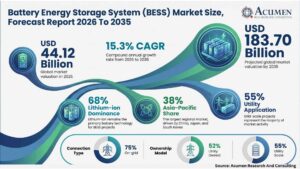
According to Acumen Research and Consulting, the Global Battery Energy Storage System Market size was valued at USD 44.12 billion in 2025 and is projected to reach USD 183.70 billion by 2035, growing at a CAGR of 15.3% from 2026 to 2035.
Increasing investments in smart grids, utility-scale energy storage projects, electric vehicle infrastructure, and distributed energy resources are creating significant growth opportunities for battery manufacturers, technology providers, utilities, and energy developers worldwide. Governments are also introducing supportive policies and financial incentives to encourage energy storage deployment as part of their decarbonization and net-zero emission strategies.
What is the Battery Energy Storage System Market?
The Battery Energy Storage System (BESS) Market refers to the global industry involved in developing, manufacturing, deploying, and operating battery-based energy storage solutions that store electricity for later use. These systems improve grid stability, support renewable energy integration, reduce peak electricity demand, provide backup power, and enhance energy efficiency across utility, commercial, industrial, and residential applications. The BESS market is expected to grow from USD 44.12 billion in 2025 to USD 183.70 billion by 2035, at a CAGR of 15.3%.
Key Market Highlights
- Global BESS market size reached USD 44.12 billion in 2025
- Projected to reach USD 183.70 billion by 2035
- Expected CAGR of 15.3% during 2026–2035
- Asia-Pacific BESS market accounted for 38% of the global market in 2025
- North America BESS market represented 27% market share
- Lithium-ion batteries dominated with 68% share
- On-grid systems accounted for 75% of installations
- Utility applications represented 55% of total demand
What is a Battery Energy Storage System?
A Battery Energy Storage System (BESS) is a technology that stores electrical energy in rechargeable batteries and releases it when electricity demand increases or renewable power generation declines. Unlike conventional power generation, battery storage systems provide flexibility by balancing electricity supply and demand in real time.
Modern battery storage systems combine battery cells, battery management systems (BMS), power conversion systems (PCS), energy management software, cooling systems, and safety mechanisms into an integrated solution.
Battery energy storage systems are increasingly deployed across:
- Utility-scale renewable energy projects
- Commercial and industrial facilities
- Residential solar installations
- Data centers
- Electric vehicle charging infrastructure
- Microgrids
- Critical infrastructure and backup power systems
Their ability to stabilize power grids and maximize renewable energy utilization has made BESS a strategic component of modern energy infrastructure.
Battery Energy Storage System Market Size & Forecast
The global Battery Energy Storage System Market is experiencing sustained expansion as utilities, governments, and private organizations prioritize investments in energy resilience and renewable integration.
The BESS market was valued at USD 44.12 billion in 2025 and is forecast to reach USD 183.70 billion by 2035, representing a 15.3% compound annual growth rate.
Several structural factors are supporting this growth:
- Rising global electricity demand
- Expansion of renewable energy capacity
- Increasing deployment of smart grids
- Electrification of transportation
- Growing frequency of grid instability caused by climate-related events
- Declining battery costs
- Technological improvements in battery performance
- Expansion of distributed energy resources
As renewable energy becomes a larger share of electricity generation, battery storage will play a crucial role in ensuring reliable and continuous power supply.
Why is the Battery Energy Storage System Market Growing?
Rapid Expansion of Renewable Energy
Solar and wind power generation continues to increase globally. Since renewable energy sources are intermittent, battery storage systems help balance electricity production and consumption by storing excess energy during periods of high generation and supplying electricity during periods of low generation.
This capability significantly improves renewable energy utilization while reducing dependence on fossil-fuel-based power generation.
Modernization of Electricity Grids
Traditional electricity grids were designed around centralized power generation.
Today’s energy landscape increasingly depends on decentralized renewable resources, distributed generation, and digital grid infrastructure.
Battery energy storage enables utilities to:
- Improve grid reliability
- Reduce transmission congestion
- Maintain voltage stability
- Support frequency regulation
- Improve power quality
- Reduce blackout risks
Grid modernization programs worldwide continue to accelerate demand for large-scale battery installations.
Increasing Demand for Energy Security
Extreme weather events, natural disasters, and rising electricity demand have highlighted the importance of resilient energy systems.
Battery storage solutions provide backup power during grid outages while improving energy independence for businesses, households, hospitals, and critical infrastructure.
This growing focus on energy resilience continues to strengthen investment in BESS technologies.
Electrification Across Industries
Transportation, manufacturing, buildings, and industrial operations are increasingly transitioning toward electrification.
The rapid growth of electric vehicles, charging infrastructure, and industrial automation creates new demand for flexible electricity management systems supported by battery storage technologies.
Key Battery Energy Storage System Market Trends
Lithium-Ion Batteries Continue to Dominate
Lithium-ion batteries remain the preferred technology due to their:
- High energy density
- Long operational lifespan
- Fast charging capability
- High round-trip efficiency
- Declining manufacturing costs
The Lithium-ion battery segment accounted for 68% of the global Battery Energy Storage System Market in 2025, making it the dominant battery technology.
Ongoing advancements in battery chemistry, thermal management, and manufacturing efficiency are expected to further strengthen the segment’s leadership.
AI and Digital Energy Management
Artificial intelligence is transforming battery storage operations through predictive analytics and automated energy optimization.
Modern energy management platforms enable operators to:
- Forecast electricity demand
- Optimize charging schedules
- Improve battery lifespan
- Reduce operational costs
- Predict maintenance requirements
- Improve grid balancing
The integration of AI with battery storage is expected to become a major competitive differentiator over the next decade.
Growth of Utility-Scale Energy Storage Projects
Large utility-scale battery installations are becoming increasingly common as power companies seek to improve renewable integration and grid stability.
These projects support:
- Peak load management
- Renewable energy storage
- Grid frequency regulation
- Emergency backup
- Capacity expansion without building new power plants
Utilities remain the largest end users of battery storage technologies globally.
Expansion of Distributed Energy Resources
Distributed energy systems—including rooftop solar, community solar projects, and localized microgrids—are creating significant opportunities for battery storage deployment.
Energy storage enables consumers to maximize self-consumption while reducing reliance on centralized electricity generation.
Market Dynamics
Market Driver: Renewable Energy Integration
The rapid deployment of renewable energy sources is one of the strongest growth drivers for the Battery Energy Storage System Market. Since solar and wind generation fluctuate based on weather conditions, battery storage systems provide the flexibility needed to store surplus electricity and supply power during periods of low renewable generation. This capability improves grid reliability, reduces renewable energy curtailment, and supports the transition toward cleaner electricity systems.
Market Restraint: High Initial Capital Investment
Although battery costs have declined over the past decade, large-scale battery energy storage projects still require significant upfront investment. Expenses related to battery procurement, power conversion systems, installation, grid integration, and long-term maintenance can create financial challenges, particularly for developing economies and smaller organizations. Access to financing and supportive policy frameworks remains essential for broader market adoption.
Market Opportunity: Smart Grids and Grid Modernization
Governments and utilities worldwide are investing heavily in smart grid technologies to enhance energy efficiency and grid resilience. Battery energy storage systems play a central role in these modernization efforts by enabling real-time energy balancing, supporting distributed energy resources, and improving electricity network reliability. As smart grid deployment accelerates, demand for advanced battery storage solutions is expected to rise significantly.
Market Challenge: Supply Chain and Critical Mineral Availability
The growing demand for lithium-ion batteries has increased pressure on the supply of critical raw materials such as lithium, nickel, cobalt, and graphite. Price volatility, geopolitical factors, and environmental concerns related to mining and processing may affect battery manufacturing costs and supply chain stability. Continued investment in battery recycling, alternative chemistries, and diversified sourcing strategies will be important to address these challenges.
Battery Energy Storage System Market Segmentation Analysis
A comprehensive understanding of market segmentation helps stakeholders identify high-growth investment opportunities and evolving demand patterns across the battery energy storage ecosystem.
By Battery Type
The Battery Energy Storage System Market is segmented into:
- Lithium-ion Batteries
- Advanced Lead-acid Batteries
- Flow Batteries
- Sodium-ion Batteries
Lithium-ion Batteries Lead the Market
The Lithium-ion battery segment accounted for 68% of the global Battery Energy Storage System Market in 2025, making it the dominant battery technology.
Its widespread adoption is driven by several technical and economic advantages, including:
- High energy density
- Longer cycle life
- Faster charging and discharging
- Lower maintenance requirements
- Higher round-trip efficiency
- Declining manufacturing costs due to economies of scale
Lithium-ion batteries have become the preferred choice for utility-scale storage projects, renewable energy integration, electric vehicle charging infrastructure, commercial facilities, and residential energy storage systems.
Meanwhile, alternative battery chemistries—including flow batteries and sodium-based batteries—continue to attract research and investment for applications requiring longer-duration energy storage and enhanced safety.
By Connection Type
The market is categorized into:
- On-grid Battery Energy Storage Systems
- Off-grid Battery Energy Storage Systems
On-grid Systems Dominate
On-grid battery energy storage systems represented 75% of the global market in 2025.
These systems are increasingly deployed to:
- Stabilize electricity grids
- Integrate renewable energy sources
- Improve grid flexibility
- Reduce peak electricity demand
- Enhance transmission efficiency
- Support ancillary grid services
Utility companies are investing heavily in on-grid battery storage as electricity networks become more decentralized and renewable energy penetration continues to rise.
Off-grid Systems Continue Expanding
Off-grid systems accounted for 25% of the market.
These solutions are increasingly adopted across:
- Remote communities
- Mining operations
- Islands
- Military facilities
- Rural electrification projects
- Telecom towers
- Disaster recovery applications
Growing demand for reliable electricity access in regions lacking stable grid infrastructure is expected to support continued growth.
By Application
Battery energy storage systems serve a wide range of end-use applications.
Major application segments include:
- Utility
- Commercial & Industrial (C&I)
- Residential
Utility Segment Maintains Market Leadership
The Utility segment accounted for 55% of the market in 2025.
Electric utilities continue to deploy battery storage for:
- Renewable energy integration
- Peak shaving
- Load balancing
- Frequency regulation
- Capacity reserves
- Grid stabilization
- Transmission congestion management
As renewable energy installations increase worldwide, utility-scale battery storage is expected to remain the largest application segment.
Commercial & Industrial Applications
Commercial and industrial users represented 27% of market demand.
Organizations increasingly deploy battery storage to:
- Reduce electricity costs
- Manage peak demand charges
- Improve energy reliability
- Support uninterrupted manufacturing operations
- Integrate rooftop solar systems
- Enhance energy resilience
Industries including manufacturing, healthcare, logistics, retail, and data centers continue to increase investments in onsite battery storage.
Residential Energy Storage
Residential applications accounted for 18% of the market.
Growing consumer adoption is supported by:
- Rooftop solar installations
- Rising electricity prices
- Home energy independence
- Backup power requirements
- Smart home energy management
Residential battery storage is expected to expand alongside distributed renewable energy systems and increasing awareness of household energy resilience.
BESS Market Regional Analysis
Asia-Pacific Leads the Battery Energy Storage System Market
Asia-Pacific accounted for 38% of the global Battery Energy Storage System Market in 2025, making it the largest regional market.
Several factors contribute to the region’s leadership:
- Strong battery manufacturing ecosystem
- Large-scale renewable energy installations
- Significant investments in smart grids
- Rapid industrialization
- Government support for clean energy
- Expanding electric vehicle production
- Advanced lithium-ion battery supply chains
Countries across the region continue investing in grid modernization and renewable energy integration, supporting long-term demand for battery storage technologies.
North America
North America represented 27% of the global market and is projected to grow at a CAGR of 6.3% through 2035.
Market growth is supported by:
- Utility-scale renewable energy projects
- Expansion of battery storage incentives
- Increasing deployment of microgrids
- Grid resilience initiatives
- Rising electricity demand
- Modernization of aging power infrastructure
Growing investments in solar-plus-storage projects continue to strengthen regional demand.
Europe
Europe remains an important market for battery energy storage due to ambitious climate targets, increasing renewable energy capacity, and the ongoing transition toward a low-carbon economy.
Regional growth is supported by:
- Carbon reduction initiatives
- Grid flexibility requirements
- Renewable energy integration
- Expansion of electric mobility
- Investments in energy independence
The region continues to prioritize energy storage as a key enabler of decarbonization.
Latin America
Latin America is witnessing increasing deployment of battery storage alongside renewable energy projects.
Growing investments in solar and wind generation, coupled with rising electricity demand and grid modernization efforts, are expected to create favorable market opportunities throughout the forecast period.
Middle East & Africa
The Middle East & Africa region is gradually expanding its battery storage capacity through investments in renewable energy, smart cities, and energy diversification initiatives.
Countries across the region are integrating battery storage into utility projects to improve energy reliability and support sustainable infrastructure development.
Competitive Landscape
The Battery Energy Storage System Market is characterized by continuous technological innovation, strategic partnerships, manufacturing expansion, and increasing investment in advanced battery technologies.
Market participants are focusing on:
- High-energy-density battery technologies
- Grid-scale energy storage solutions
- Long-duration battery storage
- Artificial intelligence integration
- Digital energy management platforms
- Battery recycling technologies
- Sustainable manufacturing
- Expansion of global production capacity
Competition is expected to intensify as demand grows across utility, commercial, industrial, and residential sectors.
Value Chain Analysis
The battery energy storage system value chain consists of multiple interconnected stages that contribute to product development, deployment, and long-term operation.
Raw Material Suppliers
Production begins with suppliers of critical materials such as lithium, nickel, cobalt, graphite, manganese, and other battery components.
Battery Cell Manufacturers
Battery manufacturers convert raw materials into high-performance battery cells optimized for energy storage applications.
System Integrators
System integrators combine batteries with:
- Battery Management Systems (BMS)
- Power Conversion Systems (PCS)
- Inverters
- Thermal management systems
- Energy Management Software
EPC Contractors
Engineering, Procurement, and Construction companies install and commission battery storage systems for utility, industrial, and commercial customers.
Utilities and End Users
The final stage includes utilities, industrial facilities, businesses, and homeowners utilizing battery storage solutions for energy management and reliability.
BESS Market Future Outlook
The future of the Battery Energy Storage System Market will be shaped by technological innovation, renewable energy expansion, and increasing electrification across multiple industries.
Several long-term trends are expected to influence market development:
- Falling battery costs
- Longer-duration storage technologies
- AI-enabled energy management
- Integration with hydrogen systems
- Smart grids
- Vehicle-to-grid (V2G) technologies
- Circular economy and battery recycling
- Expansion of decentralized energy systems
As electricity systems become more digital, decentralized, and renewable, battery energy storage will become an essential component of modern power infrastructure.
Frequently Asked Questions (FAQs)
What is a Battery Energy Storage System (BESS)?
A Battery Energy Storage System (BESS) stores electricity in rechargeable batteries for later use. It improves grid reliability, supports renewable energy integration, and provides backup power for utilities, businesses, and homes.
How large is the Battery Energy Storage System Market?
The global Battery Energy Storage System Market was valued at USD 44.12 billion in 2025.
What is the projected market size by 2035?
The market is expected to reach USD 183.70 billion by 2035.
What is the expected CAGR of the Battery Energy Storage System Market?
The market is projected to grow at a 15.3% CAGR between 2026 and 2035.
Which battery technology dominates the market?
Lithium-ion batteries dominate the market, accounting for 68% of total market share in 2025.
Which application holds the largest market share?
The utility segment leads the market with 55% share, driven by renewable energy integration and grid modernization.
Which region dominates the Battery Energy Storage System Market?
Asia-Pacific accounted for the largest market share, representing 38% of the global market in 2025.
Why are battery energy storage systems important?
Battery energy storage systems improve electricity reliability, store renewable energy, reduce peak demand, enhance grid stability, and provide backup power during outages.
What are the major growth drivers for the market?
Key growth drivers include renewable energy expansion, smart grid deployment, declining battery costs, electrification of transportation, and increasing investments in energy resilience.
What industries use battery energy storage systems?
Battery energy storage systems are widely used in utilities, manufacturing, commercial buildings, residential properties, renewable energy projects, data centers, healthcare facilities, telecommunications, and electric vehicle charging infrastructure.
The Battery Energy Storage System Market is poised for sustained growth as global energy systems evolve toward cleaner, more resilient, and digitally connected infrastructure. With the market projected to expand from USD 44.12 billion in 2025 to USD 183.70 billion by 2035, battery storage technologies will play a central role in supporting renewable energy integration, enhancing grid stability, and enabling reliable electricity supply across utility, commercial, industrial, and residential applications. Continuous advancements in battery technology, energy management software, and grid modernization are expected to create significant opportunities for stakeholders across the value chain.