
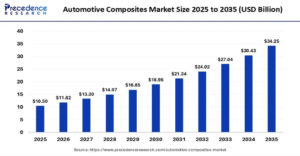
According to Precedence Research, the global automotive composites market size accounted for USD 10.50 billion in 2025 and is predicted to increase from USD 11.82 billion in 2026 to approximately USD 34.25 billion by 2035, expanding at a CAGR of 12.55% from 2026 to 2035.
Automotive Composites Market Key Insights
- By resin type, the thermoset composites segment contributed the highest market share of 61% in 2025.
- By resin type, the thermoplastic composites segment is expected to grow at the fastest CAGR of 14.8% between 2026 and 2035.
- By vehicle type, the passenger cars segment held a major market share of 47% in 2025.
- By vehicle type, the electric vehicles (EVs) segment is expected to register a rapid growth of 18.5% CAGR during 2026 and 2035.
- By application, the exterior components segment contributed the automotive composites highest market share of 31% in 2025.
- By application, the battery enclosures segment is expected to grow at a strong CAGR of 19.2% over the projected period.
Automotive Composites Market Overview
Increasing demand for lightweight, fuel-efficient, and longer-range electric vehicles continues facilitating the automotive composites manufacturing sector. Automotive composites are composed of reinforcing fibers, including carbon, glass, or natural fibers, and polymer resins. Thereby resulting in low-weight and high-strength composites.
Composites have increased structural strength, easier load handling, and corrosion resistance. They are now increasingly being utilised in automaker body panels, battery enclosures, chassis, and interior panels. Furthermore, major companies such as Toray Industries, Hexcel, Teijin, SGL Carbon, Syensqo, and BASF are progressing their efforts to make recyclable composites, boosting the market in the coming years.
Regional Outlook for Automotive Composites Market
North America held a 28% share of the market in 2025 and is expected to grow at a 11.4% CAGR between 2026 and 2035, driven by massive investments in EV programs and the swift commercialization of lightweight material feasibility options. Composites increasingly take the place of standard materials for any of those parts in vehicles, from batteries to body panels. Ongoing investment in regional manufacturing modernization helps sustain market demand for advanced automotive composites.
Asia-Pacific held a major market share of 34% in 2025 and is expected to experience the fastest growth with a CAGR of 15.6% during the predicted timeframe. Due to the largest automotive production and export volumes recorded and significant funding investments in carbon-fiber production.
China’s vehicle production and sales reached an estimated 31 million vehicles in 2024, according to the China Association of Automobile Manufacturers (CAAM). This increased the demand for high-performance composite parts. Furthermore, the home-made production of value-added composite materials supported by the government further boosts the regional market.
Europe held the second-largest market share of 31% in 2025 and is estimated to grow at a strong CAGR of 11.8% over the projected period, supported by strong demand for sustainability composite technology. Novel manufacturing techniques that lower carbon emissions continue to fuel higher and higher adoption of reusable thermoplastic composites. Furthermore, the composite technology in the region continues to be propelled by high investment from top-tier vehicle makers.
- The BMW Group continued to ramp up the production plan for Neue Klasse cars with increased car light-weighting based on composite technology for 2025.
Market Scope
| Report Coverage | Details |
| Market Size in 2025 | USD 10.50 Billion |
| Market Size in 2026 | USD 11.82 Billion |
| Market Size by 2035 | USD 34.25 Billion |
| Market Growth Rate from 2026 to 2035 | CAGR of 12.55% |
| Dominating Region | Asia Paicfic |
| Fastest Growing Region | Europe |
| Base Year | 2025 |
| Forecast Period | 2026 to 2035 |
Segmental Outlook of Automotive Composites Market
Resin Type Insights
The Thermoset Composites Segment Dominated the Market with 61% of Market Share in 2025
The thermoset composites segment dominated the automotive composites market with a share of 61% in 2025, due to its high strength and thermal stability. These advantages are essential for structural body parts, battery enclosures, and underbody assemblies. Furthermore, the lightweight thermoset lines are introduced frequently for wider end-users by Hexcel, Syensqo, Huntsman Corporation, Owens Corning, and SGL Carbon, creating wider opportunities for the market in the coming years.
By Vehicle Type Insights
The Passenger Cars Segment Dominated the Market with 47% of Market Share in 2025
The passenger cars segment dominated the automotive composites market with a share of 47% in 2025, due to the industry’s focus on reducing vehicle weight without compromising safety or performance. Composite constructions enhance crash energy absorption, corrosion resistance, and overall durability in various driving scenarios.
Glass fiber and carbon fiber composites continued to be used in high-volume production of passenger vehicles. Furthermore, the growing number of passenger vehicle production is expected to fuel the market in the coming years. European Automobile Manufacturers’ Association (ACEA) estimates Europe’s 2024 production of passenger cars is around 10.63 million.
Application Insights
The Exterior Components Segment Led the Market with 31% of Market Share in 2025
The exterior components segment led the automotive composites market with a share of 31% in 2025, as diversified body structures are going lightweight across both passenger and electric car segments. Companies are increasingly using composites to replace traditional exterior metal panels for their vehicle for good aerodynamic performance and car efficiency.
The battery enclosures segment held 11% of the market share in 2025 and is expected to grow at the highest CAGR of 19.2% between 2026 and 2035, supported by growing concerns about the protection of high-voltage battery systems and the reduction of overall vehicle weight. The use of advanced composites offers improved thermal insulation and structural integrity. Furthermore, the launch of new EV battery-specific composites is expected to fuel market growth in the coming years.
Recent Developments
- In July 2026, Syensqo partnered with Bucci Composites, a leader in structural composite parts, to utilize its Double Diaphragm Forming (DDF) technology. This collaboration aims to enhance automotive composite manufacturing and qualify innovative materials with key OEMs. DDF allows for a highly automated, single-step process that produces high-quality parts with reduced cycle times, simplifying logistics and optimizing capital investment.
- In July 2026, Rane (Madras) Limited announced an acquisition of Hindustan Composites Limited’s friction business for USD 39.1 million (₹370 crore), including the COMPO brake-lining brand and two Maharashtra manufacturing plants. The transaction, structured as a slump sale, encompasses all assets, liabilities, contracts, intellectual property, licenses, and employees associated with the friction unit. The deal is set to close by September 30, 2026, pending regulatory approvals.
Automotive Composites Market Companies
Formaplex: Formaplex is a UK-based manufacturer specializing in advanced composite components and tooling.
The company serves aerospace, automotive, motorsport, and other high-performance industries.
GMS Composites: GMS Composites provides composite manufacturing solutions and advanced composite components.
Its capabilities support aerospace, defense, automotive, and industrial applications.
Gurit: Gurit develops advanced composite materials, technologies, and solutions for demanding industries.
Its portfolio includes structural core materials, prepregs, adhesives, and composite manufacturing systems.
Hexcel Corporation: Hexcel Corporation is a leading producer of advanced composites, carbon fibers, and specialty reinforcement materials.
Its products are widely used in aerospace, defense, automotive, and industrial applications.
IDI Composites International: IDI Composites International manufactures composite materials and custom molding compounds for various industries.
Its solutions include sheet molding compounds, bulk molding compounds, and specialty composite materials.
Johns Manville: Johns Manville manufactures fiberglass and other engineered materials used in composite applications.
The company supplies reinforcement and specialty materials for construction, transportation, and industrial markets.
Mitsubishi Chemical Carbon Fiber and Composites, Inc.: Mitsubishi Chemical Carbon Fiber and Composites develops carbon fiber, prepreg, and advanced composite materials.
Its solutions serve aerospace, automotive, sporting goods, and industrial applications.
Owens Corning: Owens Corning is a global manufacturer of fiberglass reinforcements and composite materials.
Its products support applications across transportation, construction, energy, and industrial sectors.