
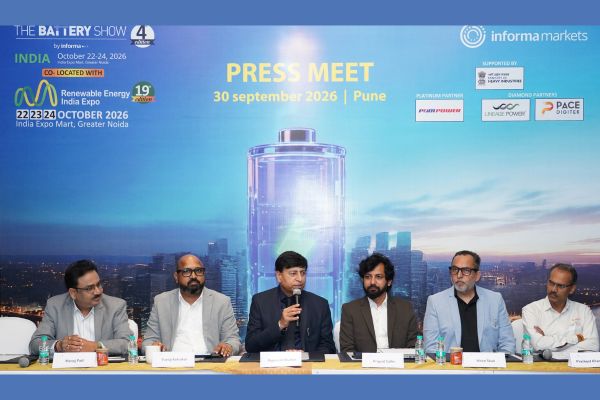
The Battery Show India, organised by Informa Markets in India, brought together leading industry stakeholders at a media roundtable in Pune to discuss India’s evolving battery, electric mobility and energy storage ecosystem, ahead of the 4th edition of the show scheduled for October 22–24, 2026, at India Expo Mart, Greater Noida. The discussions highlighted India’s automotive and engineering ecosystem, growing EV capabilities and its strategic relevance to the development of domestic battery and energy storage value chain.
The industry dialogue featured senior voices from across the battery, EV, automation and manufacturing ecosystem, with speakers including Mr.Prashant Kharade, Chief Operating Officer, Ador Digatron; Mr. Hiren Shah, Managing Director & CEO, Replus Engitech; Mr. Prajyot Sathe, Research Director – Mobility – Electric Vehicles, Frost & Sullivan; Mr. Suyog Kelsukar, Senior Director, IGS, 1lattice; Mr. Manoj Patil, Chairman & Managing Director, Patil Automation Ltd.; and Mr. Rajneesh Khattar, Senior Group Director, Informa Markets in India.
Mr. Prajyot Sathe, Research Director – Mobility Electric Vehicles, Frost & Sullivan, said “India’s electric vehicle market has evolved significantly over the past decade, with the country moving from a nascent market in 2015–16 to a market supported by stronger government initiatives, regulations and policy backing. Within the EV ecosystem, we see a clear progression from electric two-wheelers to three-wheelers and light commercial vehicles, followed by electric buses, while passenger cars are developing at a later stage. In calendar year 2025, India’s battery electric passenger car market stood at around 178,000 units, compared with approximately 99,000 units in 2024, and we expect it to reach around 180,000–190,000 units in 2026. Looking further ahead, we expect annual passenger EV sales to reach about 1.5 million units by 2032.
The next phase will be shaped by advanced battery systems, supply-chain localisation and interoperable charging infrastructure. LFP has emerged as the dominant chemistry, while sodium-ion, lithium-sulphur and solid-state batteries are being explored for the next four to six years. Component localisation is currently around 50–60% and could reach 80–90% over the next five to six years, although battery and power electronics are expected to remain below 60%. Localisation must also deliver cost efficiency to build a competitive domestic ecosystem.”
Mr. Suyog Keluskar, Senior Director, 1lattice, said, “India is entering a new phase in its energy transition, one where batteries move from being a vehicle story to a national infrastructure story. The market signal is clear: one in eight vehicles retailed in August 2026 was electric, and electric commercial vehicles more than doubled their share to 5.18% in a year. That shows fleets are now buying on total cost of ownership, not subsidies.
The bigger shift is happening beyond the showroom. Industry estimates point to advanced cell demand growing nearly tenfold about 28 GWh in 2025 to around 272 GWh by FY30, while the grid alone will need 236 GWh of battery storage by FY32. Yet domestic cell output is still close to 1 Gwh. Closing this gap is the defining opportunity of the decade. The advantage will go to players who build domestic depth across materials and cells, bring storage online at scale and on schedule, and shift from selling equipment to guaranteeing performance. That is the foundation on which India’s battery self-reliance will rest.”
Mr. Hiren Shah, Managing Director & CEO, Replus Engitech, mentioned “Replus is a technology-driven battery manufacturing company focused on grid-scale and C&I energy storage. We manufacture containerised BESS starting from 5 MWh in a 20-foot container and are currently deploying 1.2 GWh across FDRE, round-the-clock power, solar-plus-storage, standalone BESS and transmission and distribution applications. Our C&I portfolio includes DG-replacement systems from 100 kW/260 kWh to 500 kW/1 MWh, along with specialised battery packs for data centres, residential applications and EVs. Our current plant capacity is 1 GWh and is being scaled to 6 GWh, with the additional facility expected to be operational from January 2027.
India has significant opportunities across grid-scale, C&I and EV battery applications, with projected demand over the next decade of around 480 GWh, 380–400 GWh and 420 GWh respectively. As renewable penetration rises, BESS will become increasingly important for grid stabilisation, power quality and demand management. Solar-plus-BESS tariffs at around ₹4.8 per unit versus ₹8.5 for grid power also support the shift towards clean energy. Our business is expected to grow from around ₹1,800 crore this year to ₹4,500 crore next year and cross ₹8,000 crore by 2029, supported by capacity expansion and overseas operations targeting the Middle East, Africa and Europe.”
Mr. Manoj Patil, Chairman & Managing Director, Patil Automation Ltd, said “Patil Automation provides complete automation solutions for battery manufacturing, including fully automated lines for cells, modules and packs. As demand grows across two-wheelers, three-wheelers, four-wheelers, buses, trucks and battery energy storage systems, Made in India is helping reduce line and manufacturing costs. Around 30–35% of smaller battery components are already made in India and this share is expected to reach 70–80% in the coming years, driving demand for higher automation and multiple production lines.
Safety, battery life and traceability are critical, with our systems recording data at every manufacturing stage for complete process monitoring. Over the last two to three years, we have completed 10–15 fully automated base lines and are currently executing more than 15 base lines, along with multiple lines for two-wheeler and automotive batteries. We see potential for ₹700–800 crore in Indian automation-line business over the next three to four years. With solar and other renewable energy increasing the need for BESS to store daytime generation for use at night, demand for batteries, BESS and containerised solutions is expected to remain strong over the coming decade, alongside data-centre requirements.”
Mr. Prashant Kharade, Chief Operating Officer, Ador Digatron, said “While Ador Digatron operates across the energy sector, we are proud to be an e-mobility company supporting India’s transition to cleaner energy. Our portfolio spans hydrogen power supplies and rectifiers for hydrogen production, EV charging solutions under our Quench brand, and battery technologies. We have been in the battery business since 1996, supporting leading companies with battery formation and testing circuits and have transitioned from lead-acid to lithium-ion technologies over the last four to five years. We now manufacture chargers, formation and testing circuits for lithium-ion batteries. In energy storage, we introduced our first PCS last month, offering spring-based PCS solutions from 500 kW to 2.5 MW, and are also exploring the EMS business. By combining PCS and EMS capabilities with batteries made in India, we see a clear pathway towards reducing dependence on China and building a more self-reliant energy-storage ecosystem. The Battery Show India provides an important platform to discuss these developments and the evolving energy and e-mobility ecosystem.”
Mr. Rajneesh Khattar, Senior Group Director, Informa Markets in India, said “India’s electric mobility market is moving into a phase where the scale of adoption is increasingly shaping the requirements for a stronger domestic battery ecosystem. The country recorded nearly 1.97 million EV registrations in FY2024–25, with electric two-wheelers alone accounting for about 1.15 million registrations. This momentum makes it increasingly important to build capabilities not just in vehicle manufacturing, but across cells, battery management systems, power electronics, testing, safety, recycling and energy storage. Pune, with its strong automotive and engineering ecosystem, is an important part of this conversation. Through The Battery Show India, we aim to connect the wider value chain and create a platform where technology providers, manufacturers and industry leaders can address the opportunities emerging from India’s accelerating transition towards electric mobility and energy storage.”
The 2026 edition is expected to feature 300 exhibitors and 400+ brands, providing a platform for businesses across EVs, stationary storage, grid-scale BESS and domestic battery manufacturing. The event will run alongside the Renewable Energy India Expo and Energy Storage Summit India, with 40+ conference sessions across four halls, an Energy Storage Summit, four CXO conclaves and more than 500 industry representatives participating as speakers and moderators.
Pune’s Central Role in India’s Automotive and Industrial Ecosystem
Pune’s relevance to this transition is underpinned by its established automotive and industrial ecosystem. According to Maharashtra Industrial Development Corporation (MIDC), Pune is the largest automobile hub in India, with more than 4,000 manufacturing and ancillary units in the Pimpri-Chinchwad region alone. The city is also home to key R&D, testing and certification institutions, strengthening its role across vehicle development, components and advanced mobility technologies.
The state’s policy direction is also increasingly focused on building capabilities around EVs and batteries. Maharashtra’s EV Policy 2025 identifies Pune among the potential locations for Centres of Excellence focused on EVs, charging infrastructure and hydrogen-based technologies, while also identifying Pune as a potential strategic location for EV battery recycling hubs.
The Battery Show India 2026 will bring together the wider advanced battery and energy storage ecosystem, covering the value chain from raw materials and components to cell manufacturing, battery packs, BMS, recycling, testing and manufacturing technologies. The fourth edition will feature participation from companies and technology providers from Korea, Japan, Germany and China, along with a dedicated German Pavilion and a specialised BESS Hall. The event will also feature top industry players including CATL among others.