

Automotive lighting is undergoing a fundamental transformation. Headlamps are no longer viewed simply as components that illuminate the road. Increasingly, they are becoming important elements of vehicle safety, energy efficiency, design, driver visibility and advanced lighting performance.
At the center of this evolution is the Automotive Headlamp Reflector Market, which is being influenced by the transition toward energy-efficient lighting, changing vehicle architectures, increasingly sophisticated headlamp designs and stricter requirements surrounding vehicle safety and visibility.
According to Acumen Research and Consulting, the global Automotive Headlamp Reflector Market was valued at USD 842.6 million in 2023 and is projected to reach USD 1,182.2 million by 2032, expanding at a 3.9% CAGR from 2024 to 2032.
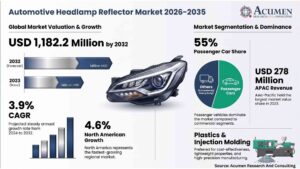
While the overall growth rate is moderate, the underlying technology landscape is changing rapidly. LED adoption, lightweight materials, advanced manufacturing and smart lighting systems are creating new opportunities for reflector manufacturers and automotive suppliers.
What Is Driving the Automotive Headlamp Reflector Market?
The increasing demand for energy-efficient automotive lighting is one of the most important growth drivers.
Automakers are looking for lighting systems that can deliver effective illumination while consuming less energy and providing greater flexibility in vehicle design. Reflectors play a critical role by collecting and directing light into a controlled beam, helping maximize illumination while reducing unwanted glare.
Acumen identifies three major factors supporting market growth: increasing demand for energy-efficient vehicle lighting, stringent regulations concerning vehicle safety and visibility, and technological advances in reflector materials and designs.
The market is also benefiting from growing consumer expectations for sophisticated vehicle styling. Headlamp assemblies increasingly contribute to a vehicle’s visual identity, making reflector design an important intersection between engineering performance and automotive aesthetics.
What Are the Key Automotive Headlamp Reflector Market Statistics?
The latest Acumen Research and Consulting analysis highlights the following market indicators:
- 2023 Market Size: USD 842.6 million
- 2032 Projected Market Size: USD 1,182.2 million
- CAGR, 2024–2032: 3.9%
- Asia-Pacific Market Value, 2023: Approximately USD 278 million
- North America CAGR: More than 4.6%
- Passenger Car Share, 2023: 55%
- Leading Product Material: Plastics
- Leading Manufacturing Process: Injection molding
- Dominant Regional Market: Asia-Pacific
These figures point to a market supported by high-volume passenger vehicle production, continued lighting innovation and increasing demand for lightweight and efficient reflector solutions.
Why Are LED Headlamps Important to the Automotive Headlamp Reflector Market?
The transition toward LED automotive lighting is one of the most important technology trends influencing reflector development.
LED systems offer energy efficiency, long operating life and considerable flexibility in headlamp design. Their smaller form factor also gives automotive designers more freedom to create distinctive lighting signatures and compact optical architectures.
For reflector manufacturers, this creates demand for components capable of handling new optical requirements while maintaining consistent light distribution.
Acumen identifies the increasing adoption of LED technology for energy efficiency and design flexibility as a significant automotive headlamp reflector market trend.
At the same time, LED and laser technologies can involve higher upfront costs than conventional lighting systems. This creates a continuing challenge for manufacturers seeking to balance technological sophistication with vehicle affordability.
Why Do Plastics Lead the Automotive Headlamp Reflector Market?
Plastics are the leading product material in the Automotive Headlamp Reflector Market.
Their advantage comes from a combination of low weight, design flexibility, moldability and cost-effectiveness. Plastic materials can be shaped into complex geometries, enabling manufacturers to optimize reflector designs for different headlamp architectures.
Weight reduction is particularly relevant as automakers attempt to improve vehicle efficiency. Lightweight components can contribute to broader vehicle-weight optimization, making plastics attractive across both conventional and electrified vehicle platforms.
Acumen’s analysis identifies plastics as the dominant product type, ahead of aluminum, sheet steel and other materials.
Which Lighting Technology Dominates the Automotive Headlamp Reflector Market?
The market encompasses halogen, xenon, LED and laser lighting technologies.
According to Acumen, halogen remains an important and dominant light-type segment because of its affordability, widespread availability and compatibility with existing vehicle electrical systems.
However, the competitive significance of the different lighting technologies is changing.
LED systems are increasingly attractive for new vehicle platforms because they combine energy efficiency with design flexibility. Laser lighting represents another technology frontier, although its higher cost and complexity can limit adoption.
This creates a dual-track market: established lighting technologies continue to support high-volume applications, while advanced lighting technologies generate demand for more sophisticated optical and reflector designs.
Why Do Passenger Cars Dominate the Market?
Passenger cars accounted for 55% of the Automotive Headlamp Reflector Market in 2023, making them the leading vehicle category.
The dominance of passenger vehicles reflects their enormous global production volumes and increasing consumer expectations around safety, appearance and technology.
Modern passenger vehicles increasingly incorporate distinctive headlamp signatures and advanced illumination systems. Consequently, reflectors must satisfy not only functional requirements but also increasingly demanding packaging and styling requirements.
Commercial vehicles—including light commercial vehicles and medium- and heavy-duty vehicles—represent additional opportunities as fleet operators increasingly focus on visibility, safety and operating efficiency.
Why Is Injection Molding Important for Automotive Headlamp Reflectors?
Injection molding is the leading manufacturing process in the market.
The technology is particularly well suited to reflector production because it can produce complex geometries with high precision, repeatability and consistent surface quality.
Large-volume automotive production also makes manufacturing efficiency critical. Injection molding can support high production volumes while maintaining dimensional consistency between components.
Acumen identifies injection molding as the leading manufacturing process because of its precision, efficiency, complex-shape capability and suitability for large-scale production.
As reflector designs become more sophisticated, manufacturing processes will increasingly need to balance optical precision, material performance, production speed and cost.
Which Region Leads the Automotive Headlamp Reflector Market?
Asia-Pacific is the dominant regional market.
Acumen estimates that the region’s Automotive Headlamp Reflector Market was worth approximately USD 278 million in 2023.
The region’s leadership is closely connected to its enormous automotive manufacturing ecosystem. China, India and Japan are major contributors, supported by large vehicle-production bases, established component suppliers and increasing investment in automotive technology.
China’s large automotive industry is particularly important to regional demand, while Japan and South Korea contribute advanced automotive manufacturing and technology capabilities.
The combination of vehicle production, manufacturing infrastructure and increasing demand for advanced safety and lighting technologies gives Asia-Pacific a strong position in the global market.
Is North America the Fastest-Growing Automotive Headlamp Reflector Market?
According to Acumen, North America is expected to record a CAGR of more than 4.6% from 2024 to 2032, making it the fastest-growing regional market in the report’s forecast.
The region’s growth is supported by demand for advanced automotive lighting, increasing vehicle production and continued technology development.
The adoption of LED and laser-based lighting technologies is also contributing to market opportunities as automakers seek improved illumination, efficiency and vehicle differentiation.
Stringent safety and energy-efficiency requirements provide an additional incentive for manufacturers to improve automotive lighting systems.
What Are the Biggest Trends in the Automotive Headlamp Reflector Market?
Several trends are likely to influence the Automotive Headlamp Reflector Market’s next phase.
Energy-Efficient Lighting
Automakers continue to prioritize lighting technologies capable of providing strong illumination with lower energy consumption. LED technology is particularly relevant to this transition.
Lightweight Reflector Materials
The use of plastics and other lightweight materials can help manufacturers reduce component weight while maintaining the geometric complexity required for advanced optical systems.
Smart and Adaptive Lighting
The development of adaptive lighting systems is creating new opportunities for reflector technology. Intelligent lighting can adjust illumination patterns based on driving conditions, vehicle speed and surrounding traffic.
Premium Vehicle Lighting
Luxury and premium vehicles increasingly use sophisticated lighting systems as both safety features and design elements. This trend creates opportunities for specialized reflectors with advanced optical performance.
Electrification
Electric and hybrid vehicles are creating additional demand for efficient lighting systems. Although headlamps generally represent a relatively small portion of total vehicle energy consumption, efficiency becomes increasingly important as automakers optimize every electrical subsystem.
Acumen specifically identifies premium vehicles, electric and hybrid vehicles, and smart/adaptive lighting as important market opportunities.
What Challenges Could Restrain the Automotive Headlamp Reflector Market?
The transition to advanced automotive lighting is not without obstacles.
One of the most significant challenges is the higher initial cost associated with advanced reflector and lighting technologies.
LED and laser headlamps can provide substantial performance advantages but require more sophisticated components and integration. This can make advanced lighting systems difficult to justify in price-sensitive vehicle segments.
Another challenge is integrating new reflector architectures with existing vehicle designs. Automotive lighting systems must fit within increasingly constrained vehicle spaces while satisfying optical, thermal, structural and regulatory requirements.
Finally, fluctuations in raw-material prices can influence reflector manufacturing costs, particularly when specialized polymers, metals or coatings are required.
Who Are the Major Automotive Headlamp Reflector Companies?
The competitive landscape includes automotive lighting specialists, component suppliers and diversified automotive technology companies.
Acumen identifies Bosch Limited, Hella GmbH & Co. KGaA, OSRAM Licht, Hyundai Mobis, Ichikoh Industries, Koninklijke Philips, Koito Manufacturing, Magneti Marelli, Federal Mogul Powertrain India, Stanley Electric and Winjet Automotive among the key companies profiled in the market.
These companies compete through different combinations of lighting technology, component manufacturing, optical engineering and automotive OEM relationships.
The competitive environment is increasingly moving beyond conventional reflector production toward integrated lighting systems, advanced materials, LED architectures and adaptive lighting technologies.
How Could Electric Vehicles Affect the Automotive Headlamp Reflector Market?
Electric and hybrid vehicles represent an important opportunity for reflector manufacturers.
Electrification is changing vehicle architectures and giving designers greater freedom to rethink lighting systems. At the same time, electric vehicles place greater emphasis on energy efficiency because every electrical load ultimately affects overall vehicle efficiency and range.
This makes efficient lighting technologies increasingly attractive.
Acumen identifies the expansion of electric and hybrid vehicle segments requiring efficient lighting solutions as an important opportunity for the Automotive Headlamp Reflector Market.
The effect is therefore broader than simply replacing conventional vehicles with electric ones. Electrification could encourage automakers to rethink the optical, electrical and design architecture of vehicle lighting altogether.
What Is the Future of the Automotive Headlamp Reflector Market?
The Automotive Headlamp Reflector Market is likely to evolve alongside the broader transformation of vehicle lighting.
Acumen projects the market to grow from USD 842.6 million in 2023 to USD 1,182.2 million by 2032, representing a 3.9% CAGR.
The industry’s future will increasingly depend on how manufacturers respond to the convergence of:
- LED and advanced lighting technologies
- Lightweight materials
- Electric and hybrid vehicles
- Adaptive lighting
- Advanced optical designs
- Vehicle safety requirements
- Premium automotive styling
- High-precision manufacturing
The reflector itself may be a relatively small vehicle component, but its role is becoming increasingly sophisticated.
The Strategic Outlook
The Automotive Headlamp Reflector Market sits at an interesting intersection between automotive engineering, optical technology, manufacturing and vehicle design.
The Automotive Headlamp Reflector Market’s projected expansion to USD 1.18 billion by 2032 indicates steady underlying demand, while the technology transition toward LED, adaptive lighting, lightweight materials and electrified vehicles is creating new areas for innovation.
Asia-Pacific currently provides the industry’s largest regional opportunity, while North America is projected to deliver the fastest regional growth. Passenger cars remain the dominant vehicle segment, plastics lead material demand, and injection molding remains the principal manufacturing process.
The next stage of competition, however, is unlikely to be determined solely by reflector production volumes.
The companies best positioned for long-term growth will be those that can combine optical precision, lightweight materials, advanced manufacturing and intelligent lighting technologies to meet the changing requirements of connected, electrified and increasingly safety-focused vehicles.
In that sense, the future of the Automotive Headlamp Reflector Market is not simply about making headlights brighter. It is about making vehicle lighting smarter, more efficient, more precise and more deeply integrated into the vehicle itself.