

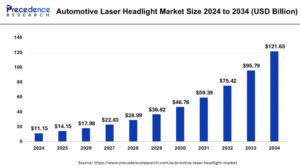
The global automotive laser headlight market is on a rapid upward trajectory. In 2024, the market was valued at $11.15 billion and is forecast to climb to $14.15 billion in 2025. By 2034, analysts at Precedence Research expect the market to surge past $121.65 billion, translating to an impressive CAGR of 26.99% from 2025 to 2034.
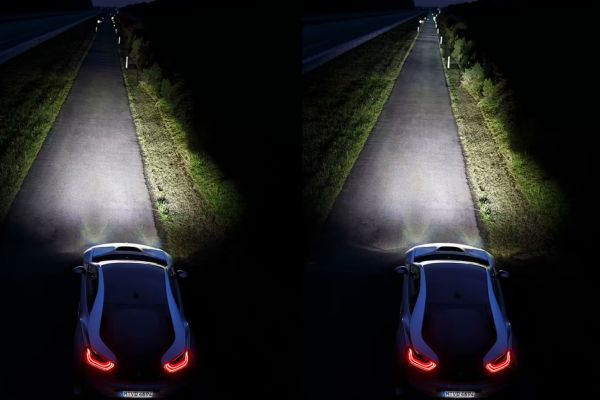
Europe, with its substantial premium car base and prominent headlight manufacturers, continues to dominate, capturing around 40% of global revenue, while Asia Pacific is advancing as the fastest-growing region.
Automotive Laser Headlight Market Key Insights
- The global automotive laser headlight market was sized at $11.15 billion in 2024 and will reach $121.65 billion by 2034.
- Annual CAGR projected at 26.99% between 2025 and 2034.
- Europe accounted for 40% of the 2024 market, retaining its leadership thanks to giants like Valeo S.A. and OSRAM GmbH.
- Asia Pacific is emerging as the fastest-growing region due to increased smart vehicle adoption and rising purchasing power in nations like India and China.
- Passenger vehicles led global adoption, contributing approximately 75% of total vehicle production.
- Intelligent laser headlights capture the largest share, fueling demand from the surge in smart and autonomous vehicles.
- Top players steering the market include Valeo S.A., OSRAM GmbH, Hella GmbH & Co. KGaA, and SLD Laser.
- The application ban in some regions (e.g., the U.S.) for high-intensity laser headlights presents a regulatory hurdle.
Market Revenue Table
| Year | Market Size (USD Billion) |
|---|---|
| 2024 | 11.15 |
| 2025 | 14.15 |
| 2034 | 121.65 |
The Role of AI: Driving Intelligence and Safety
Artificial Intelligence is rapidly reshaping the automotive lighting sector, fueling the evolution of “intelligent laser headlights.” By integrating advanced AI algorithms and sophisticated IoT sensors, laser headlights not only adapt to environmental conditions but also adjust light distribution and beam strength in real-time. This ensures optimal visibility for drivers and enhances passenger safety, especially during demanding weather or night driving scenarios.
AI also supports the convergence of laser lighting with other automotive safety features such as night vision cameras and adaptive cruise control systems. In smart vehicles, AI enables cross-talk between laser headlights, autonomous sensors, and navigation systems. This results in a seamless, predictive lighting experience that anticipates road hazards and responds instantly, reducing accidents and elevating overall road safety standards.
What’s Fueling the Relentless Market Growth?
Several powerful factors are driving the adoption of laser headlights in the automotive sector:
- Rising demand for premium and luxury vehicles fitted with intelligent lighting solutions.
- Urbanization and increased purchasing power in developing countries are fueling vehicle sales, notably in Asia Pacific.
- Automakers are investing heavily in R&D to create advanced safety features, including night vision and sensor-controlled lighting.
- Growing popularity of electric and hybrid vehicles encourages the adoption of innovative lighting technologies.
- Passenger vehicles, particularly, are seeing explosive demand as consumers seek both style and safety.
Opportunities and Trends: Will Market Breakthroughs Continue?
- Can the growing e-commerce and travel industry trigger a surge in commercial vehicle lighting innovation?
With expanding retail logistics and the booming travel sector, demand for advanced headlights in commercial vans and recreational vehicles is expected to rise. - Will intelligent laser headlights outpace conventional lighting due to autonomous vehicle growth?
As IoT and AI become central to automotive technology, intelligent laser solutions are likely to become the new standard, especially in autonomous and electric vehicles.
Regional & Segmentation Analysis: Where’s the Momentum?
Regional Breakdown:
- Europe: Holds a commanding lead, driven by luxury vehicle demand and a strong base of lighting technology manufacturers.
- Asia Pacific: Positioned for the fastest growth with high adoption in China and India, bolstered by increasing urbanization and automaker innovation.
- North America: Limited by regulatory bans but remains a significant market for luxury and high-end automakers.
- Other Regions: Latin America, Middle East, and Africa are exhibiting steady but moderate growth rates.
Segmentation Highlights:
| Segment | Key Insights |
|---|---|
| Technology | Intelligent laser headlights dominate share |
| Vehicle Type | Passenger vehicles lead adoption |
| Sales Channel | Focus on new vehicle installations |
Industry Breakthroughs
Recent years have seen groundbreaking advances:
- SLD Laser (December 2019): Launched LiFi Communication and sensing technologies for automotive use.
- OSRAM GmbH (2018): Unveiled laser-based light sources and application-specific LEDs for forward lighting.
- Valeo S.A. and Hella GmbH & Co. KGaA: Ongoing R&D and product expansion.
Companies
- OSRAM GmbH
- Valeo S.A.
- Hella GmbH & Co. KGaA
- SLD Laser
Challenges and Cost Pressures: How Will the Market Cope?
Despite rapid growth, several hurdles remain:
- Higher costs: Laser headlights are significantly costlier than conventional options, affecting widespread adoption.
- Regulatory barriers: Use of laser headlights is banned in some countries (for example, the U.S.), primarily due to high light intensity.
- Production complexity: Crafting precision laser components adds to manufacturing timelines and costs, especially for mass-market vehicles.
Case in Point: Europe’s Luxury Surge
Europe illustrates how premium car demand and manufacturer presence can drive market dominance. With brands like BMW and Audi pioneering advanced laser headlight integration, the region not only leads in revenues but also sets the bar for technology adoption, targeting discerning customers and influencing global trends through export and collaborations.

