
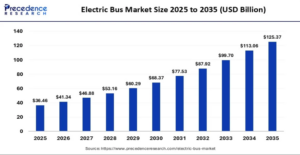
The global electric bus market size was valued at USD 36.46 billion in 2025 and is projected to grow from USD 41.34 billion in 2026 to approximately USD 125.37 billion by 2035, expanding at a CAGR of 13.15% during the forecast period from 2026 to 2035.
Key Takeaways
- By vehicle, the BEV segment has captured a revenue share of 86% in 2025.
- The FCEV segment is expected to register a lucrative CAGR of 15.1% in terms of volume over the forecast period.
- By application, the intracity segment has held a revenue share of 86% in 2025.
- The intercity segment is expanding at a CAGR of 15.6% between 2026 to 2035.
- By end-use, the public segment has held a revenue share of around 81% in 2025.
- The private segment is growing at a CAGR of 11.8% from 2026 to 2035.
- By battery, the lithium iron phosphate battery segment has accounted revenue share of 90.5% in 2025.
- The lithium nickel manganese cobalt oxide segment is poised to grow at a CAGR of 14.7% over the forecast period.
- Asia Pacific market has accounted Highest revenue share of 85.7% in 2025.
Market Overview
The electric bus market is experiencing significant growth as governments, public transportation authorities, and private fleet operators accelerate the transition toward sustainable and low-emission mobility solutions. Rising concerns about air pollution, greenhouse gas emissions, and dependence on fossil fuels are encouraging investments in battery-electric and fuel cell electric buses across urban and intercity transportation networks.
How AI is revolutionizing the Electric Bus Market
Artificial intelligence (AI) is transforming the electric bus market by improving vehicle performance, operational efficiency, and fleet management. AI-powered battery management systems optimize battery performance, predict energy consumption, and continuously monitor cell health to extend battery life and reduce maintenance costs. Intelligent route optimization enables fleet operators to analyze traffic patterns, passenger demand, and weather conditions, resulting in more efficient scheduling and lower energy consumption. AI-driven predictive maintenance identifies potential component failures before they occur, minimizing vehicle downtime and reducing repair expenses. Additionally, advanced driver assistance systems (ADAS) powered by AI enhance road safety by supporting drivers with real-time monitoring and collision prevention features. AI also enables smart charging management by optimizing charging schedules, balancing grid loads, and integrating renewable energy sources to reduce electricity costs. Together, these AI-driven innovations improve fleet reliability, lower the total cost of ownership, and accelerate the adoption of sustainable electric bus transportation worldwide.
Regional Outlook of the Electric Bus Market
North America
North America is expected to develop at the fastest rate during the forecast period, due to increasing research and development investments in the development of electric buses. The major market players of the region are collaborating with government to increase their market share in the region. This is also helping them to increase their geographical presence in developed and developing nations. In addition, the growing number of infrastructural development projects is also driving the expansion the electric bus market in the region.
Asia Pacific
Asia-Pacific dominated the electric bus market in 2025 with highest revenue share of 86%. The China dominates the electric bus market in Asia-Pacific region. The Asia-Pacific region comprises of large number of market players operating in electric bus market. The electric bus market is growing in developing and developed countries such as China, Japan, South Korea, and India. In addition, the Asia-Pacific region has vast number of original equipment manufacturers (OEMs). Furthermore, the factors such as favorable government regulations regarding electric buses and the expansion of the electric vehicle infrastructure are propelling the growth of the electric bus market in the Asia-Pacific region during the forecast period.
Europe
Europe is expected to grow significantly in the electric bus market during the forecast period. The demand as well as the use of electric buses in Europe are increasing for reducing the environment pollution. This, in turn, is supported by the government policies as well as investments. Thus, this, promotes the market growth.
Electric Bus Market Companies
- Tata Motors: Tata Motors is a leading player in the electric bus market, offering the Starbus EV range for public transportation and commercial fleet operators. The company is expanding electric mobility through government partnerships, advanced battery technologies, and large-scale deployments across India.
- Daimler AG: Daimler AG manufactures electric buses under the Mercedes-Benz brand, including the eCitaro series for sustainable urban transportation. The company focuses on zero-emission mobility, smart fleet solutions, and continuous innovation in battery-electric bus technology.
- Geely Automobile Holdings Ltd.: Geely Automobile Holdings Ltd., through its subsidiaries and strategic partnerships, develops electric buses for urban and intercity public transport. The company leverages advanced EV technologies to support China’s growing transition toward clean and intelligent mobility.
- MAN SE: MAN SE offers the Lion’s City E electric bus lineup, designed to provide efficient, low-noise, and emission-free transportation for modern cities. The company emphasizes energy efficiency, passenger comfort, and digital fleet management solutions.
- Scania AB: Scania AB develops fully electric and hybrid buses equipped with modular battery systems and intelligent energy management technologies. Its electric bus portfolio supports sustainable public transportation by improving operational efficiency and reducing environmental impact.
- AB Volvo: AB Volvo is a global leader in electric public transportation, offering the Volvo 7900 Electric and Electric Articulated bus models. The company focuses on delivering reliable, zero-emission mobility solutions while advancing smart, sustainable urban transit systems worldwide.
Segmental Insights of the Electric Bus Market
Propulsion Insights
The fuel cell electric bus (FCEB) segment is expected to grow at a CAGR of 19.10% during the forecast period. The FCEB segment is playing an elevating role in the electric public transportation as a zero-emission option instead of diesel. It eliminates operations, accelerates refueling. The FCEB’s potential to provide similar routes as diesel buses, with the absence of local emissions and less noise, makes it the most approachable option.
Application Insights
The intra-city (urban transit) segment held the largest share of 57.80% in the 2025 global electric bus market. The electric buses play a vital role in intra-city public transport by controlling noise pollution and reducing carbon emissions. The key development depends on improvement and enhancement in battery technology and the discovery of strong charging infrastructure, and financial support via incentives from the financial and government institutions.
Battery type Insights
The lithium-ion battery segment held the largest share of 86.40% in the 2025 global electric bus market. The battery is the heart, the foundation of the global electric bus. The segment is emerging with the capability and strength to operate. It improves and accelerates the vehicle’s performance. The key development targets on enhancing safety, lifespan, cost, and energy density against challenges such as faster degradation and limited range.
Battery capacity Insights
The 201-350 kWh segment held the largest share of 41.70% in the 2025 global electric bus market. The battery capacity measures the overall performance of the electric bus. This 201-350 kWh range offers moderate to long range operations in an intra-city model that precisely balances the operational and cost requirements for daily use. This battery size is a prominent part of the market with compact capacity for intercity routes, with highly driven by charging infrastructure advancement.
Ownership model Insights
The fleet-owned by transit agencies segment held the largest share of 63.40% in the 2025 global electric bus market. The segment is consistently revolutionizing globally, with the increased use of electric buses, with 60% of municipal bus sales expected by 2030. Their development represents substantial growth in China and advancement in charging and battery technologies. The leading companies, such as BYD, are initiating a transition with the supply of electric buses and unified systems.