
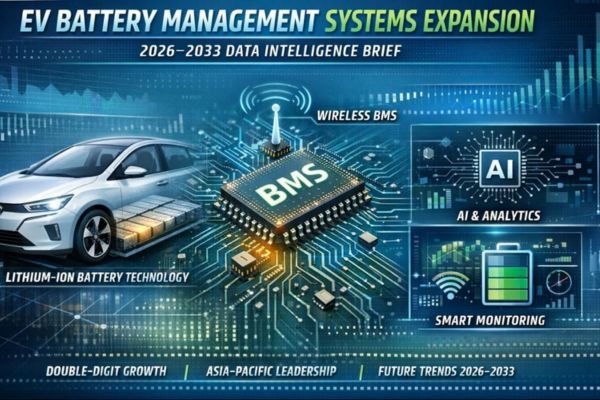
The rapid acceleration of electric mobility is reshaping the global automotive ecosystem, placing Battery Management Systems (BMS) at the core of innovation. As electric vehicles (EVs) evolve in complexity and scale, BMS technology has transitioned from a supporting component to a mission-critical system ensuring safety, efficiency, and performance.
With the growing demand for longer driving ranges, faster charging, and improved battery lifespan, the importance of advanced BMS solutions continues to rise across passenger and commercial EV segments.
As per Market Intelo’s latest market intelligence, the global EV Battery Management System (BMS) market was valued at $5.4 billion in 2024. Projections indicate a surge to $22.7 billion by 2033, reflecting a robust CAGR of 17.2% throughout the forecast period. This growth is primarily driven by the rapid acceleration of vehicle electrification and the critical need for advanced battery safety and optimization technologies.
Market Intelo Insight Snapshot
According to internal market intelligence analysis, the EV Battery Management Systems market is poised for robust expansion between 2026 and 2033, supported by consistent EV production growth and technological advancements.
Key Data Highlights:
- The market is projected to witness a strong double-digit CAGR through 2033.
- Revenue growth is driven primarily by increasing EV penetration in emerging economies.
- Lithium-ion battery dominance continues, accounting for the majority of BMS integration.
- Software-driven BMS solutions are expected to outpace hardware growth in the coming years.
- Asia-Pacific remains the leading regional contributor, followed by Europe and North America.
These insights indicate a shift toward intelligent, scalable, and software-defined battery management architectures.
Role of Battery Management Systems in EVs
Battery Management Systems function as the central intelligence unit of an EV battery pack. Their primary role is to monitor, regulate, and protect battery performance under varying operating conditions.
Core capabilities include:
- Continuous monitoring of voltage, current, and temperature
- Accurate estimation of State-of-Charge (SoC) and State-of-Health (SoH)
- Cell balancing to maintain uniform energy distribution
- Thermal management for safety and efficiency
- Fault detection and real-time protection mechanisms
These functionalities directly influence vehicle reliability, safety compliance, and battery longevity.
Market Drivers Accelerating Growth
Electrification Momentum Across Automotive Sector
Global policy support, emission reduction targets, and consumer awareness are accelerating EV adoption. This directly increases the demand for high-performance BMS solutions.
Advancements in Battery Technologies
The transition toward high-energy-density batteries and emerging chemistries is pushing the need for more sophisticated BMS platforms capable of handling complex battery behaviors.
Digitalization and Smart Mobility Integration
The integration of BMS with AI, IoT, and cloud platforms is enabling predictive diagnostics, remote monitoring, and enhanced battery analytics.
Safety and Regulatory Compliance
Stringent safety standards are compelling manufacturers to invest in advanced BMS systems that ensure operational reliability and compliance with global automotive regulations.
Trend Analysis
- Shift Toward Software-Defined BMS
BMS is increasingly becoming software-centric, allowing real-time data processing, predictive maintenance, and over-the-air updates. - Rise of Wireless BMS Architecture
Wireless communication within battery packs is reducing system complexity, lowering weight, and improving scalability across EV platforms. - AI-Driven Battery Intelligence
Artificial intelligence is enhancing battery diagnostics, enabling early fault detection and optimizing charging cycles. - Platform Standardization
Automakers are adopting standardized BMS platforms to streamline production and reduce development costs across multiple EV models.
Segmental Outlook
The EV BMS market demonstrates strong segmentation across multiple dimensions:
- By Topology: Centralized, Distributed, Modular
- By Vehicle Type: Passenger Vehicles dominate, while Commercial EVs show accelerating growth
- By Component: Hardware remains essential, but software is emerging as a high-growth segment
- By Battery Type: Lithium-ion leads, with increasing research in alternative chemistries
Among these, modular BMS architecture is gaining traction due to its flexibility and adaptability across different vehicle platforms.
Regional Performance Overview
Asia-Pacific continues to dominate the EV BMS landscape, driven by large-scale EV manufacturing and battery production ecosystems. Countries in this region are leading in both supply chain integration and technological adoption.
Europe is witnessing steady growth supported by strong regulatory frameworks and electrification targets, while North America is expanding due to increasing investments in EV infrastructure and innovation.
Emerging markets are also showing promising growth potential as EV adoption expands beyond developed regions.
Competitive Landscape and Industry Dynamics
The competitive landscape of the EV BMS market is characterized by collaboration between automotive OEMs, semiconductor manufacturers, and technology providers.
Key strategic developments include:
- Investment in next-generation semiconductor technologies
- Development of AI-enabled BMS platforms
- Partnerships for battery innovation and system integration
- Focus on reducing system cost while enhancing performance
Companies are increasingly prioritizing scalable and platform-agnostic solutions to cater to diverse EV architectures.
Challenges Impacting Market Growth
Despite strong growth potential, the market faces certain constraints:
- High complexity in BMS design and integration
- Cost pressures associated with advanced safety features
- Supply chain challenges, particularly in semiconductor components
- Lack of standardization in battery data and performance metrics
Addressing these challenges will be critical for sustaining long-term market expansion.
Future Outlook:2033
The EV Battery Management Systems market is expected to play a pivotal role in shaping the future of electric mobility. Over the forecast period, the industry will witness:
- Increased adoption of intelligent and connected BMS solutions
- Expansion into energy storage and second-life battery applications
- Greater emphasis on sustainability and battery lifecycle management
- Continuous innovation in wireless and AI-integrated systems
As EV ecosystems mature, BMS will evolve into a strategic enabler of efficiency, safety, and digital transformation in mobility.
Conclusion
Battery Management Systems are at the forefront of the EV revolution, acting as the foundation for safe and efficient battery operations. With strong market momentum, continuous technological advancements, and expanding EV adoption, the BMS market is set for sustained growth through 2033.
The transition toward intelligent, software-driven, and scalable BMS solutions will define the next phase of innovation in electric mobility.