India’s electric vehicle transition is no longer a single-category story driven by electric scooters or policy headlines. It is now a layered ecosystem, where multiple segments—cycles, batteries, fleets, and vehicle manufacturers are evolving simultaneously, each solving a different constraint that once slowed adoption.
What’s changing on the ground is far more practical than the narrative suggests. For urban users, the question is no longer whether to switch to EVs, but what fits their use case. For businesses, it’s about uptime, cost per kilometre, and charging turnaround. And for the ecosystem at large, the focus has clearly shifted from ambition to execution.
Startups are at the centre of this shift. They are not trying to build everything at once—instead, they are solving sharply defined problems: making e-cycles viable for daily commutes, reducing charging time for commercial fleets, improving battery intelligence, and designing vehicles suited to Indian road realities. Together, these efforts are quietly stitching together the foundation of India’s EV ecosystem.
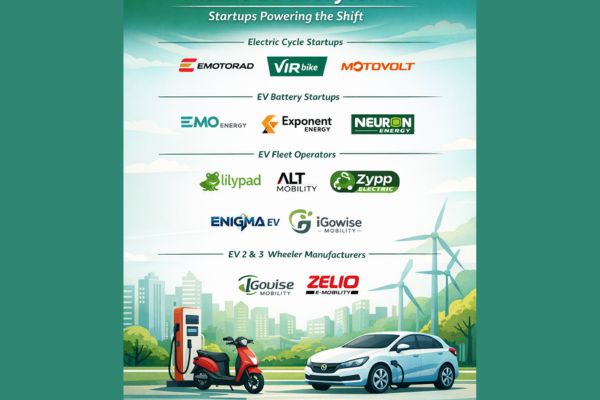
Electric Cycle Startups: Making EVs More Accessible Than Ever
- EMotorad
EMotorad has played a key role in popularising electric cycles as a legitimate urban mobility option. Its products cater to both commuters and recreational riders, helping position e-cycles as an entry point into the EV ecosystem. - VIR Bike
VIR Bike focuses on performance-led e-cycles, targeting users who want a blend of fitness, speed, and convenience. The segment itself is evolving beyond affordability into aspiration. - Motovolt Mobility
Motovolt brings a utility-first approach, building smart e-cycles designed for dense urban environments, where short-distance efficiency matters more than top speed.
EV Battery Startups: Solving the Core Technology Challenge
- EMO Energy
EMO Energy is focused on building intelligent battery systems for high-usage EVs, particularly in fleet applications where performance consistency is critical. - Exponent Energy
Exponent Energy is rethinking charging time with its rapid-charging ecosystem, aiming to make EV downtime comparable to traditional refuelling. - Neuron Energy
Neuron Energy is building scalable lithium-ion solutions across vehicle segments, supporting the growing demand from both personal and commercial EV markets.
EV Fleet Operators: Driving Real Adoption on the Streets
- LilyPad
LilyPad is building infrastructure and services around EV fleet operations, highlighting the importance of backend systems in enabling adoption. - Alt Mobility
Alt Mobility is enabling EV access through leasing and asset management, reducing upfront costs and accelerating fleet electrification. - Zypp Electric
Zypp Electric is one of the most visible players in last-mile delivery electrification, proving that EVs can work at scale in high-utilisation environments.
EV 2- and 3-Wheeler Manufacturers: Building for Indian Roads
- Enigma EV
Enigma EV is focused on practical electric scooters designed for Indian riders, with an emphasis on usability and affordability. - iGowise Mobility
iGowise Mobility is exploring unconventional formats like tilting three-wheelers, aiming to solve safety and stability challenges in urban commuting. - ZELIO E-Mobility
ZELIO is expanding in the mass-market segment with products tailored for Indian conditions, reinforcing the localisation trend in EV design.
Conclusion: An Ecosystem Taking Shape, One Problem at a Time
India’s EV transition is no longer waiting on a single breakthrough moment. It is being built incrementally through better batteries, smarter fleets, more accessible vehicles, and entirely new mobility formats. What stands out is not just innovation, but intent. These startups are not chasing headlines; they are addressing constraints that directly impact adoption cost, charging time, reliability, and usability. And as each layer strengthens, the ecosystem becomes harder to ignore. The result is a shift that feels less like disruption and more like inevitability. India’s EV story is no longer about if the transition will happen—but how quickly this ecosystem can scale to meet the demand it is already beginning to unlock.