
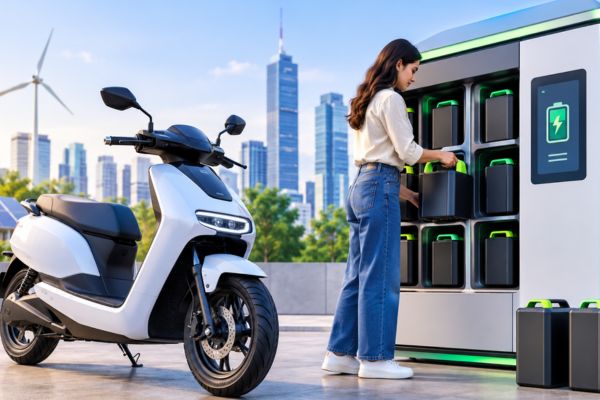
The electric vehicle industry is rapidly evolving, but one obstacle still impacts the daily lives of EV users: charging time. Even as the charging infrastructure grows in cities, highways and commercial locations, the time it takes to charge a battery can be a concern, especially for vehicles that run long hours on a daily basis. Swappable battery technology is emerging as an alternative solution, allowing users to swap out a depleted battery for a fully charged one, instead of waiting for the vehicle to charge.
The idea is simple enough, but the technology and ecosystem that supports it are getting increasingly sophisticated. Battery swapping is a combination of removable battery packs, battery management systems, dedicated swapping stations, digital connectivity and centralised charging infrastructure. As electric mobility extends beyond private passenger cars to delivery, logistics, shared mobility and commercial transport, battery swapping could well become a major part of the industry’s strategy to reduce vehicle downtime.
How Does Swappable Battery Technology Work?
A typical EV has a battery pack inside the vehicle and receives energy through a charging connector. A swappable battery system is one in which the battery can be removed from the vehicle and replaced with a compatible, charged unit.
Depending on the vehicle and battery architecture, the swap can be done manually or with an automated mechanism. In electric two-wheelers, the battery modules come in different sizes. The smaller modules can be handled by hand, while the larger systems may require mechanical assistance or robotic equipment.
Once the spent battery is removed it is taken to a charging system where it can be recharged and made ready for another car. The process effectively decouples the vehicle operation time from the battery charging time. Instead of leaving the vehicle idle while the energy is restored, the vehicle can be returned to operation almost immediately after receiving a charged battery.
This is why battery swapping is particularly applicable to use cases with high vehicle utilisation and where downtime affects the business directly.
Why Battery Swapping Is Necessary For EV Users
Convenience in charging is one of the main factors driving electric vehicle adoption. If you have dedicated parking and can leave your vehicle plugged in for a few hours, home charging is the way to go. But that model is not equally convenient to everyone.
Access to private charging facilities may not always be easy for flat residents, fleet operators, delivery riders and commercial drivers. For these users, a network of strategically located swapping stations could offer another way to access energy.
The biggest advantage is that you will wait less. A user can replace a drained battery with a charged one and continue travelling instead of waiting at a charging station for charging. Less down time can directly impact the day-to-day productivity of commercial users.
This is especially true for electric two-wheelers and three-wheelers used for delivery, passenger transport and last-mile logistics. These vehicles tend to run a lot during the day and so having energy available is an important aspect of their operation.
Battery Swapping and Electric Two Wheelers
Among the most suitable applications of swappable battery technology are two-wheel electric vehicles, as their battery packs are relatively compact and easier to handle than those in passenger cars or heavy commercial vehicles.
A modular battery architecture could allow a scooter to operate on one or more removable battery packs. Depending on the ecosystem, the battery can either be taken to an assigned charging point or swapped in a swapping station by the users.
This model can offer more flexibility for urban mobility. For riders without home access to charging points, they can rely on swapping infrastructure during daily travel. Delivery companies can also keep their operations running longer by swapping batteries instead of leaving vehicles sitting for long charging sessions.
The approach might also influence the vehicle design. By treating the battery as a removable rather than an integrated component, manufacturers are free to devise different packaging, maintenance and energy management options.
Role of Battery Management Systems
BMS (battery management systems) are crucial for a reliable swapping ecosystem. BMS monitors parameters like voltage, current, temperature and battery condition to help ensure safe and efficient operation.
In a swapping network, the BMS plays an even more important role, since individual batteries can be used in multiple vehicles or locations. Digital identification can enable operators to track battery usage, charging cycles and operational history.
This data can allow operators to see the health of batteries and identify units that may need inspection or maintenance. Batteries exhibiting anomalous performance or operating conditions may be taken out of circulation before they cause a reliability or safety issue.
Connected battery systems can also help operators with inventory management. Information on battery availability, state of charge and location can be integrated into digital platforms, allowing users to locate stations with charged batteries available.
Battery Standardization: A Critical Need
Compatibility is one of the biggest challenges for battery swapping. Different manufacturers may use different battery sizes, connectors, voltage levels, communication systems and physical mounting arrangements.
If every manufacturer has its own battery format, a swapping station may only accommodate a small group of vehicles. This can make it difficult to make a big, convenient network.
The problem could be solved by standardization. Standard battery sizes, electrical interfaces and communication protocols could enable the batteries to be used in a number of compatible vehicles.
But common standards will need cooperation between vehicle makers, battery companies, charging and swapping companies, regulators and other stakeholders. Also safety requirements and vehicle architecture differences to be considered to make a universal approach practical.
Battery-as-a-Service Models
Battery swapping is also revolutionizing the ways EV ownership can be structured. In the traditional business model, a consumer purchases a vehicle and its battery. The battery is a major cost item in an EV. Decoupling ownership of the battery from ownership of the vehicle could give rise to another business model.
Battery-as-a-Service provides the battery through a subscription, lease or usage-based model depending on the operator’s model. In this way the customer can pay separately for the use of the battery and for the vehicle.
This could potentially reduce the upfront cost of an EV and shift the burden of battery management to a specialist operator. The operator can manage charging, maintenance, replacement and battery lifecycle activities throughout its network.
Such models could be especially relevant to commercial fleets, where operating costs and vehicle utilization are closely monitored.
Fleet and Commercial Vehicle Opportunities
Commercial mobility may be one of the most promising applications for battery swapping. Delivery vehicles, electric three-wheelers, taxis and other high-utilisation fleets can’t always afford long periods of downtime.
For a delivery operator, for example, a vehicle that sits still for several hours while charging may be able to make fewer deliveries. That allows the vehicle to potentially get back into service in a much shorter period of time.
Fleet operators can also centrally manage batteries. Instead of managing hundreds of vehicles and individual charging sessions, a fleet company could partner with a swapping network to manage availability of batteries and battery health.
Those operational benefits could make swapping an important consideration to complement conventional and fast-charging infrastructure as electric commercial fleets grow.
Safety and Reliability Issues
Battery swapping has potential but needs robust safety systems. Care should be taken when charging, transporting, installing and operating lithium-ion batteries.
A robust enclosure that can withstand multiple handling is necessary for a swapping battery. The connectors and locks must be designed for regular use. The car must check that the battery is properly installed before it can be used.
Swapping stations also require systems to identify batteries with abnormal temperature, voltage or performance characteristics. These batteries need to be segregated, checked and not directly put back into vehicles.
There are other requirements for automated systems since mechanical equipment needs to be able to accurately remove and install batteries. When stations are to operate continuously, reliability becomes more important.
Automation of Battery Swapping
With automation, battery swapping could extend beyond just light two- and three-wheelers. Bigger batteries are much heavier and harder to handle manually, so automated systems could be the solution for passenger cars, busses and commercial vehicles.
Automated stations can replace a depleted battery with a charged battery using mechanical or robotic systems. “The goal is to make the process uniform, quick and less reliant on human manipulation.
But automatic swapping requires vehicle and battery designs to be highly consistent. This again highlights standardization. Without compatible vehicle architectures, it is difficult to deploy large scale automated swapping networks.
Building a Swapping Network: Challenges
One of the biggest obstacles remains infrastructure investment. A swapping network requires physical stations, charging equipment, software, battery inventory, maintenance capability and a reliable supply of electricity.
Operators also must have enough charged batteries at each location on hand to meet demand. This means that the network may require a greater total battery inventory than the number of batteries installed in vehicles.
Location is another important factor. A swapping station only has value if it is located on the routes used by customers. High utilization therefore hinges on the development of networks in zones where demand for EVs is adequate.
Ultimately business viability will come down to balancing station utilization, battery costs, electricity prices, maintenance costs and customer demand.
Swapping and the Future of EV Charging
Battery swapping should not necessarily be viewed as a replacement for conventional charging. Both technologies can serve different requirements.
Home and workplace charging can remain useful for vehicles that stay parked for long periods. Fast charging can support highway travel and situations where users prefer to recharge their own battery. Swapping can provide an alternative for users who prioritise minimum downtime and operate vehicles intensively.
In this sense, the future of EV energy infrastructure will be likely multiple technologies rather than a single universal solution.
Future Perspective of Swappable Batteries
The development of swappable battery technology is driving the EV industry toward a new energy mindset. Swapping converts the battery from a permanent element that is always with the vehicle into an exchangeable and serviceable energy asset.
Its long-term success will depend on many factors including battery standardization, infrastructure availability, safety, cost, digital connectivity and consumer acceptance. The technology also needs business models that are economically viable for both operators and users.
The opportunity is especially significant for markets with large fleets of electric two and three wheelers and commercial vehicles. If compatible batteries and efficient charging systems allow the creation of robust networks, swapping could reduce downtime and make electric mobility more viable for high-utilisation applications.
The move to electric mobility isn’t just about making better batteries or giving vehicles a longer range. It’s also about convenient ways for people and businesses to get energy. Swappable battery technologies take a different approach to that problem, with battery refills being a quick switch rather than a wait.
Battery swapping is likely to remain a technology to watch as the EV ecosystem matures. Its role may vary across vehicle segments and markets, but its basic proposition is simple – keep electric vehicles moving, while charging the batteries separately.