
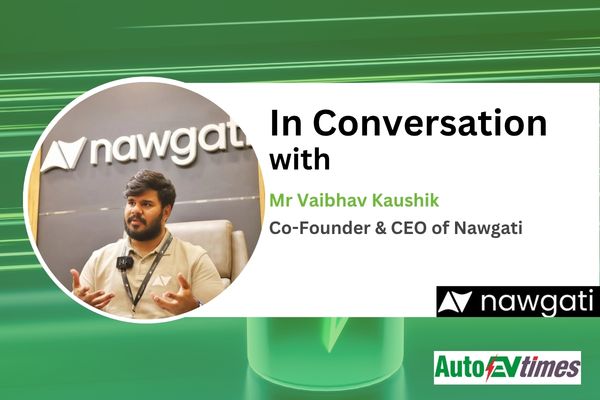
In an interview with AutoEV Times, Vaibhav Kaushik, Co-Founder & CEO of Nawgati, shared his perspective on how AI, computer vision and real-time data are transforming India’s fuel retail network. He discussed intelligent queue management, multi-fuel mobility hubs, digital transformation challenges and the role of collaboration in building smarter infrastructure. Kaushik also outlined Nawgati’s vision for connected, fuel-agnostic stations supporting India’s evolving mobility ecosystem.
Read the full interview here:
AET: India’s fuel retail network is undergoing significant transformation. How do you see AI reshaping the role of fuel stations in the broader mobility ecosystem?
AI is turning fuel stations from passive dispensing points into active nodes of intelligence. At Nawgati, we’ve seen this first-hand through Aaveg, where computer vision and predictive analytics convert everyday station operations into real-time observability for owners and OMCs. Instead of reacting to queues, dryouts, or compliance gaps after they happen, stations can now anticipate them. This shift matters because mobility infrastructure is increasingly data-driven; a station that understands demand patterns, vehicle flow, and fuel availability in real time becomes a genuine part of the mobility network, not just a stop along it.
AET: Fuel stations generate vast amounts of operational data every day. What opportunities do you see in using AI and computer vision to improve efficiency and customer experience?
Every station already generates enormous operational data through CCTV, dispensers, and vehicle movement, most of it unused. Computer vision lets us extract structured intelligence from this without new hardware, things like queue length, dispensing speed, and footfall patterns. For operators, that means better manpower allocation and fewer stockouts; for customers, it means shorter waits and more predictable service. The real opportunity isn’t just automation; it’s converting raw visual data into decisions that improve throughput and trust simultaneously. That’s exactly what we’ve built with Aaveg, and the congestion and dryout reductions we’ve seen validate this approach.
AET: As India moves towards a multi-fuel future with petrol, diesel, CNG, LNG, biofuels and EV charging, how should fuel stations evolve to remain relevant?
Stations need to stop thinking of themselves as single-fuel dispensing points and start becoming energy-agnostic mobility hubs. The underlying need for real-time visibility into availability, wait times, and capacity doesn’t change whether it’s CNG, LNG, or an EV charger. We built Nawgati’s platform to be fuel-agnostic from day one for this reason. As India’s energy mix diversifies, stations that integrate observability across all their offerings, rather than optimising for one fuel type, will stay relevant. The winners will be those who treat every energy source on-site as part of one connected, intelligently managed system.
AET: Long queues continue to affect operational efficiency at many fuel stations. How can intelligent queue management contribute to improving throughput without requiring major infrastructure expansion?
Most queuing problems aren’t capacity problems; they’re visibility problems. Our data shows a 10 to 15 percent reduction in on-ground congestion and over 80 percent fewer CNG dryouts at stations using Aaveg, achieved entirely through existing CCTV and dispenser integration, with zero new capex. Intelligent queue management works by predicting demand spikes and redistributing footfall in real time, whether that’s guiding consumers to less congested stations via our app or helping operators pre-empt bottlenecks before they form. The infrastructure already exists; what’s been missing is the intelligence layer connecting it. That’s a far more scalable fix than physical expansion.
AET: In your view, what are the biggest digital transformation challenges currently facing India’s fuel retail sector?
The biggest challenge is fragmentation; data sits in silos across dispensers, CCTV systems, and manual logs, with no unified layer connecting them. Retailers are often wary of new hardware investment, so any solution needs to work with what’s already installed. There’s also a trust gap: operators need to see measurable operational value before they’ll adopt new systems at scale. And because fuel retail spans multiple energy types and thousands of independently run stations, standardising data quality across such a distributed network is genuinely hard. Solving this requires patience, proving value station by station before scaling.
AET: How can collaborations between startups, fuel retailers and policymakers accelerate the development of smarter mobility infrastructure in India?
No single player can solve this alone. Startups bring agility and technical depth, fuel retailers and OMCs bring scale and on-ground infrastructure, and policymakers can create the frameworks that make adoption consistent nationwide. When these three work together, digitisation moves faster and more uniformly instead of happening in isolated pockets. Policymakers in particular can help by encouraging data-sharing standards and low-capex modernisation, which lets innovation reach smaller, underserved stations rather than only large urban ones.
AET: What is your long-term vision for Nawgati, and how do you see the company contributing to India’s journey towards intelligent and sustainable mobility?
We want every fuel station in India to function as a connected, intelligent mobility hub rather than a standalone dispensing point. That means real-time observability for operators, transparent choice for consumers, and eventually one of the country’s largest real-time mobility datasets supporting smarter infrastructure planning. As India moves through its multi-energy transition, our fuel-agnostic architecture lets us stay relevant regardless of what powers a vehicle. Ultimately, we see Nawgati as the digital backbone connecting retailers, fleets, and consumers, built on efficiency at the station level, but contributing to a more sustainable, well-planned mobility system nationally.