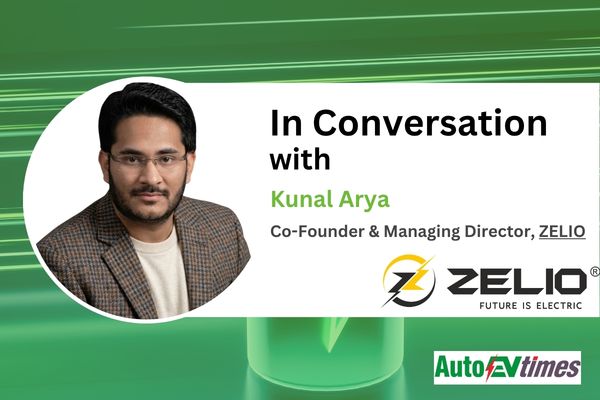
In an interview with AutoEV Times, Kunal Arya, Co-Founder & Managing Director, ZELIO shares how ZELIO E-Mobility is scaling rapidly in India’s low-speed EV segment. He highlights the brand’s focus on affordability, Tier-2 and Tier-3 expansion, in-house manufacturing, and customer-centric innovation, driving strong revenue growth and building trust across emerging mobility markets.
Read the full interview here:
AET: ZELIO has rapidly emerged as a strong player in the low-speed EV segment—what key strategies helped you capture this market so effectively in such a short time?
Kunal: When we entered the market, our focus was very clear. We wanted to solve for everyday mobility in India rather than chase only premium or high speed segments. The low speed category allowed us to address a large, underserved base across Tier 2 and Tier 3 towns where affordability, ease of use and low running cost matter the most. We built our strategy around practical products with reliable range, simple charging and durability suited for Indian roads. A key factor was also keeping entry barriers low, with non RTO models that remove the need for registration and licensing, making adoption much easier for first time EV users. At the same time, we invested heavily in building a wide dealer network and ensuring after sales support was dependable even in smaller cities, which allowed us to earn customer trust and scale rapidly across these markets.
AET: Your FY25 performance reflects impressive growth—what were the primary drivers behind achieving ₹172 Cr+ revenue and strong profitability metrics like ROCE and ROE?
Kunal: What really drove our FY25 performance was disciplined execution rather than chasing growth at any cost. We stayed focused on high demand categories like low speed scooters and ensured strong product market fit for everyday commuting and last mile usage. Our dealer network expansion to over 350 outlets played a big role in improving reach and conversion, especially in Tier 2 and Tier 3 markets where volumes are consistent. At the same time we kept manufacturing in house which helped us control costs, maintain quality and protect margins. We were also very conscious about working capital and inventory cycles, so growth did not come with inefficiencies. When you combine steady volumes, cost control and a reliable after sales ecosystem, profitability naturally strengthens alongside revenue.
AET: With 330+ dealers across 20+ states, how are tier-2 and tier-3 markets contributing to your expansion, and what unique opportunities do you see in these regions?
Kunal: For us, Tier 2 and Tier 3 markets are where the business actually scales in a real way. A large share of our volumes today comes from these regions because the product fits naturally into how people commute there. Distances are shorter, usage is more routine, and the shift from petrol to electric is a clear cost decision, not an aspirational one. What has worked for us is building strong local dealer presence and ensuring service is dependable, because customers here value long term reliability over everything else. We also see strong traction across shared mobility and last mile usage, with Logix performing well in delivery and cargo applications, while in the three wheeler category our e rickshaw models under the Tanga brand are gaining steady acceptance for shared passenger movement across these markets. The opportunity is still underpenetrated, and as awareness and financing improve, these markets will continue to scale in a very steady and predictable way for us.
AET: Affordability and reliability are crucial for EV adoption in India—how does ZELIO ensure the right balance between cost, performance, and customer trust?
Kunal: The Indian market is highly price sensitive and reliability driven, so we focus on designing products that are practical, durable, and easy to maintain, ensuring customers get dependable performance without paying a premium. Keeping entry barriers low with non RTO models and accessible pricing allows first-time EV users to adopt electric mobility comfortably. At the same time, we control costs through in-house manufacturing, efficient supply chains, and careful working capital management, protecting margins without compromising quality. Customer trust is reinforced through a strong dealer network, consistent after-sales support, and real-time service responsiveness, even in smaller towns. We also invest in smart mobility features, easy charging solutions, and robust warranties to enhance ownership experience. Strategic product-market fit, understanding regional commuting patterns, and continuous feedback from riders further help us optimize performance and ensure long-term satisfaction, making adoption seamless and sustainable across India.
AET: Can you share insights into your manufacturing capabilities, product roadmap, and how innovations like the expanded Eeva lineup fit into your long-term strategy?
Kunal: We have built our manufacturing capabilities to support both current demand and future growth, with facilities in Hisar, Patan, Cuttack, and soon Coimbatore designed for in-house production, assembly, battery integration, and rigorous quality testing, allowing us to maintain high standards and cost efficiency. On the product front, the recently expanded Eeva lineup, featuring the facelifted ZX+ and two new models, Eco LX and Eco ZX, starting at just ₹51,551, exemplifies how we blend style, practicality, and affordability for everyday urban commuters, women riders, and families. These innovations strengthen our presence in the low-speed EV segment, complement our broader portfolio, and reinforce our commitment to delivering reliable, accessible, and technologically advanced electric vehicles across India.
AET: As the EV ecosystem in India evolves, what are the biggest challenges you foresee for startups, and how is ZELIO positioning itself for sustainable growth in FY26–27 and beyond?
Kunal: The EV two-wheeler industry in India is at an inflection point, but there are clear challenges that startups need to navigate to ensure sustainable growth. Supply chain dependence on imported components, limited charging infrastructure, and fragmented financing options make scaling difficult, while inconsistent policies and GST structures add complexity for manufacturers. Startups also face the task of building customer trust in Tier 2 and Tier 3 markets, where adoption depends on affordability, reliability, and after-sales support. At Zelio, we are addressing these challenges by expanding our manufacturing footprint, strengthening our dealer network, and delivering practical, reliable, and cost-effective mobility solutions that meet real commuting needs. This approach ensures we remain resilient, build customer confidence, and position ourselves for steady, sustainable growth even as the ecosystem evolves rapidly.