
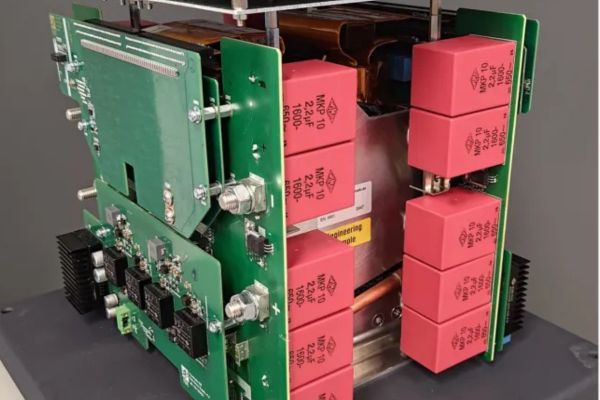
The HV-MELA-BAT project has unveiled an advanced megawatt electric vehicle (EV) charging system aimed at supporting the growing demand for ultra-fast charging infrastructure for both heavy-duty and passenger electric vehicles. The project is being coordinated by the Fraunhofer Institute for Solar Energy Systems (ISE) to accelerate next-generation EV charging technologies.
The newly developed Megawatt Charging System (MCS) is capable of delivering charging power exceeding 1 MW. The system is based on a modular architecture built around a 250 kW galvanically isolated DC/DC converter, and multiple modules can be combined to achieve megawatt-scale charging capacity.
One of the major highlights of the system is its record efficiency of 99.26%, along with a compact design that delivers a high power density of about 9 kW per litre. The achievement was made possible through advanced resonant converter technology and high switching frequencies, which help reduce energy losses while improving overall performance.
The charging solution also features an integrated buffer energy storage system using second-life EV batteries. This approach allows the charging station to operate with lower grid connection requirements while still delivering high-power charging by drawing additional energy from the storage system during peak demand.
In addition, the system has been designed to support both the existing Combined Charging System (CCS) standard and the upcoming Megawatt Charging System standard. It can also be integrated with renewable energy sources such as solar power to further improve sustainability and reduce the carbon footprint of EV charging.
The HV-MELA-BAT project is supported by Germany’s Federal Ministry for Economic Affairs and Energy and involves key industry partners including Mercedes-Benz Energy and Fraunhofer IVI. The successful development of this high-efficiency megawatt charging technology represents a significant step toward enabling faster, scalable and more efficient EV charging infrastructure.



 charging system aimed at supporting the growing demand.)