
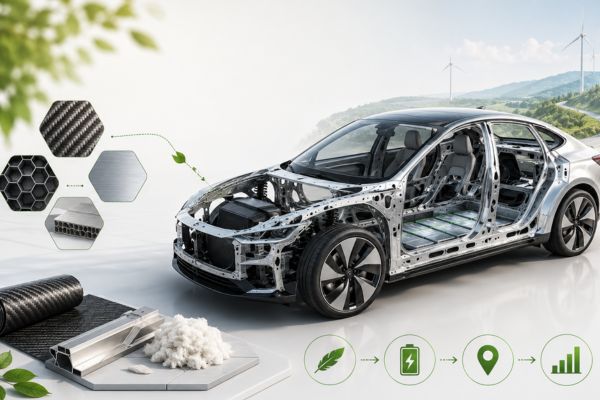
Ask any EV buyer what they worry about most, and range anxiety tops the list almost every time. The industry has responded, predictably, by throwing bigger batteries at the problem. But there is another lever, quieter, more elegant, and arguably more sustainable, that is reshaping how the world’s leading automakers engineer electric vehicles: making the vehicle itself lighter.
Every kilogram removed from an electric vehicle is a kilogram the battery does not need to move. The physics are straightforward. Engineering is not. And the materials science behind modern EV lightweighting is evolving faster than most people realize.
The Weight Problem Nobody Talks About
Here is the fundamental tension at the heart of EV design. Batteries are heavy. A typical large-format lithium-ion battery pack, the kind that delivers 400–500 km of range in a premium EV, weighs between 400 and 700 kilograms. That is a significant fraction of the vehicle’s total mass, and it works directly against the efficiency that the battery is supposed to provide.
This creates a compounding effect. A heavier vehicle needs more energy to move. More energy consumption means a larger battery is required for the same range. A larger battery adds more weight. The cycle repeats.
The alternative strategy is to attack the problem from the opposite direction: reduce the mass of the vehicle structure, the body panels, the chassis, and the suspension, so that the same battery delivers meaningfully more range. Research consistently shows that a 100 kg weight reduction in an electric vehicle translates to approximately 10–15 km of additional range. At 200 kg of savings, that is a real-world improvement of 20–30 km without adding a single kilowatt-hour of battery capacity.
This is why the global electric vehicle lightweight materials market, valued at approximately $20 billion in 2025, is projected to reach nearly $96 billion by 2033. The economics and the engineering point in the same direction.
Aluminum: The Workhorse of EV Lightweighting
If carbon fiber is the glamorous headline material, aluminum is the one doing the heavy lifting in actual production vehicles. Replacing conventional steel with aluminum across body panels, frames, and structural components can reduce vehicle weight by 30–40% for those parts, while maintaining the crashworthiness and corrosion resistance that automotive safety standards demand.
The 6000-series alloys (aluminum-magnesium-silicon) and 7000-series alloys (aluminum-zinc-magnesium) are the workhorses of automotive aluminum, offering enhanced strength through alloying elements while remaining amenable to the stamping, extrusion, and casting processes that modern auto plants require. Tesla’s Model S chassis, for instance, has long relied on aluminum extensively, contributing to a structure that balances stiffness and mass. Audi’s “Space Frame” architecture, now evolved into the Audi Space Frame technology used across multiple models, demonstrated that a vehicle body built primarily from aluminum castings and extrusions could outperform a conventional steel design on both weight and rigidity.
The trade-off is cost. Aluminum is more expensive than steel per kilogram, and joining aluminum components, particularly to dissimilar metals, requires specialized processes. But as production volumes scale and manufacturing infrastructure matures, the cost premium is narrowing.
Carbon Fiber: The High-Performance Frontier
Carbon fiber reinforced polymer (CFRP) is where the engineering conversation gets genuinely exciting. CFRP has a specific strength approximately ten times higher than steel, while weighing a fraction as much. In density terms, CFRP parts used in vehicles typically range from 1.50 to 1.60 g/cm³, roughly 40–45% lighter per unit volume than the aluminum alloys they replace.
The real-world performance implications are significant. For EVs, a 10% weight reduction through CFRP integration can increase range by 8–10%. The BMW i3’s carbon fiber passenger cell, built using a modular “Carbon Core” structure, produced a body-in-white weighing just 223 kg, approximately half the weight of an equivalent steel structure. This directly extended the vehicle’s viable range without requiring battery chemistry improvements.
More recent implementations have become more targeted and cost-conscious. The NIO ES6’s carbon fiber composite rear floor panel weighs just 5.3 kilograms and achieves over 30% weight reduction compared to an aluminum equivalent. The NIO ET7 incorporates CFRP in roof reinforcement beams, improving torsional stiffness while cutting component weight by 30%. Carbon fiber wheels, increasingly offered as options on performance EVs, can be 30–40% lighter than forged aluminum equivalents, reducing unsprung mass in a way that improves handling, braking, and acceleration simultaneously.
The persistent barrier is cost. CFRP materials, tooling, and manufacturing processes, autoclave curing, automated fiber placement, resin transfer molding, remain expensive relative to metals. But cycle times are coming down. Large-scale composite manufacturing breakthroughs have achieved production times as short as two minutes per component, enabling annual production of over 100,000 parts. By 2030, automotive CFRP demand is expected to exceed 500,000 tons, with per-kilogram costs projected to fall into the $8–12 range as production scales.
Magnesium: The Underutilized Contender
Magnesium is the lightest structural metal used in engineering, with a density of just 1.74 g/cm³, roughly two-thirds that of aluminum and one-quarter that of steel. Magnesium alloys can reduce component weight by more than 60% compared to steel equivalents, and in some configurations, carbon fiber reinforced magnesium composites (CFRMg) achieve weights approximately 79% lighter than mild steel and 41% lighter than aluminum.
Despite these properties, magnesium currently accounts for less than 1% of average vehicle weight. The reasons are well-understood: lower hardness and corrosion resistance compared to aluminum, difficulty joining to dissimilar metals in multi-material systems, and recycling challenges at end of life.
These barriers are being addressed. Research backed by the US Department of Energy has demonstrated new manufacturing processes including warm forming for high-volume applications and friction-stir welding of magnesium-steel joints. Advanced alloy formulations, including Mg-Sn, Mg-Al-Zn, and multicomponent systems, are achieving compressive strengths up to 627 MPa with improved ductility and corrosion resistance. As these process improvements mature, magnesium is positioned to take a larger structural role, particularly in components like instrument panel crossbeams, seat frames, and steering columns where its vibration-damping properties offer an additional advantage.
High-Strength Steel: The Incumbent Fighting Back
It would be a mistake to write off steel entirely. High-strength steel (HSS) and advanced high-strength steel (AHSS) variants have evolved significantly, offering weight reductions of 15–25% compared to conventional steel while remaining far cheaper than aluminum or composites and fully compatible with existing manufacturing infrastructure.
For crash structures, the crumple zones and safety cages where controlled deformation matters more than simple weight minimization, high-strength steel remains the material of choice in many architectures. The strategic reality in modern EV manufacturing is not an either/or competition between materials, but an intelligent multi-material approach: aluminum and CFRP where weight savings and premium performance justify the cost, high-strength steel where structural demands and economics favor it.
The Multi-Material Philosophy
The most sophisticated contemporary EV architectures don’t bet on a single material. They engineer each component to be made from the material that best serves that component’s function, structurally, thermally, and economically.
BYD’s “Cell-to-Body” technology integrates CFRP with battery structures, reducing overall weight by 15% while enhancing torsional stiffness by 20%. The approach treats the battery pack not as a passive passenger sitting on the floor but as a structural member of the vehicle, a philosophical shift that simultaneously lightens the car and simplifies the architecture. Replacing cast iron and steel with aluminum alloys, magnesium alloys, carbon fiber, and polymer composites across the body and chassis can reduce vehicle weight by up to 50%. That is not a marginal improvement. It is a transformation.
Hybrid CFRP-aluminum composite structures, like Audi’s A8 Space Frame, balance the performance of carbon fiber with the cost and joinability of aluminum, placing each material where it performs best relative to cost. This kind of intelligent material selection, guided by finite element modeling and simulation, is what separates best-in-class EV engineering from simple component substitution.
Emerging Frontiers: Aerogels and 3D Printing
Two developments on the materials frontier deserve attention for what they signal about the next decade of EV lightweighting.
Aerogel-based thermal insulation, introduced for EV battery applications by companies like Cabot Corporation through products like their ENTERA aerogel particle portfolio, offers a way to dramatically reduce the weight and thickness of thermal management components within battery packs. Thinner, lighter thermal barriers mean more energy-dense battery configurations in the same packaging volume, effectively increasing range without changing battery chemistry.
Additive manufacturing, 3D printing with continuous carbon fiber filaments, is enabling complex lightweight geometries that are impossible to achieve through conventional forming or casting. Parts can be optimized topologically: material placed only where stress analysis shows it is needed, eliminating dead weight with precision that was previously unachievable at production scale.
What This Means for the Road Ahead
The global EV lightweight materials market is growing at a CAGR of approximately 27% through the early 2030s. That growth rate reflects how fundamentally the industry has recognized lightweighting as a structural priority, not an incremental nicety.
For automakers in mature markets, lightweight materials are a competitive differentiator. For markets like India, where cost sensitivity constrains the path to mass EV adoption, the evolving economics of these materials, aluminum growing more accessible, CFRP costs declining, magnesium alloys maturing, will gradually make lightweight design viable at accessible price points.
The goal is not to build a lighter car for its own sake. It is to build a car that can go further, carry more, respond faster, and operate more efficiently on the same stored energy. Every kilogram removed is range added. Every structural innovation in materials is a step toward an electric vehicle that genuinely outperforms its combustion equivalent, not just in emissions, but in everything a driver actually experiences.
That is the real promise of lightweight materials. Not black fiber and shiny alloys for their own sake. But the simple, powerful idea that the best battery is the one that has to do the least work.