
The Liquid-cooled EV Charger Modules Market is emerging as a critical technology segment within the rapidly evolving electric vehicle charging ecosystem. As EV charging infrastructure moves toward higher power levels, ultra-fast charging, commercial fleet electrification and megawatt-scale charging, conventional thermal-management approaches are increasingly being challenged.
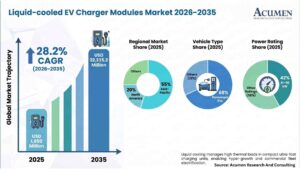
According to Acumen Research and Consulting, the Global Liquid-cooled EV Charger Modules Market was valued at approximately USD 1.85 billion in 2025 and is projected to reach USD 22.24 billion by 2035, expanding at a 28.2% CAGR between 2026 and 2035.
The underlying market opportunity is closely connected to a simple engineering reality: higher charging power produces greater heat. As charging equipment becomes more compact and powerful, removing that heat efficiently becomes essential for maintaining performance, reliability and service life.
Liquid cooling therefore represents more than a thermal-management upgrade. It is becoming an enabling technology for the next generation of high-power EV charging infrastructure.
What Are Liquid-cooled EV Charger Modules?
Liquid-cooled EV charger modules are power-electronics units used within EV charging systems to convert and manage electrical power while using a liquid-based cooling system to dissipate heat generated by high-power electronic components.
Unlike conventional air-cooled modules, which depend primarily on fans, heatsinks and airflow, liquid-cooled systems circulate coolant through or near heat-generating components. This approach enables more effective heat transfer and can support higher power density within a relatively compact physical footprint.
The technology is particularly relevant to DC fast chargers, ultra-fast charging stations, fleet charging systems and emerging heavy-duty or megawatt charging platforms.
The Liquid-cooled EV Charger Modules Market is predominantly a B2B market. Module manufacturers typically supply charger OEMs, charging infrastructure integrators, charging-network operators and other power-electronics companies that integrate the modules into complete charging systems.
Key Trends Driving the Liquid-cooled EV Charger Modules Market
1. Rapid Expansion of High-power EV Charging
The most important factor driving the Liquid-cooled EV Charger Modules Market is the rapid deployment of high-power DC charging infrastructure.
EV manufacturers and charging operators are under pressure to reduce charging times. As charger output rises, however, power-conversion components generate more heat. Effective thermal management becomes increasingly important to prevent excessive temperature increases and performance derating.
This creates a direct relationship between charging power and demand for advanced cooling technologies.
Acumen Research and Consulting identifies rising deployment of high-power and ultra-fast EV charging infrastructure as a principal driver of the market.
2. Growing Demand for Ultra-fast Charging
Ultra-fast charging is changing the design requirements for charging equipment.
A charger capable of delivering very high power for a short period must manage significant thermal loads without compromising efficiency or reliability. Liquid cooling provides charger manufacturers with greater flexibility to design compact, high-power systems capable of handling sustained or repeated charging cycles.
As charging networks increasingly compete on charging speed, liquid-cooled power modules are likely to become an increasingly important component of premium charging infrastructure.
3. Increasing Power Density
Power density is becoming a major competitive parameter for charger manufacturers.
Instead of simply making chargers larger to accommodate higher power, manufacturers increasingly want to deliver more electrical output from a smaller enclosure. Liquid cooling can support this objective by transferring heat more efficiently and reducing dependence on large heatsinks and extensive airflow channels.
Higher power density can also simplify charging-station design where space is limited.
4. Growth of Modular Charging Architectures
Modular power-conversion architectures are becoming increasingly important because they allow charging systems to scale their output by combining multiple modules.
According to Acumen Research and Consulting, the 41–60 kW segment accounted for 42% of the Liquid-cooled EV Charger Modules Market in 2025, making it the largest power-rating category. The 21–40 kW segment represented another 27%.
Together, these two categories accounted for 69% of the market, highlighting the importance of modular power blocks as building units for larger charging systems.
This modular approach enables charger manufacturers to configure systems for different power requirements while improving scalability and potentially simplifying maintenance.
5. Integration of AC-DC and DC-DC Conversion
AC-DC modules currently represent the largest module category.
Acumen Research and Consulting estimates that AC-DC modules accounted for 64% of the global market in 2025. Their dominance reflects the fundamental requirement to convert grid-supplied AC electricity into DC power suitable for EV battery charging.
At the same time, integrated AC-DC/DC-DC modules are emerging as a particularly fast-growing segment. Their market share is projected to increase from 8% to 10% by 2035, with an estimated CAGR of approximately 31.1%.
The shift toward integrated power conversion reflects the industry’s focus on reducing component count, improving power density and creating more compact charging architectures.
6. Electrification of Commercial Fleets
Passenger EVs currently account for the majority of market demand, but commercial vehicles represent an increasingly important opportunity.
Acumen estimates that commercial EVs accounted for 27% of the market in 2025.
Electric buses, trucks, delivery vehicles and logistics fleets typically have demanding charging requirements. Fleet operators cannot afford lengthy vehicle downtime, making fast, reliable and high-utilization charging infrastructure particularly valuable.
This makes commercial fleet charging an important long-term growth opportunity for liquid-cooled charger modules.
7. Emergence of Heavy-duty and Megawatt Charging
One of the most significant future opportunities for the Liquid-cooled EV Charger Modules Market is heavy-duty vehicle charging.
Electric trucks and buses require substantially more energy than passenger vehicles. Fleet operators may also need to charge multiple vehicles during relatively short operational windows.
As charging power moves toward megawatt-class levels, thermal management becomes progressively more challenging. Liquid cooling could therefore become increasingly important in charging infrastructure designed for electric trucks, buses, logistics hubs and high-throughput commercial depots.
Liquid Cooling vs. Air Cooling in EV Chargers
Liquid cooling does not automatically replace air cooling in every EV charging application.
Air cooling remains attractive for lower-power charging systems because it is comparatively simple and inexpensive. Liquid cooling introduces additional components, including pumps, coolant circuits, cold plates, heat exchangers, sensors, hoses and fittings.
However, liquid cooling offers important advantages when charging systems operate at high power or under sustained loads.
Liquid-cooled systems generally provide:
- Higher heat-dissipation capability.
- Greater power density.
- Better thermal control around heat-generating components.
- Potentially smaller charger footprints.
- Stronger performance during sustained high-power operation.
- Greater suitability for ultra-fast and heavy-duty charging.
The principal disadvantage is higher system cost and engineering complexity.
According to Acumen Research and Consulting, these additional costs and maintenance considerations remain an important restraint on adoption, particularly in lower-power and cost-sensitive applications.
The market is therefore likely to develop according to application requirements rather than through a complete replacement of air cooling.
Major Companies in the Liquid-cooled EV Charger Modules Market
The competitive landscape includes specialist power-electronics manufacturers as well as diversified companies involved in EV charging infrastructure.
According to Acumen Research and Consulting, leading companies include:
- Infypower
- UUGreenPower
- Tonhe Electronics Technologies
- Winline Technology
- Huawei
- Shenzhen Sinexcel Electric
- Shenzhen Increase Tech
- Kstar Science & Technology
- TELD
- XYPower
These companies have different competitive positions.
Infypower, UUGreenPower, Tonhe Electronics Technologies and Winline Technology have significant exposure to charging power modules and power-conversion technologies.
Huawei approaches the opportunity through its broader digital-power and EV-charging ecosystem, combining power electronics, charging equipment and digital management technologies.
Sinexcel and Kstar bring broader expertise in power conversion, energy infrastructure and EV charging.
TELD has a significant position in the broader charging infrastructure ecosystem, while other specialist module suppliers compete primarily through efficiency, thermal performance, reliability and power density.
The competitive landscape is therefore becoming increasingly sophisticated. Price alone is unlikely to determine long-term winners. OEM qualification, reliability testing, thermal performance, efficiency, certification and manufacturing scale are becoming critical differentiators.
Regional Analysis of the Liquid-cooled EV Charger Modules Market
Asia-Pacific
Asia-Pacific is currently the dominant regional market.
According to Acumen Research and Consulting, Asia-Pacific accounted for 55% of global Liquid-cooled EV Charger Modules Market revenue in 2025, equivalent to approximately USD 1.02 billion.
China is the principal contributor because of its large EV manufacturing ecosystem, extensive charging infrastructure and strong concentration of power-electronics manufacturers.
Japan and South Korea also contribute through their established automotive and electronics industries, while India is becoming an increasingly important market as EV adoption and charging infrastructure expand.
Asia-Pacific therefore represents both the largest demand market and one of the most important manufacturing centers for liquid-cooled charging technology.
North America
North America represented the second-largest regional market, with a 20% share in 2025.
The region’s growth is being supported by the expansion of high-power DC charging infrastructure, commercial fleet electrification and charging networks.
Highway charging corridors are particularly important because charging operators need equipment capable of supporting frequent and sustained high-power sessions.
The increasing electrification of commercial vehicles is another important opportunity for liquid-cooled charger modules in North America.
Europe
Europe represents another strategically important market because of its strong automotive industry, expanding public charging infrastructure and emphasis on EV adoption.
European charging infrastructure is increasingly moving toward high-power charging, particularly along major transportation corridors.
For module suppliers, Europe is also a market where product certification, interoperability, reliability and energy efficiency can significantly influence purchasing decisions.
Middle East & Africa
Middle East & Africa currently represents a relatively small portion of the global market, accounting for approximately 3% in 2025 according to Acumen Research and Consulting.
However, the region is expected to experience the fastest growth among the major geographic markets, with an estimated CAGR of approximately 30.2% between 2026 and 2035.
Growing investment in EV infrastructure and the development of new charging networks create an opportunity for the region to deploy advanced charging technologies without being constrained by extensive legacy infrastructure.
Market Segmentation Highlights
Several market segments provide useful insight into where current demand is concentrated.
By Module Type
AC-DC modules dominated with a 64% share in 2025.
Integrated AC-DC/DC-DC modules are expected to grow at the fastest rate as manufacturers increasingly prioritize compact and integrated power-conversion architectures.
By Power Rating
The 41–60 kW category led with 42% of market revenue in 2025, followed by 21–40 kW at 27%.
Higher-power categories above 100 kW currently represent smaller shares but have substantial strategic importance because of their connection to ultra-fast and heavy-duty charging.
By Charger Architecture
Standalone architecture accounted for 62% of the market in 2025, while distributed charging architecture represented 38%.
Distributed architectures may become increasingly important at large charging sites because centralized power conversion can serve multiple charging dispensers.
By Charging Application
Public fast charging dominated with 48% of market revenue in 2025.
Commercial fleet charging followed with 22%, while heavy-duty and megawatt charging represented 12%.
By Vehicle Type
Passenger EVs accounted for 68% of market revenue in 2025, while commercial EVs represented 27%.
Although passenger EVs dominate today, commercial vehicles could become disproportionately important as charging power requirements increase.
By End User
Charger OEMs represented the largest end-user category at 54% in 2025.
Charging infrastructure system integrators followed at 16%.
This demonstrates that charger OEMs are currently the most important customer group for liquid-cooled power-module suppliers.
By Deployment Stage
New charger installations represented an overwhelming 82% of the market in 2025.
Retrofit and upgrade applications accounted for 13%, while replacement and aftermarket demand represented 5%.
The dominance of new installations indicates that the current market is being driven primarily by the construction of new high-power charging infrastructure rather than replacement of existing liquid-cooled equipment.
Key Opportunities in the Liquid-cooled EV Charger Modules Market
The market’s long-term opportunity extends beyond conventional public fast charging.
Commercial Fleet Charging
Fleet operators are likely to become major users of high-power liquid-cooled charging technology because vehicle utilization and charging uptime directly affect operating economics.
Electric Trucks and Buses
Heavy-duty electrification requires substantially greater charging power than conventional passenger vehicles. This creates an important opportunity for advanced thermal-management systems.
Charging Hubs
Large charging hubs may use centralized power conversion and distributed charging architectures to serve multiple vehicles simultaneously.
Such systems can benefit from modular, liquid-cooled power electronics.
Charger Upgrades and Retrofits
As the installed base of charging infrastructure grows, operators may seek to increase power output without completely replacing existing equipment.
Liquid-cooled modules could provide an opportunity to upgrade charger performance where the underlying architecture permits module replacement.
Energy Storage Integration
Future charging stations are increasingly likely to combine EV chargers with stationary battery energy storage.
Liquid-cooled power modules can potentially play a role in these integrated energy systems by supporting high-power bidirectional conversion and efficient energy management.
Challenges Facing the Market
Despite its strong growth outlook, the Liquid-cooled EV Charger Modules Market faces several challenges.
The first is system cost. Liquid cooling requires additional hardware and engineering, increasing the initial cost compared with simpler air-cooled solutions.
The second is system complexity. Pumps, coolant loops, seals and sensors create additional components that must operate reliably throughout the charger’s service life.
The third challenge is maintenance. Coolant leakage, pump failure and thermal-loop servicing can increase maintenance requirements.
Another challenge is grid capacity. Increasing charger power does not eliminate the need for adequate electrical infrastructure. Charging sites may require substantial grid upgrades, transformers, energy storage or intelligent load management.
Finally, manufacturers must navigate differences in charging standards, safety requirements, certifications and market-specific regulations.
Future Outlook for the Liquid-cooled EV Charger Modules Market
The next phase of market development will likely be defined by higher power density, greater integration and increasingly intelligent thermal management.
The industry is moving toward charging systems that can deliver more power from smaller physical footprints while maintaining efficiency and reliability.
Artificial intelligence and predictive monitoring could also become increasingly important. Thermal sensors and real-time operating data can potentially be used to detect abnormal temperature behavior, predict component failures and optimize cooling performance.
Another important trend will be the integration of charging, energy storage and grid-management technologies.
As charging stations evolve from simple electricity-delivery points into energy-management hubs, power modules will become increasingly important components of the overall infrastructure.
Competitive Outlook: What Will Differentiate Market Leaders?
The future competitive landscape is unlikely to be determined by module price alone.
Successful suppliers will need to demonstrate:
- High conversion efficiency.
- High power density.
- Reliable liquid-cooling architecture.
- Strong thermal performance.
- Low maintenance requirements.
- Flexible modular configurations.
- Compatibility with different charger architectures.
- Global certification capabilities.
- Scalable manufacturing capacity.
- Strong OEM relationships.
- Long-term product reliability.
- Integration with intelligent charging and energy-management systems.
OEM design wins will be particularly important.
Since charger OEMs accounted for 54% of market demand in 2025, according to Acumen Research and Consulting, module suppliers that secure long-term OEM relationships can potentially establish recurring demand as new generations of charging equipment are deployed.
Frequently Asked Questions About the Liquid-cooled EV Charger Modules Market
How big is the Liquid-cooled EV Charger Modules Market?
According to Acumen Research and Consulting, the global Liquid-cooled EV Charger Modules Market was valued at approximately USD 1.85 billion in 2025 and is expected to reach approximately USD 22.24 billion by 2035, growing at a CAGR of 28.2% from 2026 to 2035.
What is driving the Liquid-cooled EV Charger Modules Market?
The primary growth drivers include the expansion of high-power DC fast charging, ultra-fast charging, commercial fleet electrification, increasing charger power density and the emergence of heavy-duty and megawatt charging.
Which region dominates the Liquid-cooled EV Charger Modules Market?
Asia-Pacific dominated the market in 2025 with a 55% share, supported by its large EV manufacturing base, extensive charging infrastructure and strong power-electronics manufacturing ecosystem.
Which companies are leading the Liquid-cooled EV Charger Modules Market?
Major companies identified by Acumen Research and Consulting include Infypower, UUGreenPower, Tonhe Electronics Technologies, Winline Technology, Huawei, Shenzhen Sinexcel Electric, Shenzhen Increase Tech, Kstar Science & Technology, TELD and XYPower.
Why are liquid-cooled modules important for EV charging?
Liquid cooling enables more effective heat removal from high-power electronic components. This can support higher power density, compact charger designs and more reliable operation under sustained high-power charging conditions.
Is liquid cooling better than air cooling for EV chargers?
Liquid cooling is generally better suited to high-power, ultra-fast and heavy-duty charging applications because it offers greater thermal-management capability and supports higher power density. Air cooling remains attractive for lower-power applications because it is simpler and less expensive.
What is the fastest-growing opportunity in the market?
Ultra-fast charging, commercial fleet charging and heavy-duty or megawatt charging represent some of the most important long-term opportunities because these applications require high power, high utilization and effective thermal management.
The Liquid-cooled EV Charger Modules Market is becoming an increasingly important component of the global EV charging ecosystem.
The market’s projected expansion from USD 1.85 billion in 2025 to USD 22.24 billion by 2035, as estimated by Acumen Research and Consulting, reflects a broader transformation in EV charging technology.
Charging systems are becoming faster, more compact and more power-intensive. As a result, thermal management is moving from a supporting engineering function to a strategic differentiator.
Asia-Pacific currently leads the market, while North America and Europe offer significant opportunities through high-power charging deployment and commercial electrification. Meanwhile, emerging markets in the Middle East, Africa and other regions could create new demand as charging infrastructure expands.
The next major growth phase will likely come from ultra-fast passenger-vehicle charging, commercial fleets, electric trucks and buses, charging hubs and megawatt-class systems.
Ultimately, the competitive advantage will belong to companies that can combine power density, efficiency, thermal reliability, modularity, scalability and cost-effectiveness.
Liquid cooling is therefore not simply a solution for removing excess heat. It is becoming one of the technologies that can determine how far EV charging infrastructure can push the boundaries of charging speed, power and reliability.