
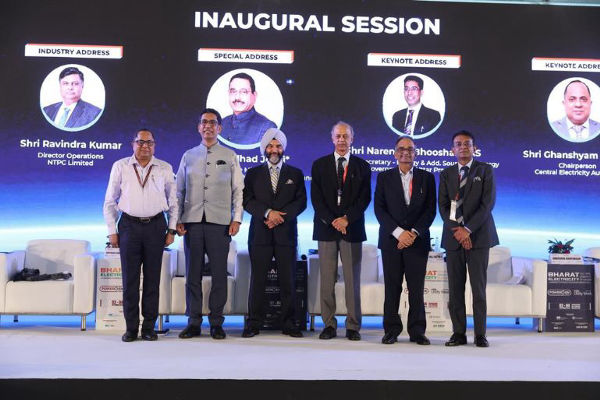
Bharat Electricity 2025, co-located with POWERGEN India and Indian Utility Week, kicked off today at Yashobhoomi, IICC Dwarka, New Delhi. Held under the theme “Viksit Bharat: Transforming Energy, Transforming Lives,” the event highlights India’s remarkable progress in the power and clean energy sectors. With installed capacity surpassing 490 GW—over half of which comes from non-fossil fuel sources—India has successfully integrated the world’s largest synchronous grid and set global benchmark prices for green hydrogen and ammonia.
The event, supported by key central ministries, was inaugurated in the presence of prominent leaders, including Shri Bhupinder Singh Bhalla, IAS (Retd.), Former Secretary, MNRE; Shri P.K. Pujari, IAS (Retd.), Former Chairperson, CERC & Former Power Secretary; Shri Narendra Bhooshan, IAS, Additional Chief Secretary, Energy & Additional Sources of Energy, Government of Uttar Pradesh; Shri Ghanshyam Prasad, Chairperson, Central Electricity Authority; and Shri Alok Kumar, IAS (Retd.), Director General, All India Discom Association and Former Secretary, Ministry of Power. The inaugural session highlighted India’s strong commitment to building a resilient, inclusive, and climate-aligned power sector. Speakers stressed that India’s energy transition is a deliberate and strategic choice aimed at driving growth, fostering innovation, and enhancing global competitiveness—rather than merely a response to climate imperatives.
With over 10,000 stakeholders, 120+ policymakers and experts, and more than 250 exhibitors spread across 12,500 square meters, Bharat Electricity 2025 has established itself as India’s premier platform for policy, industry, and technology convergence. The exhibition features cutting-edge solutions in renewable integration, hydrogen, energy storage, digital grids, and decarbonization technologies, with live demonstrations showcasing real-world pathways to a sustainable energy future. The event’s scale and ambition underscore India’s dual position as one of the world’s largest energy consumers and a rapidly growing hub for clean energy investment.
In his welcome address, Shri Bhupinder Singh Bhalla emphasized that the forum represents far more than an industry gathering, describing it as “a national canvas and a global stage” where India’s energy transition is driven by bold ambition, innovation, and transformation. He highlighted the nation’s commitment to a path of responsible and self-reliant growth, stating that, “In the future, every megawatt we add will symbolize a promise fulfilled, and every policy we craft will bring us closer to an energy future that is globally competitive, affordable, and scalable.”
In his special address, Shri P.K. Pujari described the event as “India’s electricity Davos,” highlighting its role as a pivotal platform for shaping the future of the energy sector. He stressed the importance of placing flexibility, market dynamics, and citizens at the core of the energy transition. Shri Pujari further noted that the forum provides a unique opportunity for global players to exchange ideas, forge partnerships, and drive collective growth in the sector.
Delivering the keynote address, Shri Narendra Bhooshan outlined Uttar Pradesh’s bold vision of becoming a $1 trillion economy within the next five years. He reflected on the state’s past challenges with energy infrastructure and supply, noting the remarkable progress achieved in recent years. “Today, with demand reaching 32 GW, we stand among the leading states in electricity supply,” he said. Highlighting the state’s vast potential, resources, and ambition, he emphasized that the energy sector will play a pivotal role in driving this transformative growth journey.
Addressing the operational challenges of India’s energy transition, Shri Ghanshyam Prasad, Chairperson of the Central Electricity Authority, emphasized the importance of unified efforts across all sectors. He noted, “While previous speakers have outlined the broader vision of India’s energy ambitions, it is equally important to tackle the on-ground realities of execution. From managing grid operation constraints to integrating renewables at scale, the journey ahead demands close collaboration among policymakers, utilities, and industry stakeholders to overcome these challenges effectively.”
Shri Alok Kumar, Director General of the All India Discom Association, contextualized India’s energy ambitions by highlighting the urgent need for comprehensive systemic reforms. He noted, “Energy demand in India is growing at a CAGR of 3%, with actual consumption rising even faster. This growth will only accelerate, driven by rapid industrialization, improving living standards, and a manufacturing-focused economy.” Emphasizing the need to reduce dependence on imported oil and move towards true energy independence, he added, “The way forward lies in bold, accelerated action built on three core pillars: affordability, reliability, and sustainability.”
In his vote of thanks, Shri Abhishek Bhatnagar, Director General of ENCIS, highlighted that in an era defined by AI, electrification, and climate volatility, the true measure of progress lies in infrastructure intelligence—systems that are smart, self-healing, resilient, and seamlessly integrated with India’s digital public infrastructure. He emphasized, “For India, this transformation is not just a technological evolution; it is a sovereign imperative.”
Day One also featured a series of high-impact sessions, including a leadership plenary on India’s Electricity Roadmap 2035 and Energy Outlook to 2047, along with an international plenary focused on strengthening regional cooperation and advancing global energy goals, with participation from Denmark, Germany, and Australia. Key discussions covered the future of electricity markets and the role of nuclear power in achieving a net-zero future. The day concluded with the Bharat Electricity Awards 2025, celebrating excellence in energy, grid innovation, and climate leadership.
Bharat Electricity 2025, alongside POWERGEN India and Indian Utility Week, serves as more than just a showcase of India’s power sector transformation—it is a declaration of vision and purpose. The event underscores India’s commitment to building an energy future that is secure, affordable, sustainable, and globally competitive. By bringing together policy leaders, industry innovators, global collaborators, and citizens, it creates a definitive platform where strategy meets execution. This convergence is propelling India closer to its net-zero goals while cementing its position as a leader in the global energy transition.