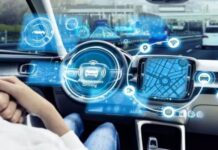

A connected car is a vehicle that is always in sync with internet connectivity and onboard sensors. These enable drivers to access vehicle communication and other online systems to communicate and share data with other vehicles, devices, infrastructure, and cloud-based services. Through technologies such as IoT, GPS, and wireless networks, connected cars provide real-time data for navigation, entertainment, safety, remote diagnostics, infotainment, and over the air software updates.
Use of key technologies provides numerous features that are crucial for connected car operations. Connectivity modules in these cars use cellular 4G/5G, Bluetooth, or Wi-Fi to be synced and connected to the internet as well as other devices. GPS, cameras, sensors, accelerometers, and gyroscopes are installed to enable continuous collection and analysis of data. Data transmission is bidirectional wherein cars can send as well as receive data from systems outside the vehicles.
Connected car support advanced fleet management, predictive maintenance, usage-based insurance, and enhanced customer experiences. Connected cars improve operational efficiency, increase road safety, and enable data-driven mobility services, playing a key role in the evolution of intelligent transportation systems.
Key communication types
Connected cars use V2X, i.e., Vehicle-to-Everything technology to interact in several ways with the surrounding environment.
V2V (Vehicle-to-Vehicle) technology enables vehicles to exchange speed and position data with other cars to better coordinate and avoid collisions in traffic.
V2I (Vehicle-to-Infrastructure): Vehicles are able to connect to road signs and traffic lights to receive alerts about signals, available parking or diversions.
V2P (Vehicle-to-Pedestrian) enables detection sensors to alert both pedestrians/cyclists and drivers to avoid potential accidents.
V2C (Vehicle-to-Cloud) enables data sharing in real time to allow navigation updates and entertainment streaming as well as offer remote diagnostics.
V2G (Vehicle-to-Grid) allows electric vehicles (EVs) to communicate with the power grid, which optimizes charging or enables power backup during peak demand.
Key developments
Connected cars offer higher safety and security as they can send automatic crash notification, collision, and hazard warnings in real time, and have a stolen vehicle tracking system. It is extremely convenient as the engine starts; locking/unlocking, and control can be remotely handled through apps.
Connected cars enhance comfort and improve travel efficiency by automating routine driver tasks. They make the trips smoother and easier as well as help avoid accidents.
Connected cars are extremely efficient as manufacturers can fix bugs and improve the overall performance of the car using over-the-air (OTA) updates, which avoids physical visits and thereby saves time. Sensors enable predictive maintenance as they continuously monitor the tire pressure, engine oil, and other parameters of the vehicle. They share alerts with the driver or the dealership to act accordingly and prevent breakdown.
Connected cars feature infotainment systems that allow seamless integration of music, media, and navigation with smartphones. Telematics offers maintenance alerts and enables vehicle diagnostics in real time, which helps in efficient management of the fleet.
Connected cars use advanced Driver Assistance Systems (ADAS), which is an important feature that assists the driver in managing the vehicle. It uses sensors and cameras to enable adaptive cruise control, automatic emergency braking, lane keeping/lane departure warning, and parking assistance to prevent collisions. It offers safety features such as blind spot monitoring to warn vehicles about blind spots and forward collision warnings to avoid potential frontend crashes. ADAS applies an advanced navigation system that provides real-time traffic updates and GPS-based routing. This enables the driver to avoid traffic jams and select the best travel route.
Advancements and trends in connected car
5G networks are being deployed in connected cars. This integration enhances the capabilities of connected cars by enabling real-time V2X communication. It also offers enhanced features that facilitate autonomous driving and offer enhanced infotainment services.
Connected car technology is essential for autonomous driving as it provides support and the required communication infrastructure. This enables safe navigation for self-driving or autonomous vehicles.
V2X technology is crucial for the development of smart cities as it enables better traffic management, enhanced coordination for public transport, and supports urban planning.
AI in connected cars enhances comfort, safety, and efficiency in connected cars. It offers personalized in-car voice assistants, drowsiness detection among drivers, natural language interactions to control settings and navigation, and offers optimized routes.
Conclusion
The connected car system is continuously evolving. It is driven by technological advancements and regulatory requirements. In addition, a rise in consumer expectations about safety and convenience is expected to boost the demand for connected cars. Thus, as innovations and communication features increase among connected cars, it is expected to improve safety, reduce crashes, and improve traffic flow. They will lead to a majorly efficient and connected road network and thus, form the basis of a more autonomous, efficient, and sustainable mobility system.